Herringbone Laminate Flooring: Style Meets Practicality—The Pros and Cons
Product Definition
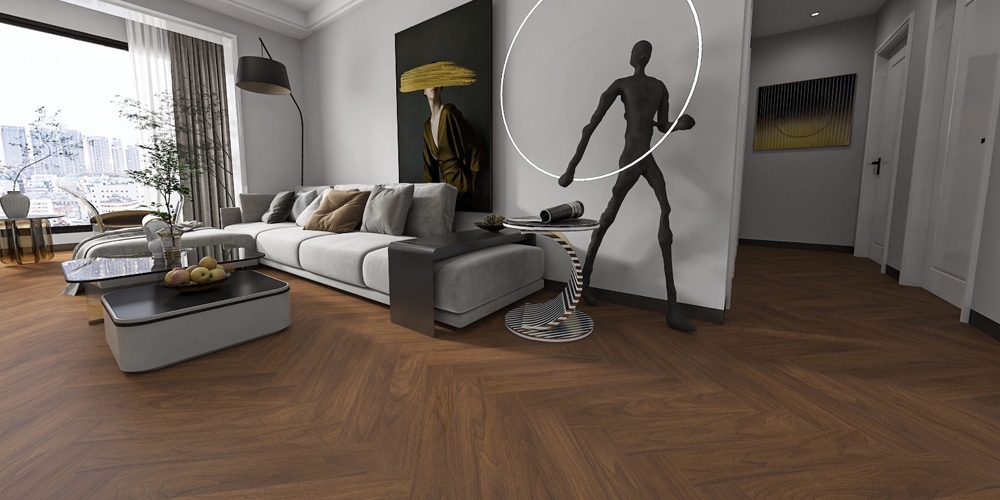
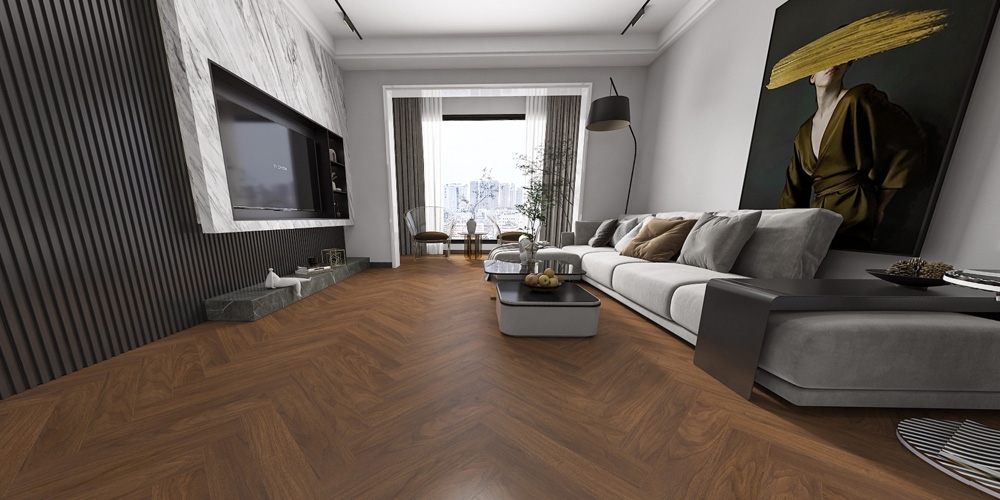
Herringbone laminate flooring is a decorative laminate floor system engineered to replicate the classic herringbone wood pattern using interlocking high-density fiberboard (HDF) panels. It combines geometric aesthetics with industrial-grade wear resistance, making it suitable for both residential and light-to-medium commercial applications.
Technical Parameters and Specifications
| Parameter | Typical Range |
|---|---|
| Total Thickness | 8–12 mm |
| Wear Layer Rating | AC3 / AC4 / AC5 |
| Panel Size | 600 × 100 mm / 750 × 125 mm |
| Core Density | 850–900 kg/m³ (HDF) |
| Surface Treatment | Embossed / EIR |
| Formaldehyde Emission | E1 or CARB Phase II |
| Installation System | Angle-Angle or Drop-Lock |
Structure and Material Composition
Overlay Layer: Aluminum oxide impregnated melamine for abrasion resistance.
Decor Paper: High-resolution printed herringbone wood grain design.
HDF Core: High-density fiberboard providing structural stability.
Balance Backing: Moisture-resistant melamine layer to prevent warping.
Manufacturing Process
HDF board production using refined wood fibers and resin under high pressure.
Decor paper printing with synchronized grain alignment for herringbone patterns.
Hot-press lamination integrating overlay, decor, and core layers.
CNC precision cutting into left/right herringbone planks.
Click-lock profiling and dimensional calibration.
Quality inspection including abrasion, swelling, and locking strength tests.
Industry Comparison
| Flooring Type | Aesthetics | Installation | Durability | Cost Level |
|---|---|---|---|---|
| Herringbone Laminate | High | Moderate | Medium–High | Medium |
| Straight-Plank Laminate | Medium | Easy | Medium | Low–Medium |
| Engineered Wood Herringbone | Very High | Complex | Medium | High |
| SPC Herringbone | High | Moderate | High | Medium–High |
Application Scenarios
Distributors: Mid-to-high-end retail flooring collections.
EPC Contractors: Apartments, serviced residences, boutique hotels.
Project Developers: Residential upgrades and mixed-use interiors.
Importers/Wholesalers: Private-label herringbone laminate programs.
Core Pain Points and Solutions
1. Complex Installation Alignment
Solution: Factory-calibrated left/right planks with directional markings.
2. Edge Chipping Risk
Solution: Reinforced click profiles and higher-density HDF cores.
3. Moisture Sensitivity
Solution: Waxed edges and water-resistant core treatments.
4. Higher Waste Rate
Solution: Accurate site measurement and modular layout planning.
Risk Warnings and Mitigation
Avoid installation in wet zones such as bathrooms.
Ensure subfloor flatness within ±2 mm per 2 m.
Use expansion gaps of 8–10 mm around perimeters.
Control indoor humidity between 40–65%.
Procurement and Selection Guide
Confirm AC rating based on traffic requirements.
Specify core density and thickness in contracts.
Verify left/right plank ratio consistency.
Request locking system test reports.
Check emission compliance certifications.
Order mock-up samples for pattern validation.
Engineering Case Example
A 120-unit serviced apartment project adopted 10 mm AC4 herringbone laminate flooring across living areas totaling 8,500 m². Installation time increased by 18% compared to straight-plank laminate, but achieved a 30% higher post-project valuation premium while maintaining lifecycle maintenance costs within forecast.
FAQ
Is herringbone laminate suitable for commercial use? Yes, with AC4 or AC5 ratings.
Does it require glue? Typically no, floating click-lock installation.
Can it be installed over underfloor heating? Yes, within temperature limits.
What is the typical lifespan? 10–20 years depending on traffic.
Is it waterproof? Water-resistant, not fully waterproof.
Are left and right planks mandatory? Yes, for correct pattern formation.
What is the waste allowance? 8–12% recommended.
Can damaged planks be replaced? Partial replacement is possible.
Does pattern affect cost? Yes, higher machining and QC costs.
Is private labeling feasible? Yes, for volume orders.
CTA
For technical datasheets, project samples, or bulk pricing discussions, contact our engineering sales team to support your upcoming herringbone laminate flooring projects.
E-E-A-T Author Credentials
This article is authored by a flooring materials engineering team with over 12 years of experience supporting international EPC projects, private-label manufacturing, and performance testing of laminate and rigid core flooring systems across residential and commercial markets.