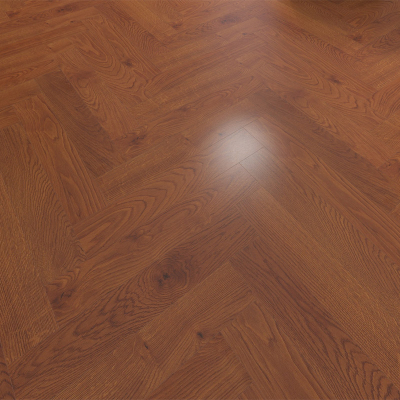
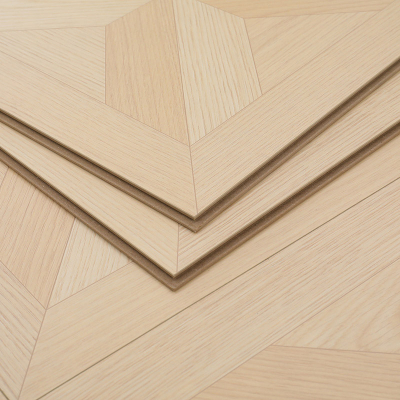
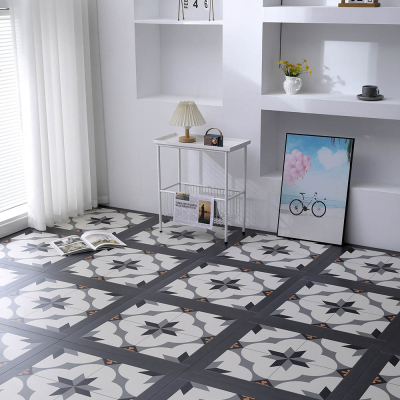
8mm Waterproof Herringbone Laminate Flooring
The production of 8mm waterproof herringbone laminate flooring follows an industrialized, quality-controlled process.
Process Steps
HDF board pressing using continuous hot-press lines
Decor paper impregnation with melamine resin
Layer fusion under high pressure and temperature
Precision CNC profiling for left/right herringbone geometry
Edge sealing with paraffin or polymer waterproof coating
Automated inspection and batch-level QC testing
Product Overview
"Waterproof" is the market name of this range, not a test result: it does not mean the plank can withstand standing water, and the moisture behaviour of the product is described below in four parts, each supported by the test data held for the product rather than by the name. With that stated, 8mm waterproof herringbone laminate flooring is a laminate floor with an 8mm HDF core, a printed décor and a herringbone pattern laid with matched left and right planks. The planks are jointed with a click-lock profile and installed as a floating floor, and the product is offered with a moisture-resistant core and sealed edges.
This page describes the HDF laminate construction with a moisture-resistant core. A rigid core SPC herringbone floor is a different construction and is specified on its own page, and a standard 8mm herringbone laminate without the core treatment and the edge sealing is a different product with different limits.
This page answers three questions: how the moisture resistance is achieved, what it actually amounts to, and how it differs from a standard 8mm herringbone laminate. The general laminate knowledge is covered on the laminate flooring guide, and the pattern as a design choice on the herringbone flooring page.
Technical Specifications
The table states the specification for the product. Entries marked as pending are confirmed for the order; a value is published only where the product documentation supports it.
| Specification | Product details |
|---|---|
| Product type | 8mm moisture-resistant herringbone HDF laminate flooring |
| Total thickness | 8mm, with the tolerance stated in the product specification |
| Core material | HDF with the core treatment stated for the product |
| Core density | The tested value and the test method, pending confirmation |
| Plank dimensions | Actual length and width, pending confirmation |
| A/B plank dimensions | The A and B plank length and width, and whether the pair differs in size or only in profile orientation |
| Wear resistance class | The abrasion class stated in the test report for this product, pending confirmation |
| Edge sealing | The edge treatment actually applied, and its coverage on the cut face, checked on a cross-section |
| Locking system | The locking profile for the product, with the licence status stated |
| Thickness swelling | The measured result, with the test standard, the specimen, the immersion time and the water temperature stated |
| Water resistance | The measured result, with the test method and conditions stated |
| Formaldehyde emission | The emission class and the report held for the product, for the destination market |
| Surface finish | Matte, satin, embossed or other finish actually supplied, pending confirmation |
| Customization | Décor, colour, surface texture and packaging actually supported |
| MOQ and lead time | Confirmed in the quotation for the configuration |
Three points about the specification belong here. First, the wear resistance class is one class for this product, not a choice between two: where a second class is available it is a separate product and is quoted separately. Second, the formaldehyde requirement depends on the destination market, and the product carries one emission class for that market. Third, the A and B planks are supplied as a matched set, and the coverage per carton is calculated for the pair.
Moisture-Resistant HDF Core
The core is a high-density fiberboard, and the moisture resistance of the product begins with the board. The treatment applied to the core for this product is stated in its specification, and the effect of the treatment is shown by the thickness swelling test rather than by the description of the additive.
The core density is a property of the core and not a quality score, and the density is read with the swelling and the dimensional stability data for the same product. A denser core does not by itself establish a lower swelling, and a swelling figure quoted without its test conditions cannot be compared with another product's.
Swelling Resistance Testing
Two standards are often quoted for laminate, and they answer different questions.
ISO 24336 covers the determination of thickness swelling after partial water immersion of a specimen, under the conditions the standard specifies. A result from this test describes how a specimen of the board swells under that test, with the specimen size, the immersion time and the water temperature recorded; it does not mean that a finished floor left in standing water for a day or more is unaffected.
The laminate product standard, such as EN 13329, sets the performance requirements for the product and includes water-related requirements among them. Compliance with the product standard is a statement about the product against those requirements; it does not by itself make the floor suitable for a bathroom, a laundry room or any area that is regularly wet.
ISO 4760, where a report is held under it, covers the determination of swelling after water exposure under its own conditions, and its result is read with those conditions. Results from ISO 24336, ISO 4760 and the product standard are not interchangeable: each answers its own question, and a figure from one method should not be presented as the result of another. The standard version and the conditions applied to this product are stated in its report.
Edge Sealing and Water Resistance
This is where a moisture-resistant product differs from a standard 8mm laminate, and four parts are involved.
The core treatment reduces the rate at which the board takes up water, and its effect is shown by the swelling test described above.
The edge sealing is applied to the cut edges, which are the part of the board where the fibres are exposed. The treatment is a wax or a polymer coating, and what matters is its coverage and continuity: a seal that covers the cut face continuously resists water at the edge better than one that is patchy or stops short of the profile. The edge treatment is checked on a cross-section rather than assumed from the specification, and the coverage is stated for the product.
The locking joint is the route through which water reaches the core from the surface, which is why the joint is treated here as a moisture path rather than only as a mechanical connection. A tight joint with an intact edge resists water better than a loose or damaged one, and the joint is checked on a sample before the order.
The surface is protected by the wear layer and the coating, which resist marking and make cleaning easier; the surface is not what makes the floor water-resistant, and a surface that beads water does not mean that the core and the joints are protected.
Two limits follow. A tight joint does not make the seam waterproof, and a moisture-resistant core does not make the installed floor a waterproof system: the joints, the wall edges, the doorways and the subfloor still have to be dealt with according to the project conditions. A bathroom with a shower requires a product designed for wet areas, and adding a moisture-resistant underlay or sealing the joints does not make a laminate floor suitable for a bathroom.
Herringbone Pattern and Locking System
The herringbone pattern requires matched left and right planks, and the pair is supplied as a matched set: a mixed set from different batches, or a set in which the A and B profiles are not matched, will not close correctly. The layout has a direction, and the starting point, the direction and the A and B orientation are planned before the first row is laid.
The locking profile for this product is stated in its specification, together with its licence status. The planks are engaged by hand and closed with the tapping block specified for the system, and the floor is installed as a floating system without adhesive to the subfloor. Whether a specific tool is required, and which one, is stated in the installation instructions; the profile is designed for the plank it is milled into, and the tools for one system are not necessarily correct for another. The joint quality is checked on a sample before the order, and the general installation requirements are covered on the laminate flooring installation guide.
Surface Finishes and Applications
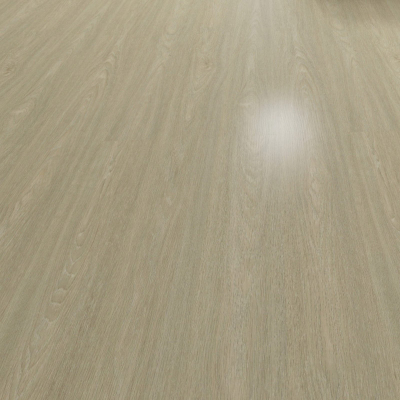
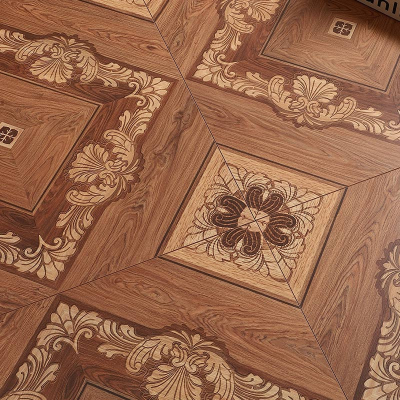
The décor is a printed design, and the available wood-grain effects, colours and surface textures are the ones the factory actually produces. A matte finish reduces reflection and makes fine surface marks less obvious, a satin finish sits between matte and gloss, and an embossed finish adds texture and changes how light falls across the grain. The tone is confirmed on a sample in the room where the floor will be laid.
In residential interiors, the floor is used in living rooms, bedrooms, studies and hallways. In commercial interiors, the suitability is checked against the declared use class and the project's requirements rather than assumed from the product type: an office floor turns on the behaviour under chair castors, a retail floor turns on the traffic and the cleaning routine, a hotel turns on the traffic and the maintenance cost, and a school, a library or another public interior turns on the traffic profile and the cleaning routine of the building.
In a kitchen, spills are frequent and the prompt removal of water matters, and the product is assessed on the specific conditions rather than assumed suitable. Where the project includes underfloor heating, the compatibility and the temperature limits are confirmed from the installation instructions for this specific product and from the heating system's requirements.
Quality Control and Testing
The moisture-related items are the two this page treats as central, and the other items are the same for any laminate product. The standard each item belongs to is stated, and no figure is quoted here for a test that the product's own report does not state.
| Item | Standard or document it belongs to | What the buyer checks |
|---|---|---|
| Thickness swelling | The test standard stated in the report, with the specimen, immersion time and water temperature | The measured result and the conditions it was measured under |
| Edge sealing coverage | The product's own quality records | The coverage and continuity of the seal on a cross-section |
| Joint strength | The locking test for the product | The test result, with the specimen and direction |
| A/B plank fit | The product's own quality records | Size, profile orientation and pattern fit of the pair |
| Abrasion resistance | The laminate product standard, abrasion test | The abrasion class and the standard version stated in the report |
| Dimensional stability | The laminate product standard, dimensional test | The test result and the conditions stated |
| Formaldehyde emission | The emission requirement of the destination market | The emission class, the method and the report |
| Reaction to fire | The fire classification system of the destination market | The classification for this product, at this thickness and in the mounting tested |
The standard reference for a product is a product standard, not a certification: a claim that a product is certified to it is supported by the report for the exact model, with the standard version stated. A management-system certificate such as ISO 9001 relates to the production management system and does not demonstrate the performance of the product. The report verification method is covered on the laminate flooring quality standards page.
OEM and Wholesale Supply
The following items are confirmed for the specific order and stated in writing in the quotation:
Décor, colour and surface texture options actually available.
A and B plank dimensions and whether the pair differs in size or only in profile orientation.
Wear resistance class and the standard version stated in the report.
The core treatment and the edge sealing actually applied, with the coverage stated.
Thickness swelling and water resistance results, with the test methods stated.
Locking profile with its licence status.
Packaging, including pieces per carton, coverage per carton for the A/B pair and OEM packaging.
MOQ for standard and customized designs, and the tooling requirement for a custom décor.
Sample availability, and whether the sample is free or charged.
Production lead time and warranty scope, including commercial use.
To request a quotation, state the required quantity, the destination market, the preferred décor, the plank size, whether the order is standard or customized, and whether samples and the water-resistance test reports are needed; the quotation states the specification, the packaging, the MOQ, the sample terms and the lead time for that configuration.
Frequently Asked Questions
1. Is 8mm waterproof herringbone laminate flooring suitable for kitchens?
It is assessed on the specific conditions: spills are frequent in a kitchen and prompt removal matters, and the suitability depends on the product's installation instructions and warranty rather than on the name. It is not intended for areas with standing water.
2. How does edge sealing improve moisture resistance?
The edge sealing covers the cut face of the board, which is where the fibres are exposed. A continuous seal slows water at the edge, and its effect is checked on a cross-section; a patchy seal or one that stops short of the profile does not give the same protection.
3. Is waterproof herringbone laminate flooring completely waterproof?
No. "Waterproof" is the market name of this range and is not a test result. The core treatment, the edge sealing, the joint and the surface each contribute something different, and none of them makes the installed floor a waterproof system.
4. What is the difference between waterproof and water-resistant laminate flooring?
A water-resistant product reduces the rate of water uptake and its claim is tied to a test for short-term exposure. A waterproof claim should also be tied to a test that states what was measured and for how long. The way to tell them apart is to read the test report rather than the label, and the reports held for this product are requested through the route given in question 8.
5. Does 8mm laminate flooring support underfloor heating?
It depends on the product and the heating system, and the compatibility and temperature limits are confirmed from the installation instructions for this specific product and from the heating system's requirements.
6. What are the dimensions of the left and right herringbone planks?
The A and B plank dimensions are stated in the specification table and confirmed in the quotation, and the pair is supplied as a matched set. The dimensions are not interchangeable between the two, and a mixed set will not close correctly.
7. Can the flooring be installed with a floating click-lock system?
Yes, it is installed as a floating click-lock floor without adhesive to the subfloor. Whether a glue-down installation is permitted is stated in the installation instructions, and the two methods are not interchangeable.
8. Can you provide water-resistance test reports?
The test reports held for the product are supplied on request, before the order, together with the sample. The report states the test standard, the specimen and the conditions, and the report name, number and testing laboratory are stated with it.
9. Do you offer OEM colors and surface finishes?
OEM colours and surface finishes are available within what the factory can print and press, and the options are confirmed on a sample before the order. A custom décor requires its own tooling and has a higher MOQ than a standard design.