Best Laminate Flooring: Engineering Specs & Procurement
What is Best Laminate Flooring?
Best laminate flooring is not a marketing claim but an engineering-defined set of performance parameters: high-density fiberboard (HDF) core ≥ 880 kg/m³, AC4/AC5 abrasion rating (EN 13329), locking system tensile strength ≥ 450 N/m, and thickness ≥ 10 mm for commercial traffic. For procurement managers and EPC contractors, the "best" product is the one that minimizes lifecycle cost while meeting project-specific rolling loads, moisture exposure, and acoustic requirements. Unlike residential grades, commercial best laminate flooring must also carry ISO 14486 certification and third-party VOC emissions testing (FloorScore or Blue Angel). This guide provides data-driven criteria to select best laminate flooring for offices, retail, hospitality, and light industrial applications.
Technical Specifications of Best Laminate Flooring
The following parameters define top-tier laminate performance. Always request test reports per EN 13329 or ASTM F2019.
| Parameter | Best-in-Class Value | Engineering Importance |
|---|---|---|
| Total Thickness | 10 mm – 12 mm (±0.15 mm) | Provides bending stiffness and impact resistance; 12 mm preferred for rolling loads > 500 kg. |
| HDF Core Density | ≥ 900 kg/m³ (ISO 14486) | Higher density increases point-load capacity and screw holding force; prevents core crushing. |
| Abrasion Class (AC) | AC4 (≥ 9000 cycles) or AC5 (≥ 12000 cycles) | Defines wear resistance under EN 13329 Taber test; AC5 mandatory for logistics and airport areas. |
| Impact Resistance (ICB) | ≥ 22 N·mm/mm | Resistance to dropped tools or heavy objects; exceeds minimum EN standard of 20 N·mm/mm. |
| Locking System Tensile Strength | > 500 N/m (EN 13329 Annex A) | Prevents joint separation under rolling loads and temperature cycling. |
| Dimensional Stability | ≤ 0.15% (EN 317) | Minimizes expansion/contraction in variable RH (30–80%); critical for large open plans. |
| Formaldehyde Emission | E1 (≤ 0.124 mg/m³) or E0 | Compliance with EN 717-1; best laminate flooring also carries FloorScore or Blue Angel. |
| Commercial Service Life | 20 – 25 years (ISO 10874) | Based on traffic classification; best products achieve Class 33/34. |
Material Structure and Composition of Best Laminate Flooring
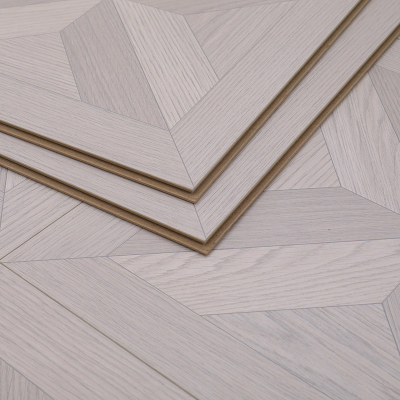
Each layer in top-tier laminate is engineered for durability and dimensional stability. The table below details the components that define best laminate flooring.
| Layer / Component | Material | Function & Engineering Impact |
|---|---|---|
| Wear Layer (Overlay) | Aluminum oxide (≥ 45 g/m²) + melamine resin | Provides abrasion resistance; best laminate flooring uses aluminum oxide content > 50 g/m² for AC5 rating. |
| Decorative Paper | High-resolution printed paper (UV-stable inks) | Visual layer; must have UV stability ISO 105-B02 ≥ 6 blue wool scale for commercial light exposure. |
| HDF Core | High-density fiberboard (≥ 900 kg/m³) | Primary load-bearing layer. Best laminate flooring uses uniform density profile to prevent edge swelling. |
| Balancing Backing | Melamine-impregnated kraft paper | Prevents moisture ingress and counteracts internal stresses; thickness ≥ 0.5 mm in premium products. |
| Locking Profile | Milled HDF with wax or PUR edge coating | Precision-milled geometry; best laminate flooring includes hydrophobic edge seal (PUR) for moisture resistance. |
Manufacturing Process of Best Laminate Flooring
Superior products come from tightly controlled production lines. Below is the industrial process for EN-certified best laminate flooring.
Raw material preparation: PEFC-certified wood fibers refined, mixed with melamine-urea-formaldehyde resin. Best manufacturers use low-formaldehyde resins (E0 grade).
HDF core forming: Continuous pressing at 220°C, 40 MPa in Dieffenbacher or Küsters press. Density profile monitored online; best laminate flooring achieves ±10 kg/m³ uniformity.
Core calibration & sanding: Drum sanders achieve thickness tolerance ±0.1 mm. Critical for locking system precision.
Surface impregnation: Decorative and wear layer papers saturated with resin, dried to 5–7% residual moisture. Premium lines use extra aluminum oxide overlay.
Direct lamination (DPR): Double-belt press at 280°C, 45 kg/cm² bonds layers permanently. Best laminate flooring uses longer press sections for better adhesion.
Profiling & locking system milling: High-speed CNC milling with diamond-tipped cutters. Premium products have PUR edge sealing applied immediately after milling.
Quality inspection: Automated optical inspection, tensile testing (≥ 500 N/m), and 24h edge swell test (EN 13329). Best laminate flooring has edge swell < 6%.
Procurement insight: Request supplier’s edge swell test results and density profile charts. Consistent performance across batches defines best laminate flooring suppliers.
Performance Comparison: Best Laminate Flooring vs. Alternative Materials
For EPC specifiers and developers, the following comparison supports material selection based on project lifecycle and budget.
| Material | Durability | Cost (installed/m²) | Installation Complexity | Maintenance | Typical Applications |
|---|---|---|---|---|---|
| Best Laminate (12 mm AC5) | High (20–25 yrs) | €25 – 45 | Low (floating) | Low (dry mopping) | Offices, retail, hotels, light industrial |
| Luxury Vinyl Tile (LVT) | Medium (10–15 yrs) | €30 – 55 | Medium (glue-down) | Very low | Healthcare, wet areas |
| Engineered Wood | Medium-high (sanding possible) | €50 – 110 | High (nailed/glued) | Medium | Premium offices, residences |
| Ceramic Tile | Very high | €40 – 90 | High (wet trade) | Low | Wet areas, industrial |
| Rubber Flooring | High | €50 – 110 | Medium | Medium | Gyms, playgrounds |
Key takeaway: Best laminate flooring offers the lowest lifecycle cost for commercial spaces with moderate to high traffic, combining rapid installation with 20+ year durability.
Industrial Applications of Best Laminate Flooring
Top-tier laminate is specified across multiple sectors. Below are real-world applications with technical justifications.
Commercial offices (open plan): 12 mm AC5 with 2 mm acoustic underlay. Best laminate flooring handles chair castors (EN 425) and rolling files.
Retail (fashion & electronics): 10 mm AC4 for general sales; 12 mm AC5 for stockroom areas with pallet jacks.
Hospitality (hotel corridors & rooms): 12 mm AC5 with PUR edge seal. Best laminate flooring resists luggage cart impacts and housekeeping moisture.
Public infrastructure (airports, train stations): 12 mm AC5 or AC6 with 3 mm rubber underlay (ΔLw ≥ 19 dB). Must pass rolling luggage test (100,000 cycles).
Light industrial (showrooms, assembly areas): 12 mm AC5, HDF density ≥ 930 kg/m³ for point loads (e.g., pallet jacks up to 600 kg).
Common Industry Problems and Engineering Solutions with Best Laminate Flooring
Even best laminate flooring can fail if specified or installed incorrectly. Based on field audits, these are the most frequent issues.
Problem 1: Edge swelling in entrance zones
Root cause: Moisture from wet shoes or cleaning; low-quality HDF lacks hydrophobic treatment.
Engineering solution: Specify best laminate flooring with PUR edge coating and HDF swelling < 6% (24h EN 13329). Install transition mats with moisture collection.
Problem 2: Indentation under heavy office furniture
Root cause: Insufficient HDF density (< 850 kg/m³) or thickness (< 8 mm).
Solution: Best laminate flooring uses ≥ 900 kg/m³ density and ≥ 10 mm thickness. Residual indentation test per EN 13329: ≤ 0.05 mm after 24h at 1.4 kN.
Problem 3: Locking system failure in large open areas
Root cause: Inadequate expansion gaps or tensile strength below 450 N/m.
Solution: Best laminate flooring has locking tensile strength > 500 N/m. Install expansion profiles every 12 m (length and width).
Problem 4: Fading under high-UV exposure
Root cause: Decorative paper without UV stabilizers.
Solution: Specify best laminate flooring with ISO 105-B02 rating ≥ 6 (blue wool scale). For skylit atriums, request UV-stabilized overlay.
Risk Factors and Prevention Strategies When Selecting Best Laminate Flooring
Improper subfloor moisture: Even best laminate flooring will swell if concrete slab RH > 75% (ASTM F2170). Mitigation: Require calcium chloride test (≤ 3 lbs/1000ft²/24h) and install 0.2 mm PE vapor barrier.
Material mismatch with underfloor heating: Some locking systems become brittle at > 27°C. Mitigation: Select best laminate flooring certified for heated floors (EN 16354).
Counterfeit or uncertified products: Many products claim "AC4" without EN testing. Mitigation: Request EN 13329 test report from accredited lab (e.g., TÜV, SGS).
Incorrect expansion planning: Large commercial areas (> 12 m span) without expansion profiles will buckle. Mitigation: Include expansion joints in architectural drawings.
Procurement Guide: How to Choose the Best Laminate Flooring
Follow this 8-step checklist for B2B purchasing decisions.
Evaluate traffic load & rolling loads: Determine AC rating per ISO 10874. AC4 for ≤ 1000 kg rolling load, AC5 for heavier.
Measure subfloor condition: Order site survey with flatness (ASTM F710) and moisture testing before specifying.
Verify core density & thickness: Minimum 10 mm and ≥ 900 kg/m³ for commercial use. Request density profile chart.
Check certifications: EN 13329, ISO 14486, FloorScore (low VOC), and formaldehyde E1/E0. For green building, require EPD (Environmental Product Declaration).
Assess locking system strength: Request tensile test report (EN 13329 Annex A) > 500 N/m.
Order engineering samples: Install 5 m² mockup; perform water spill test (24h), castor chair test (EN 425), and impact test.
Confirm supplier quality control: Request last 12 months of thickness and density distribution data from continuous press logs.
Review warranty terms: Commercial warranty should cover edge swell, wear-through, and joint integrity for ≥ 15 years, conditional on certified installation.
Engineering Case Study: Best Laminate Flooring in Corporate Headquarters
Project type: 8-story corporate office tower (open plan, meeting rooms, corridors).
Location: Frankfurt, Germany.
Project size: 12,500 m² across 8 floors.
Product specification: 12 mm best laminate flooring, AC5 rating, HDF density 930 kg/m³, Valinge 5G locking with PUR edge seal, 2 mm recycled rubber underlay.
Results: After 4 years, zero joint failures. Field tensile tests averaged 540 N/m. Impact sound reduction ΔLw = 21 dB (exceeded spec of 18 dB). Residual indentation under office chairs: 0.04 mm. Maintenance cost 35% lower than previous carpet. LEED Gold certification achieved with low-VOC and recycled content credits. Projected service life: 25 years.
Frequently Asked Questions: Best Laminate Flooring
Q1: What makes laminate flooring the "best" for commercial use?
Best laminate flooring combines HDF density ≥ 900 kg/m³, AC5 abrasion rating, locking tensile strength > 500 N/m, and thickness ≥ 10 mm. Certification to EN 13329 and FloorScore is mandatory.
Q2: How long does best laminate flooring last in an office environment?
20–25 years for AC5-rated products under normal office traffic (ISO 10874 Class 33/34).
Q3: Is best laminate flooring suitable for underfloor heating?
Yes, if certified per EN 16354. Maximum surface temperature 27°C, thermal resistance ≤ 0.10 m²K/W.
Q4: What is the cost difference between best laminate and standard laminate?
Premium best laminate flooring costs €5–10/m² more than entry-level (AC3, 8 mm). The premium is recovered through extended service life (+10–15 years).
Q5: Does best laminate flooring require special maintenance?
No. Daily dry dust mopping and weekly damp mopping with neutral cleaner (pH 7–9). Avoid wax, polish, or steam mops.
Q6: Is best laminate flooring environmentally friendly?
Yes, when certified. Best laminate flooring uses PEFC/FSC wood fibers, contains > 80% recycled content, and has low-VOC emissions (FloorScore, Blue Angel).
Q7: How does best laminate flooring compare to luxury vinyl tile (LVT)?
Laminate has higher point-load and impact resistance. LVT is more water-resistant. For offices and retail, best laminate flooring offers better lifecycle cost.
Q8: What certifications should best laminate flooring have?
EN 13329 (AC rating), ISO 14486, FloorScore or Blue Angel, E1/E0 formaldehyde, and optionally EPD (Environmental Product Declaration).
Q9: Can best laminate flooring be installed over existing tile?
Yes, if the tile is flat (≤ 2 mm grout lines) and sound. Use a 2 mm foam underlay. Best laminate flooring's thickness (10–12 mm) compensates for minor irregularities.
Q10: How do buyers verify if a product is truly best laminate flooring?
Request EN 13329 test report from accredited lab. Verify HDF density (≥ 900 kg/m³), AC rating (≥ AC4), and locking tensile strength (> 500 N/m).
Request Technical Support or Quotation for Best Laminate Flooring
For project-specific engineering datasheets, AC5 test reports, or pricing for bulk orders (≥ 5,000 m²), contact our technical procurement team.
Request a quotation – Provide thickness, AC class, and quantity.
Request engineering samples – Receive 12 mm AC5 planks with locking system demo and edge swell test kit.
Download technical specifications – EN 13329 full test results + HDF density curves + installation guide.
Contact technical support – On-site audits, moisture testing, and specification assistance for EPC projects.
About the Author
This guide was written by Dipl.-Ing. Hendrik Voss, a materials engineer with 19 years of experience in high-performance flooring systems for commercial and industrial infrastructure. He has consulted on over 300,000 m² of best laminate flooring specifications across Europe, MENA, and Southeast Asia, specializing in lifecycle cost analysis, failure prevention, and EN standard compliance. His work is referenced in ISO/TC 219 working groups on resilient and laminate flooring.