Laminate Flooring Is Making a Comeback
Should You Switch from SPC?
Over the past decade, SPC (Stone Plastic Composite) flooring has dominated the global resilient flooring market, gaining popularity among distributors, importers, engineering contractors, and procurement managers for its waterproof performance and dimensional stability. However, a noticeable shift is emerging in 2025: laminate flooring is making a comeback – should you switch from SPC?
Driven by advancements in core technology, improved water resistance, enhanced surface durability, and competitive pricing, modern laminate flooring is regaining attention in both residential and commercial segments. For B2B buyers, this raises a strategic question—not just about product preference, but about inventory optimization, project suitability, and long-term ROI.
What Is Laminate Flooring Is Making a Comeback – Should You Switch from SPC?
The phrase “Laminate Flooring Is Making a Comeback – Should You Switch from SPC?” reflects a broader industry trend where next-generation laminate products are addressing traditional weaknesses—particularly water sensitivity—while maintaining their advantages in cost, aesthetics, and surface performance.
Modern laminate flooring typically consists of:
· A high-density fiberboard (HDF) core
· A decorative layer with high-resolution printing
· A wear-resistant overlay
· A balancing layer
Unlike SPC, which uses a rigid mineral-plastic core, laminate flooring leverages wood-based materials, offering a warmer feel and often a more natural acoustic profile.
The “comeback” is largely driven by:
· Waterproof laminate innovations (e.g., waxed edges, hydrophobic coatings)
· Lower raw material costs compared to SPC
· Improved embossing and texture realism
· Environmental considerations (lower PVC content)
Key Technical Specifications
Below is a technical comparison between modern laminate flooring and SPC flooring:
Specification | Laminate Flooring | SPC Flooring |
Core Material | HDF (Wood-based) | Stone-plastic composite (PVC + CaCO₃) |
Thickness Range | 7–12 mm | 4–8 mm |
Water Resistance | Water-resistant / Waterproof (new gen) | 100% Waterproof |
Wear Layer | AC3–AC5 rating | 0.3–0.7 mm PVC wear layer |
Thermal Stability | Moderate | High |
Sound Insulation | Better natural acoustics | Requires IXPE/EVA underlayment |
Installation Method | Click-lock | Click-lock / Glue-down |
Environmental Impact | Lower PVC content | Higher PVC content |
Cost (Material) | Lower | Medium |
Main Cost Factors or Performance Factors
When evaluating Laminate Flooring Is Making a Comeback – Should You Switch from SPC, cost-performance balance becomes critical.
Key Cost Drivers:
1. Raw Materials
o Laminate uses wood fiber (HDF), which is often more cost-stable than PVC.
o SPC relies on petrochemical-based PVC, subject to oil price fluctuations.
2. Production Complexity
o Laminate manufacturing is mature and scalable.
o SPC requires extrusion and precise formulation.
3. Logistics and Weight
o SPC is heavier, increasing shipping costs.
o Laminate is lighter, improving container efficiency.
4. Installation Costs
o Both use click systems, but laminate may require stricter subfloor preparation.
Performance Considerations:
· Moisture Resistance: SPC still leads in high-moisture environments.
· Scratch Resistance: Laminate (AC4/AC5) often outperforms SPC.
· Comfort: Laminate provides a warmer and quieter underfoot experience.
Product Structure or Core Technology
Laminate Flooring Structure:
1. Wear Layer
o Aluminum oxide coating for abrasion resistance
2. Decorative Layer
o High-definition printed wood/stone visuals
3. HDF Core
o High-density fiberboard for strength and stability
4. Balance Layer
o Prevents warping and improves dimensional stabilit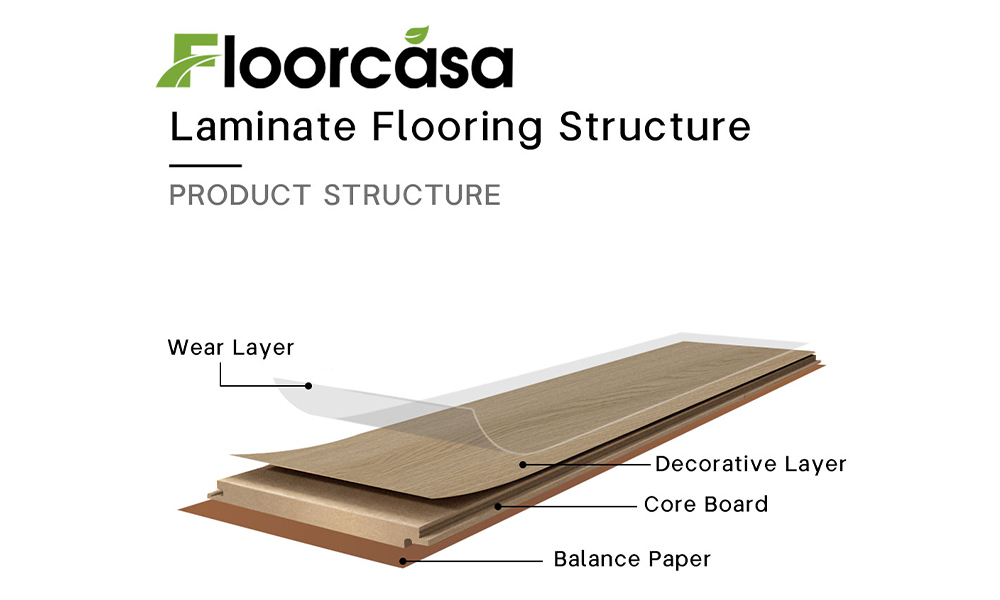
SPC Flooring Structure:
1. UV Coating
2. Wear Layer
3. Vinyl Decor Film
4. SPC Core (Rigid Core)
5. Attached Underlayment (optional)
Innovation Trend:
Laminate manufacturers are integrating hydrophobic edge sealing technologies, significantly improving water resistance and reducing swelling risk.
Manufacturing Process Overview
Laminate Flooring Production:
1. Wood fiber processing → HDF board creation
2. Decorative paper printing
3. High-pressure lamination (HPL/DPL)
4. Surface texturing (EIR – Embossed in Register)
5. Cutting and click system profiling
SPC Flooring Production:
1. PVC + calcium carbonate mixing
2. Extrusion into rigid core boards
3. Lamination of decorative film and wear layer
4. UV coating application
5. Cutting and profiling
Laminate production is generally less energy-intensive and more environmentally aligned compared to PVC-based SPC manufacturing.
Industry Comparison
Laminate vs SPC vs WPC
Feature | Laminate Flooring | SPC Flooring | WPC Flooring |
Waterproof | Moderate–High | Excellent | Excellent |
Cost | Low | Medium | High |
Comfort | High | Medium | High |
Stability | Medium | High | Medium |
Environmental | More eco-friendly | Less eco-friendly | Moderate |
Insight:
While SPC remains dominant in bathrooms and basements, laminate is regaining share in living spaces, offices, and retail environments.
Application Scenarios
Laminate flooring is increasingly suitable for:
· Residential projects (living rooms, bedrooms)
· Commercial spaces (retail stores, offices)
· Hospitality environments (hotel rooms)
· Low-moisture public areas
SPC remains preferable for:
· Bathrooms
· Kitchens with frequent water exposure
· Underground or high-humidity environments
Common Buyer Concerns
1. Is laminate flooring really waterproof now?
New technologies offer up to 24–72 hours of water resistance, but not full waterproofing like SPC.
2. Will laminate swell over time?
With proper installation and modern sealing, swelling risks are significantly reduced.
3. Is laminate more cost-effective than SPC?
Yes, especially for large-scale projects with tight budgets.
4. How does it perform in commercial use?
AC4–AC5 ratings make it suitable for heavy traffic.
Procurement and Selection Guide
When deciding Laminate Flooring Is Making a Comeback – Should You Switch from SPC, consider the following:
Key Selection Criteria:
· Project Environment
o High humidity → SPC
o Dry areas → Laminate
· Budget Constraints
o Tight budget → Laminate
· Target Market Preferences
o Europe: Strong laminate acceptance
o North America: SPC still dominant but shifting
· Technical Specifications
o AC rating (laminate)
o Wear layer thickness (SPC)
· Certifications
o FSC, E1/E0 (laminate)
o FloorScore, CE (SPC)
Case Study or Example
A European distributor managing multi-family residential projects shifted 30% of its SPC inventory to laminate flooring in 2024.
Results:
· Cost reduction: 18% per project
· Customer satisfaction: Improved due to better acoustic performance
· Return rate: Decreased by 12%
The distributor reported that laminate’s improved water resistance met most residential needs, making it a viable SPC alternative.
FAQ (Buyer-Focused)
1. Is laminate flooring cheaper than SPC?
Yes, laminate typically has lower material and shipping costs.
2. Can laminate replace SPC completely?
No, SPC is still better for wet areas.
3. What AC rating should I choose?
AC4 for commercial, AC5 for heavy-duty applications.
4. How long does laminate flooring last?
10–20 years depending on usage and quality.
5. Is laminate environmentally friendly?
More eco-friendly than SPC due to lower PVC usage.
6. Does laminate require underlayment?
Yes, usually a separate underlayment is needed.
7. Is SPC more durable?
SPC is more impact-resistant, but laminate has better scratch resistance.
8. What markets prefer laminate?
Europe and parts of the Middle East.
9. Can laminate be used in kitchens?
Yes, if water-resistant types are used.
10. How does temperature affect both products?
SPC handles temperature fluctuations better.
Conclusion
So, Laminate Flooring Is Making a Comeback – Should You Switch from SPC?
The answer depends on your project portfolio and market strategy. Laminate flooring is no longer the moisture-sensitive product it once was. With technological advancements, it now offers a compelling combination of cost efficiency, durability, and aesthetics, making it a strong alternative in many applications.
For B2B buyers, the smartest approach is not a complete switch, but a strategic diversification—leveraging laminate where it delivers the best ROI, while retaining SPC for high-moisture environments.
In 2025 and beyond, those who adapt their product mix based on data, application scenarios, and customer demand will gain a competitive edge in the global flooring market.