Interlocking Laminate Flooring
Manufacturing Process and Engineering Control
Engineering Production Workflow
HDF board production using hot-press technology
Impregnation of decor and overlay papers with melamine resin
High-pressure lamination under controlled temperature
CNC profiling of interlocking edges
Surface inspection, packaging, and batch traceability
Key Manufacturing Equipment
Continuous hot-press lines
Resin impregnation systems
High-speed CNC profiling machines
Automated inspection and packing units
Critical Process Control Points
HDF moisture content stabilization
Precision tolerance of locking geometry
Uniform resin curing for surface durability
Product Definition
Interlocking laminate flooring is an engineered floor covering system composed of high-density fiberboard (HDF) core panels with precision locking profiles, enabling floating installation without adhesives while providing stable performance, consistent appearance, and cost-efficient solutions for residential and commercial interior projects.
How Interlocking Laminate Flooring Works
Interlocking laminate flooring is an engineered floor covering system composed of high-density fiberboard (HDF) core panels with precision locking profiles. The locking profile is machined into the edges of each panel, allowing the panels to connect to each other without adhesive. This is called a floating installation—the floor is not fixed to the subfloor but held together by the locking joints and the weight of the floor itself.
The performance of an interlocking laminate floor depends on the locking profile as much as on the core and surface. A well-designed locking profile holds the joints tight, resists joint opening under movement, and allows the floor to expand and contract as a single surface. A poorly designed or poorly machined profile can lead to joint opening, edge damage, and premature failure.
The following sections explain the main locking system types and how the locking profile works.
Angle-Tap Locking
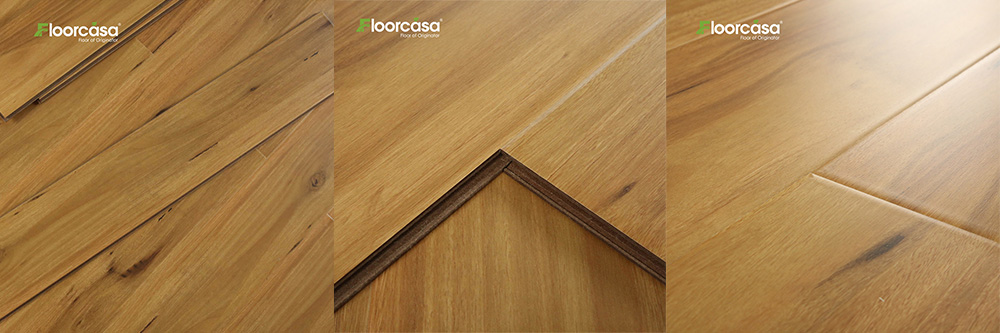
Angle-tap locking is one of the most common locking systems. The panel is inserted at an angle into the previous panel, then tapped down with a tapping block to engage the lock. The joint is held by the mechanical engagement of the profile.
The panel is typically inserted at a 20–30° angle. The angle is important—inserting at too shallow an angle can damage the locking profile, while inserting at too steep an angle can make engagement difficult. Use a tapping block (not a mallet) and avoid excessive force.
Installation method: Angled insertion, then tap down.
Best use: Residential installations where standard installation speed is acceptable.
Drop-Lock Systems
Drop-lock systems allow the panel to be dropped vertically into place, without angling. This is useful in installations where angling is difficult—for example, near walls or in confined spaces.
Installation method: Vertical drop into the previous panel.
Best use: Renovation projects and confined spaces.
5G Click Systems
5G click systems (and similar fast-click systems) allow the panel to be inserted at a low angle and clicked into place with minimal force. They are designed for faster installation and are common in large projects.
Installation method: Low-angle insertion, click into place.
Best use: Large projects and installations where speed is a priority.
Locking Profile Geometry
The locking profile geometry determines how the panels engage, how much force is required to engage them, and how well the joint resists opening. Key features of the profile include the shape of the tongue and groove, the angle of the locking surfaces, and the precision of the machining. The profile geometry is protected by patents in some systems, and different manufacturers use different profile designs.
Joint Engagement and Tensile Strength
Joint engagement refers to how fully the locking profile is engaged after installation. Full engagement is required for the joint to function correctly. Tensile strength refers to the joint's resistance to being pulled apart. Both are determined by the profile design and the precision of the machining.
Joint Opening and Edge Damage
Joint opening occurs when the locking joint separates under movement—from thermal expansion, subfloor movement, or insufficient expansion gaps. Edge damage occurs when the locking profile is chipped or broken, often during installation or from excessive force. Both are common failure modes for interlocking laminate flooring.
Replacement and Expansion Movement
Interlocking laminate flooring can be disassembled and individual panels replaced, provided the locking profiles are not damaged. The floor must also be allowed to expand and contract—expansion gaps at the perimeter and at intermediate intervals allow the floor to move as a single surface without buckling or joint opening.
Interlocking Laminate Flooring Locking Systems Compared
The following table compares the main locking system types. Performance depends on the specific locking profile and manufacturer testing. Verify locking test reports before specification.
| Locking System | Installation | Installation Speed | Best Use |
|---|---|---|---|
| Angle-Tap | Angled installation | Medium | Residential |
| Drop-Lock | Vertical/angled | Fast | Renovation |
| 5G Click | Fast click | Very Fast | Large projects |
| Traditional Tongue & Groove | More manual | Slow | Older systems |
Important note: Joint strength and locking performance depend on the specific locking profile, the precision of the machining, and the manufacturer's testing. Values vary between products. Request locking test reports and, where possible, conduct a sample installation trial before specification.
Common Problems With Interlocking Laminate Flooring
Field-observed problems with interlocking laminate flooring provide practical lessons for specifiers and installers. The most common problem in interlocking laminate installations is locking joint opening, followed by edge chipping during installation, boards separating after installation, buckling, and squeaking or movement.
1. Locking Joint Opens
Cause: Uneven subfloor, insufficient expansion gaps, damaged profile, or excessive movement.
Symptom: Visible gaps at the joints; liquid and dirt can penetrate.
Solution: For small gaps, use colour-matched filler; for larger gaps, disassemble and replace affected panels.
Prevention: Verify subfloor flatness, calculate expansion gaps correctly, and handle panels carefully during installation.
2. Edge Chipping During Installation
Cause: Incorrect installation angle, poor machining, or excessive force.
Symptom: Chipped or broken edges on the locking profile.
Solution: Replace damaged panels; use a tapping block (not a mallet) and correct installation angle.
Prevention: Verify profile quality, use correct installation technique, and avoid excessive force.
3. Boards Separate After Installation
Cause: Poor locking geometry, substrate movement, or incorrect installation.
Symptom: Panels separate at the joints after installation.
Solution: Disassemble the affected area and reinstall with correct technique; address substrate movement.
Prevention: Verify locking profile quality, verify subfloor stability, and follow installation instructions.
4. Buckling
Cause: Insufficient expansion gap, moisture, or temperature movement.
Symptom: The floor lifts or buckles at the edges or in the middle of the room.
Solution: Increase expansion gaps; install expansion profiles at intermediate intervals; address moisture source.
Prevention: Calculate expansion gaps correctly, install expansion profiles, and maintain appropriate indoor humidity.
5. Squeaking or Movement
Cause: Uneven subfloor, inadequate underlay, or loose joints.
Symptom: Audible squeaking or movement when walking on the floor.
Solution: Address subfloor flatness; verify underlay installation; check joint engagement.
Prevention: Verify subfloor flatness, use appropriate underlay, and ensure full joint engagement.
Technical Parameters and Specifications
Interlocking laminate flooring performance is defined by mechanical strength, wear resistance, moisture tolerance, and locking accuracy. The following table provides typical values.
| Parameter | Typical Range | Reference Standard |
|---|---|---|
| Total Thickness | 7 – 12 mm | EN 13329 |
| Surface Abrasion Class | AC3 – AC5 | EN 13329 |
| HDF Core Density | 830 – 900 kg/m³ | ISO 9426 |
| Dimensional Stability | ≤ 0.15% | EN 318 |
| Impact Resistance | ≥ 12 N (EN 13329, falling ball or similar test method) | EN 13329 |
| Formaldehyde Emission | E1 / ≤ 0.124 mg/m³ | EN 717-1 |
Contact us for the complete technical datasheet, test reports, and OEM specifications. Technical values vary by production specification, and the appropriate specification depends on the project requirements. We provide test reports with each shipment.
Structure and Material Composition
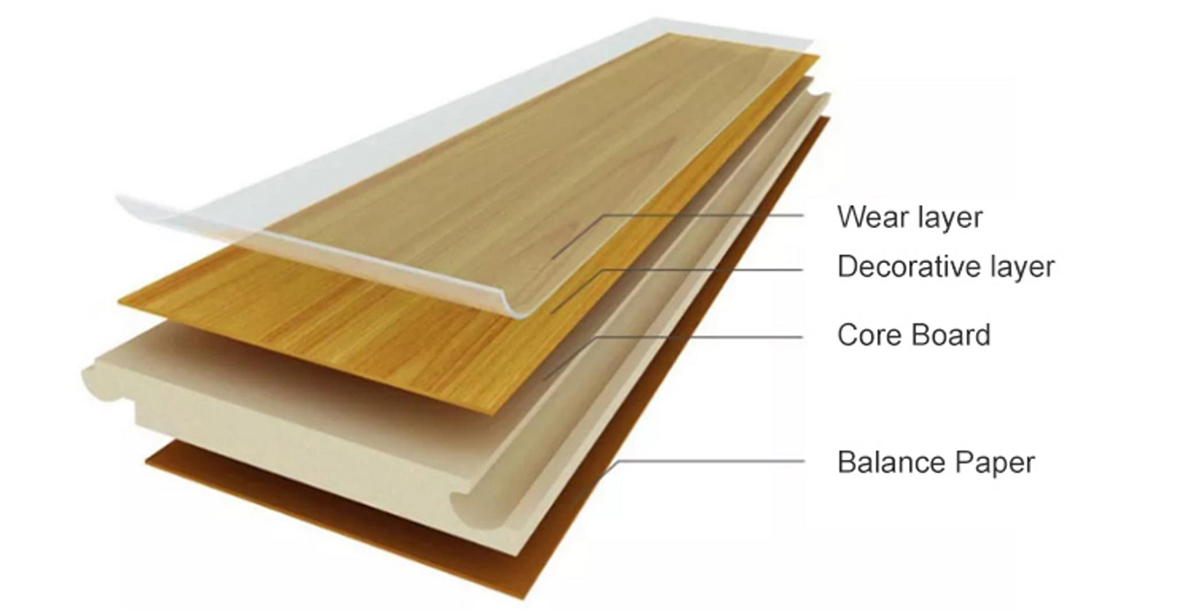
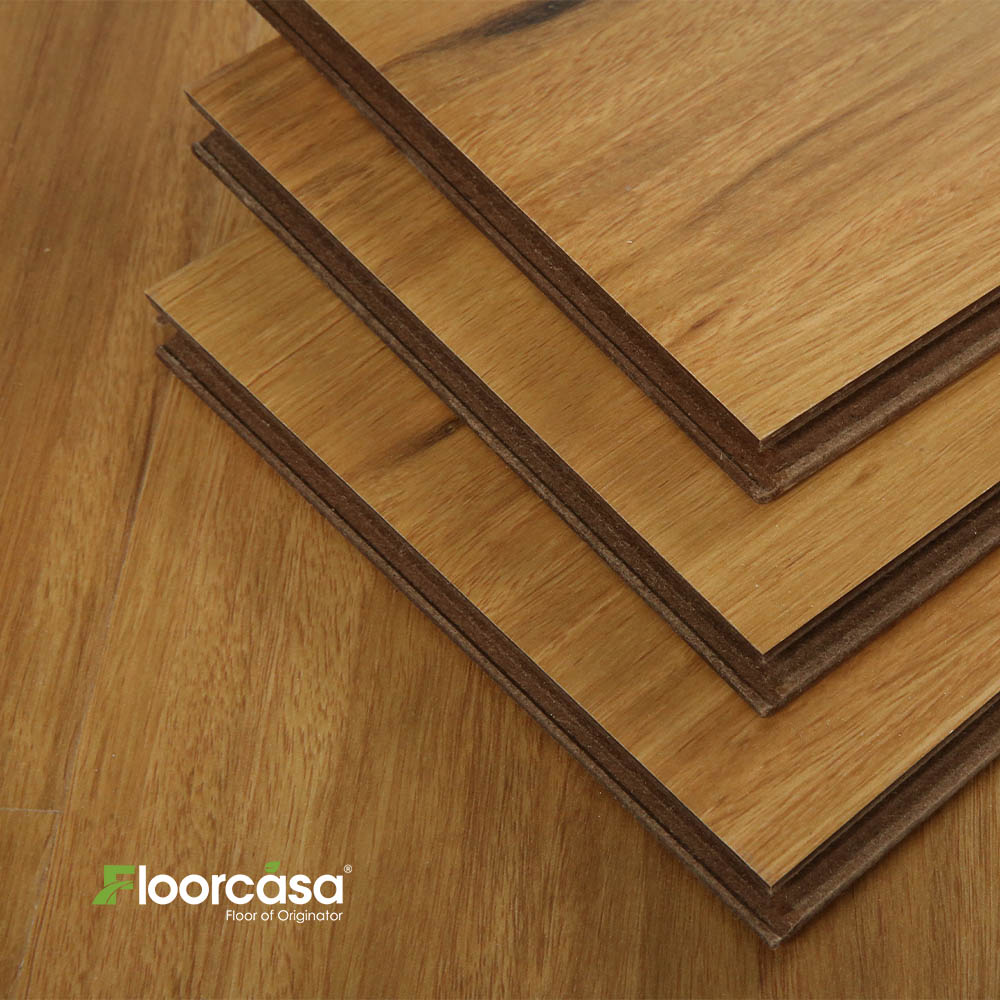
Interlocking laminate flooring is a multilayer composite system engineered for surface durability, structural stability, and precise installation.
Overlay layer. Aluminum oxide-infused transparent wear layer.
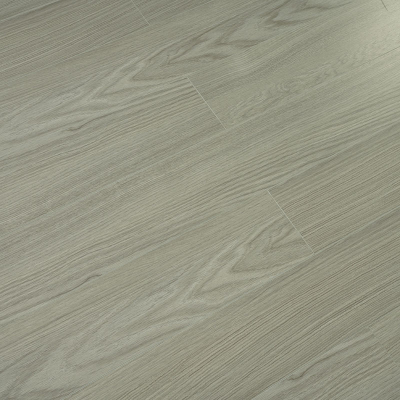
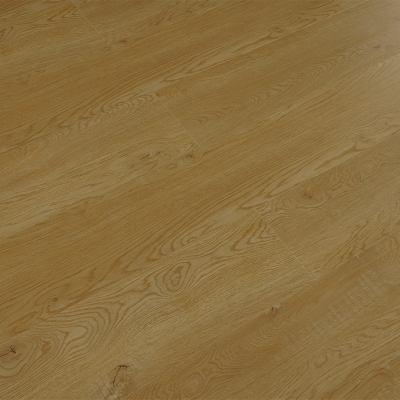
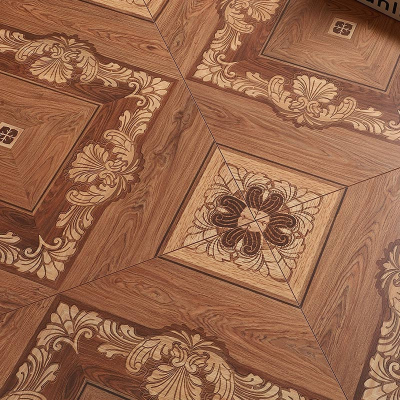
Decor paper. High-definition printed wood or stone visuals.
HDF core board. Load-bearing layer with machined locking system.
Balancing backing layer. Moisture control and stress balancing.
The locking profile is machined into the HDF core board. The precision of the machining determines how well the panels engage and how well the joint resists opening.
Manufacturing Background
Manufacturing quality affects locking performance through two main factors: (a) CNC profiling precision, which determines joint engagement and joint strength, and (b) locking system quality control, which verifies profile geometry and joint performance. Other manufacturing steps—HDF production, resin impregnation, and lamination—affect the core and surface but are covered in the laminate flooring manufacturing page.
CNC profiling. The locking profile is machined into the panel edges using CNC (computer numerical control) machines. The precision of the machining determines joint engagement, joint strength, and ease of installation. Tolerance is typically ±0.05 mm for premium products.
Locking system quality control. Quality control includes verification of profile geometry, joint engagement testing, and batch testing. Test reports should be provided with each shipment.
Industry Comparison: Interlocking Laminate vs Alternatives
The following table compares interlocking laminate flooring with alternative flooring types.
| Flooring Type | Installation Method | Moisture Resistance | Maintenance | Cost Level |
|---|---|---|---|---|
| Interlocking Laminate Flooring | Floating click-lock | Moderate | Low | Low–Medium |
| Solid Hardwood | Nail/Glue | Low | High | High |
| LVT / SPC Flooring | Click or Glue | High | Low | Medium |
| Ceramic Tile | Mortar | Excellent | Medium | Medium–High |
Moisture resistance levels: Moderate = moisture-resistant but not waterproof; High = waterproof or highly moisture-resistant; Excellent = waterproof and suitable for wet areas. Low = limited moisture resistance.
Important note: The comparison above is general guidance. The appropriate flooring choice depends on the specific project requirements, including traffic level, moisture exposure, acoustic requirements, and budget. Verify product test reports before specification.
Application Scenarios and Target Users
Interlocking laminate flooring is widely specified in projects requiring fast installation, visual consistency, and controlled budgets.
Distributors. Typically order in container volumes for retail and project supply. Product mix covers multiple AC ratings and décor options.
EPC contractors. Typically specify for residential buildings and office interiors in the 5,000–50,000 m² range. Priorities are installation speed, consistent appearance, and controlled lifecycle cost.
Engineering consultants. Typically specify for fit-out and refurbishment projects. Priorities are locking system durability, subfloor compatibility, and acoustic performance.
Importers and wholesalers. Typically order in container volumes for distribution. Priorities are packaging stability, pallet efficiency, and batch traceability.
Core pain points and engineering solutions:
Installation efficiency. Click-lock systems reduce labor time.
Cost control. Competitive pricing versus natural wood.
Surface wear. AC-rated overlays improve service life.
Dimensional movement. Balanced layer minimizes warping.
Risk Warnings and Mitigation Measures
The following risks should be considered when specifying or installing interlocking laminate flooring.
Excessive moisture exposure. May cause core swelling. Mitigation: verify moisture resistance, avoid wet areas, and clean up spills promptly.
Uneven subfloors. Can compromise locking performance. Mitigation: verify subfloor flatness before installation.
Low-density HDF. Reduces joint strength. Mitigation: specify HDF density appropriate for the application.
Improper expansion gaps. May cause buckling. Mitigation: calculate expansion gaps correctly and install expansion profiles.
Edge damage during installation. Can compromise joint performance. Mitigation: use correct installation technique and handle panels carefully.
Procurement and Selection Guide
The following steps provide a practical framework for specifying interlocking laminate flooring.
Identify project usage class (AC3–AC5). Match the abrasion class to the expected traffic level.
Confirm HDF density and moisture resistance. Higher density improves joint strength and edge durability.
Evaluate locking system durability and ease of installation. Request locking test reports and, where possible, conduct a sample installation trial.
Request compliance test reports and certifications. Verify EN 13329, EN 717-1, and other relevant standards.
Conduct sample installation trials. Verify that the locking system performs as expected under actual installation conditions.
Assess packaging, pallet stability, and logistics efficiency. Verify that the product arrives in good condition and can be handled efficiently on site.
Engineering Application Example
In a multi-story residential apartment project, interlocking laminate flooring was installed using floating systems across living rooms and bedrooms. The project achieved reduced installation time, uniform appearance, and controlled lifecycle costs while meeting acoustic and indoor air quality requirements. The locking system performed without joint opening or edge damage over the project period, and individual panels could be replaced without removing the entire floor.
FAQ: Interlocking Laminate Selection and Installation
1. Is interlocking laminate suitable for commercial use?
Yes, AC4–AC5 grades are appropriate for commercial use. Verify the wear class against the expected traffic level and request test reports.
2. Can interlocking laminate be installed over existing floors?
Yes, with proper subfloor preparation. The existing floor must be flat, sound, and clean. Do not install over carpet or uneven surfaces.
3. Is underlay required for interlocking laminate?
Underlay is recommended for acoustic performance and moisture control. The appropriate underlay depends on the product and the project requirements.
4. How water-resistant is interlocking laminate flooring?
It is moisture-resistant but not waterproof. It is not designed for wet areas such as bathrooms, kitchens, or basements. Spills should be cleaned promptly.
5. What thickness is most common for interlocking laminate?
8–10 mm is common for residential projects. Thicker products (10–12 mm) are available for commercial and heavier-duty applications. Thickness should be evaluated together with HDF density, wear class, and locking system.
6. Can damaged panels be replaced?
Yes, by disassembling the affected sections and replacing the damaged panels. The locking profiles must not be damaged for the panels to be reconnected.
7. Does interlocking laminate support underfloor heating?
Yes, within specified temperature limits. Verify the product's underfloor heating compatibility and follow the underfloor heating manufacturer's instructions.
8. What AC rating is required for a residential project?
AC3 is typically suitable for residential use. AC4 is suitable for general commercial use; AC5 for heavy commercial use. Verify the expected traffic level and match the AC rating accordingly.
9. What factors affect the lifespan of interlocking laminate flooring?
Service life is affected by the wear class, HDF density, locking system quality, subfloor condition, installation quality, maintenance regime, and the actual traffic level. Verify product test data and project references for the specific application.
10. Are emissions controlled in interlocking laminate flooring?
E1 formaldehyde class is standard. CARB Phase 2 is available for North America. Verify certification for the specific product before specification.
- Call to Action
For upcoming projects requiring reliable, cost-effective flooring solutions, request technical datasheets, laboratory test reports, pricing quotations, or installation samples of interlocking laminate flooring to support specification and procurement decisions.
E-E-A-T Author Credentials
This article is prepared by professionals with extensive experience in laminate flooring manufacturing, building material engineering, and international B2B procurement, ensuring technically accurate and commercially practical guidance for project stakeholders.
- Product structure -