How Is Laminate Flooring Made? Manufacturing Process & Quality Control
What Is Laminate Flooring Made Of?
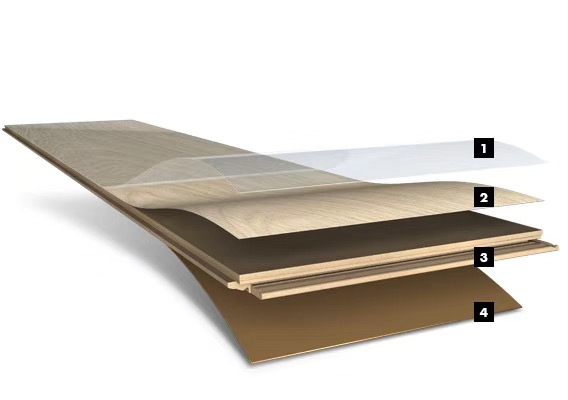
Laminate flooring is a multi-layer engineered floor covering. Each layer performs a specific function, and the quality of each layer determines the performance of the finished product.
HDF core. The core is high-density fiberboard (HDF), made from refined wood fibers bonded with resin under heat and pressure. The core provides structural stability, load-bearing strength, and the material into which the locking profile is machined. Core density typically ranges from 800–930 kg/m³, depending on the product specification. Verify density against the product test report.
Decorative paper. The decorative layer is printed paper that provides the wood, stone, or textile appearance. The print resolution and colour accuracy determine the visual realism of the surface.
Overlay. The overlay is a melamine resin-infused film that protects the decorative layer from abrasion. In higher-grade products, the overlay contains aluminum oxide for additional wear resistance.
Balancing layer. The balancing layer is a moisture-resistant backing paper applied to the underside of the core. It balances the tension in the panel and prevents warping.
Resin. Melamine resin is used to impregnate the decorative paper and overlay, and to bond the layers together during lamination. The resin formulation affects surface hardness, moisture resistance, and durability.
Locking system. The locking system is machined into the edges of the HDF core. The precision of the machining determines how well the panels engage and how well the joint performs under movement.
Laminate Flooring Manufacturing Process
Laminate flooring production follows a standardized industrial process. The following steps describe the sequence from raw material to finished, packaged flooring.
1. Raw Material Preparation
Wood fibers are prepared from raw wood or recycled wood materials. The fibers are refined, dried, and mixed with resin and additives. The moisture content of the fibers is controlled before pressing—this is critical for consistent HDF quality. Fiber moisture content is typically controlled within a narrow range before the forming stage.
2. HDF Board Production
The prepared fibers are formed into a mat and pressed under high temperature and pressure to form HDF board. The board is then cooled, conditioned, and cut to size. Density, thickness, and moisture content are controlled at this stage. Pressing temperature typically ranges from 170–220°C, and pressure is controlled to achieve the target density.
3. Decorative Paper Impregnation
The decorative paper is impregnated with melamine resin. The paper passes through a resin bath and is then dried to remove excess moisture. The resin content and distribution affect the surface hardness and moisture resistance of the finished product. Resin pickup is controlled to achieve the target resin content.
4. Overlay Preparation
The overlay paper is also impregnated with melamine resin, often with aluminum oxide added for wear resistance. The overlay is prepared in the same way as the decorative paper.
5. Lamination and Hot Pressing
The overlay, decorative paper, HDF core, and balancing layer are stacked and pressed together under high temperature and pressure. The heat cures the melamine resin and bonds the layers into a single panel. Pressing parameters—temperature, pressure, and time—are controlled to ensure consistent bonding and surface quality. Typical pressing parameters depend on the resin system and product specification; verify with the manufacturer.
6. Cooling and Conditioning
After pressing, the panels are cooled and conditioned to release internal stresses. This step is important for dimensional stability—panels that are not properly conditioned may warp or change shape after profiling. Cooling is controlled to avoid thermal shock and to allow the panel to reach moisture equilibrium.
7. Cutting and Profiling
The laminated panels are cut to the required plank dimensions. The edges are then profiled—machined into the locking system—using CNC (computer numerical control) equipment. The precision of the profiling determines joint engagement and joint strength. Tolerance is typically ±0.05 mm for premium products.
8. Click-Lock Machining
The click-lock profile is machined into the panel edges. The profile geometry is verified against the design specification. Cutting tools are inspected and replaced at defined intervals to maintain profile precision.
9. Surface Finishing
The surface is embossed to create the texture pattern. For natural touch products, the embossing is synchronized with the printed decor (EIR). The surface may also be treated with a UV-cured coating for additional protection.
10. Quality Inspection
Finished panels are inspected for thickness, density, abrasion resistance, swelling resistance, dimensional stability, locking strength, surface quality, colour consistency, and formaldehyde emission. Test reports are generated for each batch. See the quality control section below for details.
11. Packaging
Panels are packed into cartons, stacked on pallets, and prepared for shipment. Packaging protects the panels during transport and storage, and batch traceability allows the production history of each shipment to be verified.
Laminate Flooring Quality Control
Quality control is what separates a reliable laminate flooring manufacturer from an unreliable one. The following tests and inspections are standard in a well-controlled production process.
Thickness inspection. Verifies that the panel thickness is within tolerance. Thickness variation affects installation quality and joint performance.
Density testing. Verifies that the HDF core density is within specification. Density affects load-bearing strength, joint strength, and dimensional stability.
Abrasion resistance. Measures the wear layer's resistance to surface abrasion. Measured by Taber test or equivalent, and classified by AC rating (AC3, AC4, AC5).
Swelling resistance. Measures the panel's thickness swelling after water exposure. This is a key indicator of moisture resistance.
Dimensional stability. Measures the panel's dimensional change under temperature and humidity variation. This affects whether the floor remains flat and joints remain closed over time.
Locking strength. Measures the joint's resistance to being pulled apart. This is tested on the finished profile and is a key indicator of locking performance.
Surface inspection. Visual inspection of the surface for defects—scratches, colour variation, embossing misalignment, and surface contamination.
Colour consistency. Verifies that the colour of the finished panels matches the approved reference. Colour variation between batches can be a problem for large projects.
Formaldehyde emission. Verifies that the formaldehyde emission class meets the applicable standard (E1, E0, ENF, or CARB Phase 2, depending on the market).
Packaging inspection. Verifies that the packaging protects the panels and that labelling and batch coding are correct.
Test frequency. Test frequency depends on the manufacturer's quality system. Typical practice: thickness and density tested on every batch; abrasion resistance and swelling resistance tested per production run; surface inspection performed continuously; formaldehyde emission tested per batch or per certification requirement. Verify the manufacturer's QC documentation before specification.
How to Evaluate a Laminate Flooring Manufacturer
For distributors, importers, and project suppliers, choosing the right manufacturer is as important as choosing the right product. The following factors should be evaluated.
Production capacity. Verify the manufacturer's monthly and annual production capacity, and whether it can meet your order volume and delivery schedule.
HDF quality. Verify the source and quality of the HDF core. Core density, thickness tolerance, and moisture content should be within specification.
Production equipment. Verify the manufacturer's equipment—hot press lines, impregnation systems, CNC profiling machines, and inspection equipment. Modern equipment produces more consistent results.
QC procedures. Verify the manufacturer's quality control procedures—what tests are performed, at what frequency, and what records are kept. Request test reports for specific batches.
Certifications. Verify the manufacturer's certifications—ISO 9001 (quality management), ISO 14001 (environmental management), and product certifications relevant to the target market (CE, CARB Phase 2, E1, FSC/PEFC).
OEM/ODM capability. If custom design is required, verify the manufacturer's OEM/ODM capability—custom decor, custom embossing, custom packaging, and private label.
Sample approval. Verify the sample approval process. Custom orders typically require sample approval before production.
Packaging. Verify the packaging specifications—carton design, pallet configuration, labelling, and batch coding. Packaging affects transport protection and warehouse efficiency.
Container loading. Verify the container loading plan—how many cartons per pallet, how many pallets per container, and how the load is secured. Efficient container loading reduces shipping cost per square meter.
Export experience. Verify the manufacturer's export experience—which markets they supply, what documentation they provide, and how they handle logistics and customs.
Factory audit. For critical projects, a factory audit is recommended. A factory audit typically covers production equipment, QC procedures, raw material sourcing, production records, and packaging. Where a factory audit is not possible, request video documentation or conduct a sample order.
Limitations of Laminate Flooring Manufacturing
Laminate flooring manufacturing produces a consistent, dimensionally stable product, but the process has limitations that should be considered during specification.
Moisture sensitivity. The HDF core is moisture-sensitive, so the finished product is not suitable for wet areas such as bathrooms, kitchens, or basements. For wet areas, consider waterproof SPC flooring.
Surface cannot be refinished. Unlike solid hardwood, the laminate surface cannot be sanded and refinished. Damaged panels must be replaced.
Quality varies by manufacturing specification. Performance varies significantly by HDF density, wear layer thickness, and locking system precision. Two products with the same thickness and AC rating may perform differently if the core density or profile precision differs.
Embossing and decor synchronization. For natural touch products, the synchronization between the embossing and the printed decor must be controlled within tolerance. Misalignment results in a surface where the texture and the image do not match.
For projects where these limitations are a concern, consider alternative flooring types or additional system components.
Laminate Flooring Factory Production Case
The following case illustrates a typical factory production project for a commercial office development.
Project type: Commercial office renovation.
Project size: 12,000 m².
Flooring specification: 8 mm AC4 laminate flooring, wood-look decor, click-lock system.
Selection rationale: The project required a durable, consistent floor that could be installed quickly and maintained with low effort. Laminate flooring was selected over carpet (maintenance) and tile (installation time). AC4 rating was specified for general commercial traffic; 8 mm thickness was selected for floor height and cost balance.
Production process: HDF core produced to 8 mm thickness with density controlled within specification. Decorative paper impregnated with melamine resin. Overlay with aluminum oxide applied. Lamination under controlled temperature and pressure. Panels cooled and conditioned. CNC profiling of click-lock edges with tolerance verified. Surface embossed. Batch tested for thickness, density, abrasion resistance, swelling resistance, dimensional stability, locking strength, and formaldehyde emission. Test reports generated for each batch.
Quality control: Thickness, density, and locking strength verified on every batch. Abrasion resistance and swelling resistance tested per production run. Surface inspected for colour consistency and embossing alignment. Packaging inspected for protection and labelling.
Packaging and delivery: Panels packed in cartons, stacked on pallets, and loaded into containers according to the loading plan. Batch codes recorded for traceability. Delivered to the project site according to the agreed schedule.
Result: Installation completed on schedule. After five years of continuous use under high foot traffic, the floor maintained surface integrity without joint opening or edge damage. Individual panels could be replaced without removing the entire floor.
The case above is based on a project delivered by Jining Floormaker. Project-specific details are available on request. For reference projects in your market, contact us.
FAQ: Laminate Flooring Manufacturing and Sourcing
1. How is laminate flooring manufactured?
Laminate flooring is manufactured by combining an HDF core with decorative paper and an overlay, pressing the layers together under heat and pressure, cooling and conditioning the panels, profiling the edges, embossing the surface, and inspecting the finished product. See the manufacturing process section above for the full sequence.
2. What materials are used to make laminate flooring?
The main materials are HDF (high-density fiberboard) for the core, printed decorative paper for the appearance, melamine resin-impregnated overlay for wear resistance, and a balancing backing layer for stability. Aluminum oxide is often added to the overlay for additional wear resistance.
3. What HDF density is suitable for laminate flooring?
HDF density typically ranges from 800–930 kg/m³, depending on the product specification. Higher density improves load-bearing strength, joint strength, and dimensional stability. The appropriate density depends on the application—higher density is recommended for commercial applications. Verify density against the product test report.
4. How is laminate flooring tested?
Laminate flooring is tested for thickness, density, abrasion resistance, swelling resistance, dimensional stability, locking strength, surface quality, colour consistency, and formaldehyde emission. Test reports should be provided for each batch. Test frequency depends on the manufacturer's quality system.
5. How is abrasion resistance tested during production?
Abrasion resistance is tested using a Taber abrasion test or equivalent. The number of cycles required to wear through the surface determines the AC rating. AC3 requires ≥2,000 cycles; AC4 requires ≥4,000 cycles; AC5 requires ≥6,000 cycles. Testing is typically performed per production run.
6. How do I choose a laminate flooring manufacturer?
Evaluate production capacity, HDF quality, production equipment, QC procedures, certifications, OEM/ODM capability, sample approval process, packaging, container loading efficiency, and export experience. For critical projects, conduct a factory audit or request video documentation. Request test reports and, where possible, conduct a sample order.
7. Can laminate flooring manufacturers provide OEM services?
Yes. OEM services typically include custom decor paper, custom colours, custom surface texture, custom embossing pattern, custom plank size, custom thickness, private label, and custom packaging. Contact the manufacturer with your requirements.
8. What documents should accompany a laminate flooring shipment?
A typical shipment should include a packing list, batch codes, test reports for the specific batch, certificates of compliance for the target market (CE, CARB Phase 2, E1), and any OEM/ODM documentation. Verify the documentation requirements with the manufacturer before ordering.