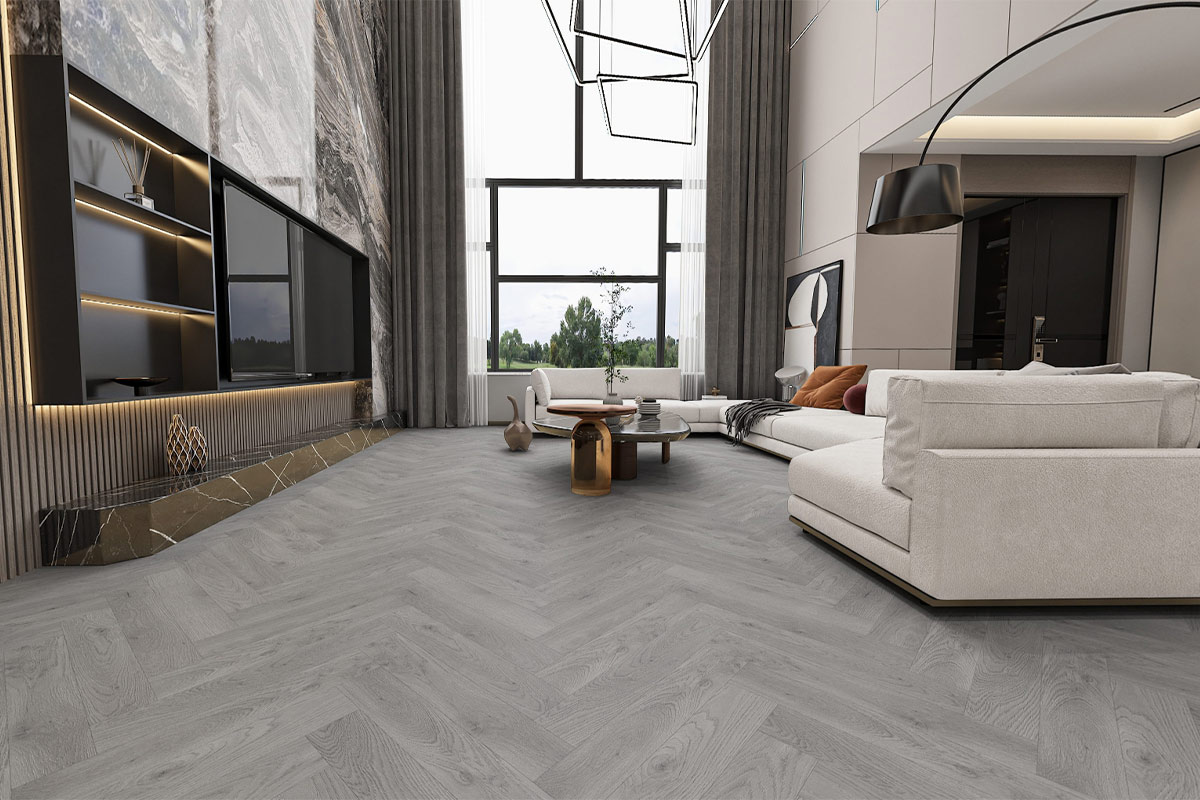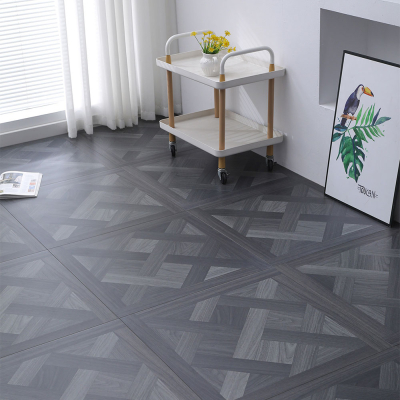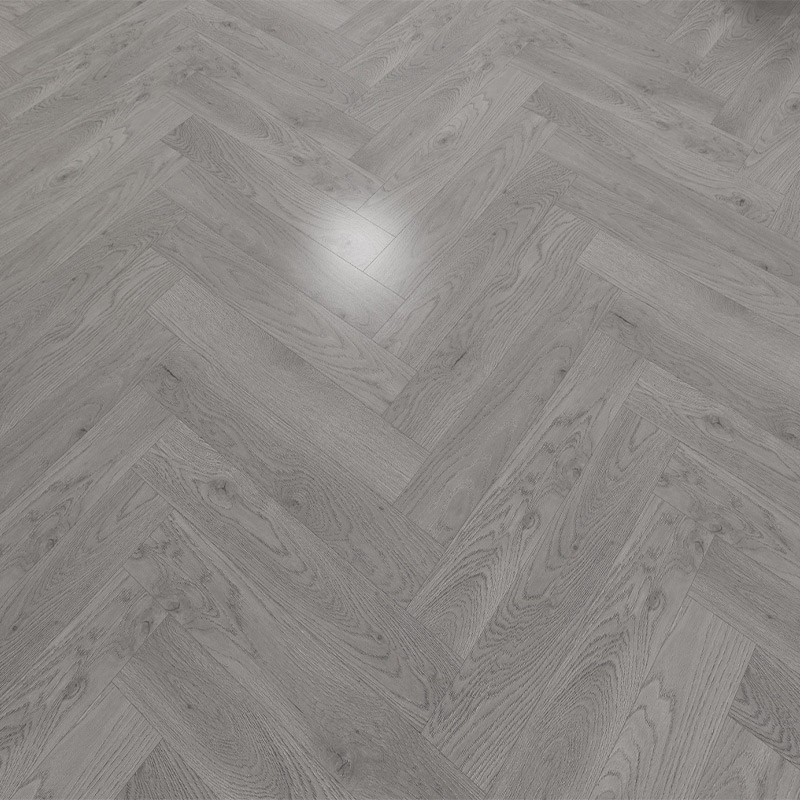
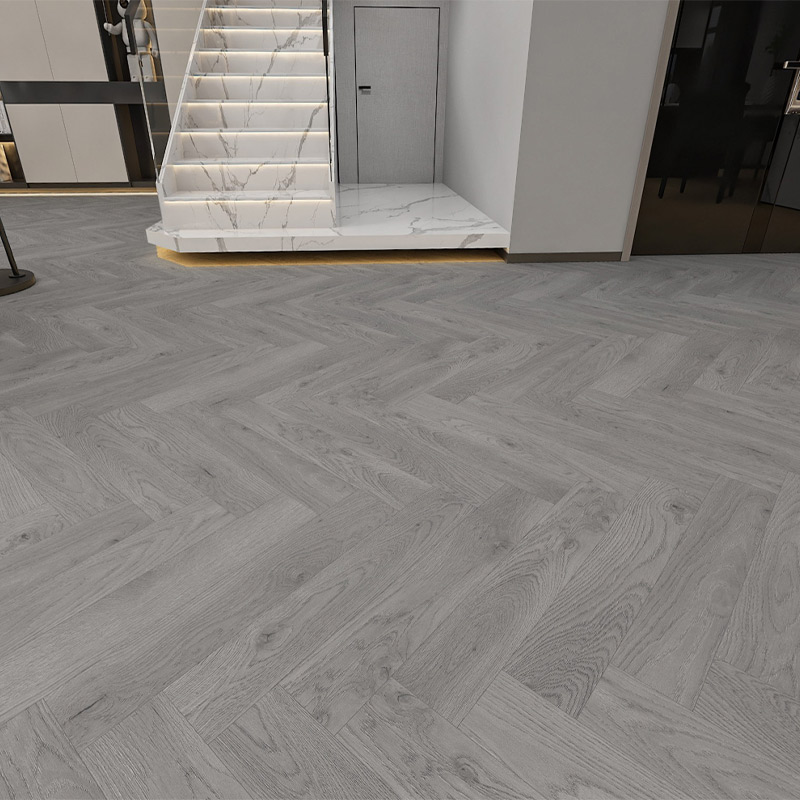
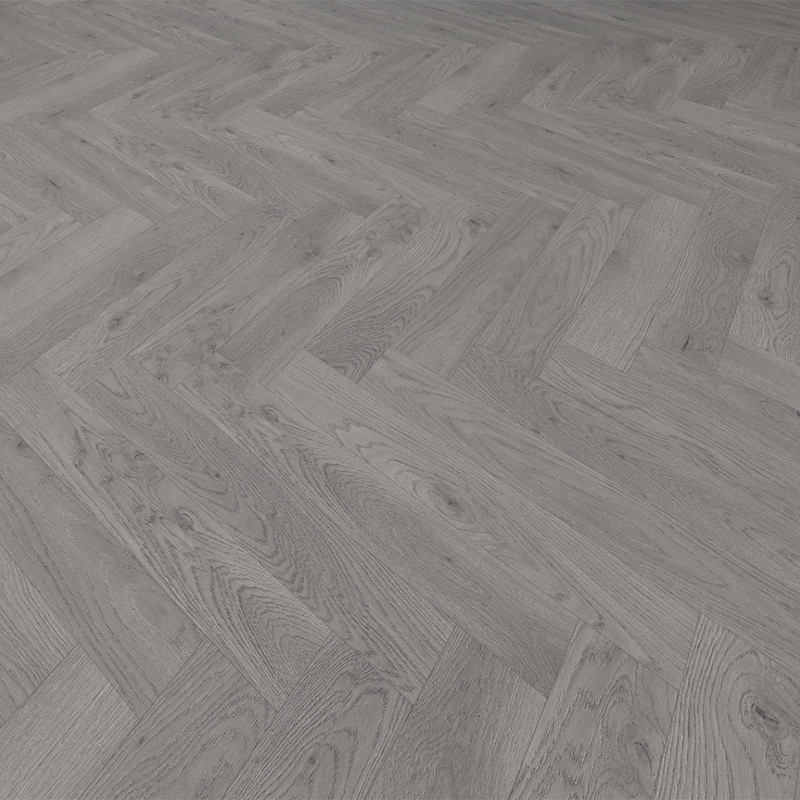
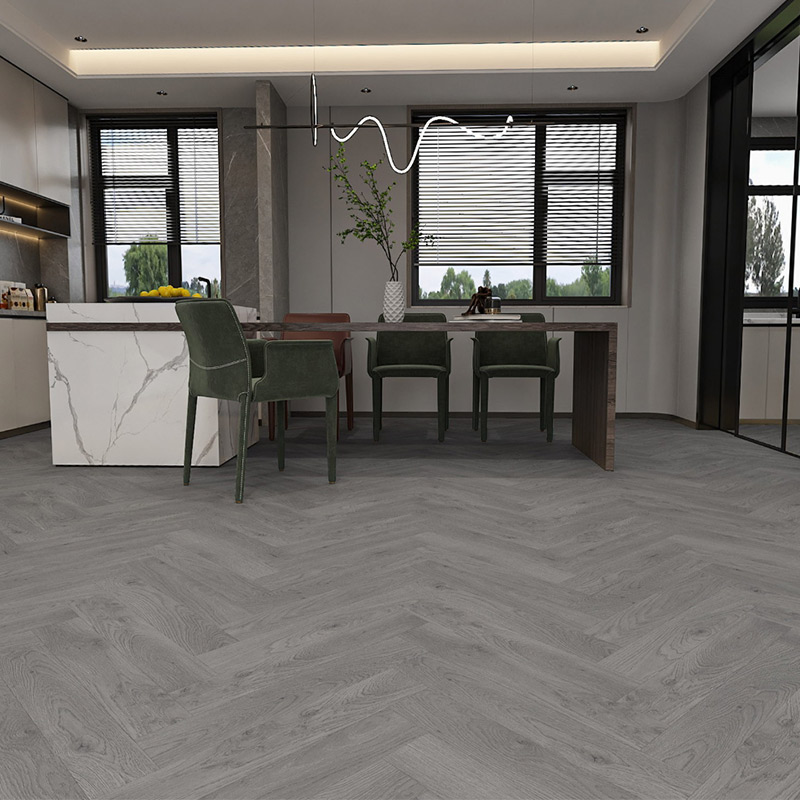
Grey Herringbone Laminate Flooring
Manufacturing Process
Wood fibers preparation and defibration
HDF pressing with resin under high pressure and temperature
Decor layer lamination and texture embossing
CNC profiling to create herringbone locking edges
Dimensional inspection and moisture balance testing
Surface abrasion and click strength laboratory testing
Commercial-grade packaging and pallet protection
Grey Herringbone Laminate Flooring is a multi-layer engineered flooring system combining high-density fiberboard (HDF) core with decorative grey wood-grain surfaces arranged in a herringbone pattern, designed for commercial and residential interior applications requiring dimensional stability, abrasion resistance, and cost efficiency.
Technical Parameters & Specifications
Typical technical parameters of Grey Herringbone Laminate Flooring used in commercial projects are as follows:
Total Thickness: 8mm / 10mm / 12mm
Core Density (HDF): 820–880 kg/m³
Abrasion Class: AC3 / AC4 / AC5 (EN 13329)
Surface Wear Resistance: ≥ 4000 revolutions (AC4)
Formaldehyde Emission: E1 (≤0.124 mg/m³), optional E0
Moisture Content: 6–8%
Impact Resistance: ≥ 12N (EN standard)
Click System: Valinge / Unilin locking system
Water Swelling (24h): ≤ 18% (standard HDF)
Slip Resistance: R9–R10
Grey Herringbone Laminate Flooring designed for EPC and commercial use commonly adopts AC4 or AC5 ratings for high foot traffic environments.
Structure & Material Composition
Grey Herringbone Laminate Flooring consists of the following layered structure:
1. Wear Layer: Transparent aluminum oxide overlay for abrasion resistance
2. Decorative Layer: Printed grey oak or ash grain paper
3. Core Layer: High-density fiberboard (HDF)
4. Balancing Layer: Moisture-resistant backing paper
5. Optional Underlayment: IXPE or EVA acoustic pad
The herringbone configuration requires precision milling of left and right planks to ensure tight interlocking alignment.
Manufacturing Process
1. Raw Material Preparation
Wood fiber refining
Resin blending and drying
HDF board hot pressing (continuous press line)
2. Surface Lamination
Decor paper impregnation
Overlay application
Short-cycle press lamination at 180–220°C
3. Precision Profiling
CNC double-end tenoner
Click-lock profiling
Left/right herringbone angle cutting (45° precision)
4. Quality Inspection
Thickness tolerance check (±0.15mm)
Surface abrasion test
Moisture swelling test
Manufacturing consistency is critical in Grey Herringbone Laminate Flooring because minor angle deviations can lead to visible alignment gaps during installation.
Industry Comparison
| Material Type | Cost Level | Moisture Resistance | Installation Complexity | Maintenance |
|---|---|---|---|---|
| Grey Herringbone Laminate Flooring | Medium | Moderate | Medium (patterned layout) | Low |
| Engineered Wood Flooring | High | Moderate | High | Medium |
| SPC Flooring | Medium | High | Low | Low |
| Solid Hardwood | Very High | Low | High | High |
Grey Herringbone Laminate Flooring offers a balance between cost efficiency and visual premium aesthetics compared with solid hardwood options.
Application Scenarios
Distributors: Retail-ready decorative laminate collections
EPC Contractors: Apartment complexes, hotels, offices
Developers: Mid-to-high-end residential projects
Importers: European grey-tone market demand
Grey Herringbone Laminate Flooring is particularly suitable for indoor dry areas with moderate-to-high traffic levels.
Core Pain Points & Solutions
1. Alignment Difficulty
Solution: Use factory-matched left/right labeling and installation layout drawings.
2. Edge Swelling Risk
Solution: Select waxed edge sealing and moisture-resistant HDF core.
3. Pattern Installation Waste
Solution: Calculate 8–12% extra material allowance for herringbone layouts.
4. Acoustic Performance
Solution: Integrate IXPE underlayment for sound reduction (≥18dB).
Risk Warnings & Mitigation
Do not install in wet areas (bathrooms without waterproof system).
Ensure subfloor moisture content ≤2% (CM method).
Acclimatize material 48 hours before installation.
Avoid uneven subfloors (tolerance ≤3mm/2m).
Procurement Selection Guide
Define project traffic class (AC rating requirement).
Confirm herringbone plank dimensions (e.g., 600×100mm).
Verify HDF density certificate.
Request formaldehyde emission test report.
Evaluate locking system patent authorization.
Calculate installation waste ratio.
Confirm packaging strength for export shipping.
Grey Herringbone Laminate Flooring selection should balance aesthetic specification with mechanical performance requirements.
Engineering Case Study
Project: 12,000 m² residential complex in Northern Europe
Specification: 12mm AC4 Grey Herringbone Laminate Flooring
Installation Method: Floating click system over 2mm IXPE underlay
Result: 15% cost reduction compared to engineered oak flooring; installation cycle shortened by 20%; no visible swelling after 12-month inspection.
FAQ
1. Is Grey Herringbone Laminate Flooring suitable for heavy commercial areas?
AC4 or AC5 grades are recommended.
2. Can it be installed over underfloor heating?
Yes, if surface temperature ≤27°C.
3. What is the expansion gap requirement?
8–10mm perimeter expansion gap.
4. How much waste factor is required?
Typically 8–12%.
5. Is it waterproof?
Standard laminate is moisture-resistant, not fully waterproof.
6. What is the typical warranty?
15–25 years residential, 5–10 years commercial.
7. What plank size is common?
600×100mm or 606×101mm.
8. Can damaged planks be replaced?
Yes, floating installation allows partial replacement.
9. Does it require glue?
No, click-lock floating system.
10. What certification is required for EU import?
CE marking and E1 emission compliance.
CTA – Request Technical Documentation
For detailed technical data sheets, installation manuals, bulk pricing quotations, or project samples of Grey Herringbone Laminate Flooring, please contact our technical sales department. Engineering drawings and compliance certificates are available upon request.
E-E-A-T Authoritative Statement
This article is prepared by a flooring industry technical team with over 15 years of manufacturing and export experience in laminate and engineered flooring systems. Content is based on EN standards, commercial installation practices, and global project supply experience for distributors and EPC contractors.