Why Is Laminate Flooring So Cheap? Cost, Structure & Global Market Analysis
Introduction: Understanding the Price Advantage of Laminate Flooring
Laminate flooring has become one of the most widely adopted flooring solutions in residential, commercial, and light-industrial projects worldwide. Compared with solid hardwood, engineered wood, or stone flooring, laminate flooring is often significantly cheaper—sometimes by 30–60%. This price gap frequently raises a core question among international buyers and project developers: Why is laminate flooring so cheap, and does low cost imply compromised quality?
This article provides a professional, data-driven explanation from a global B2B perspective. By examining industry background, market data, product structure, manufacturing processes, and international procurement behavior, we clarify the real cost drivers behind laminate flooring and assess its value proposition for overseas buyers.
Global Laminate Flooring Industry Background
Market Size and Regional Distribution
The global laminate flooring market has shown steady growth over the past decade. According to multiple industry reports, global market value exceeded USD 40 billion in recent years, with Asia-Pacific and Europe accounting for the largest production volumes. China alone contributes a dominant share of global laminate flooring exports due to its mature supply chain and cost-efficient manufacturing ecosystem.
Key export destinations include:
Europe (Germany, France, UK, Eastern Europe)
North America (United States, Canada)
Middle East and Africa
Emerging markets in Southeast Asia and Latin America
The scale of production directly contributes to the affordability of laminate flooring by enabling economies of scale and standardized output.
Core Reasons Why Laminate Flooring Is Affordable
1. Optimized Product Structure
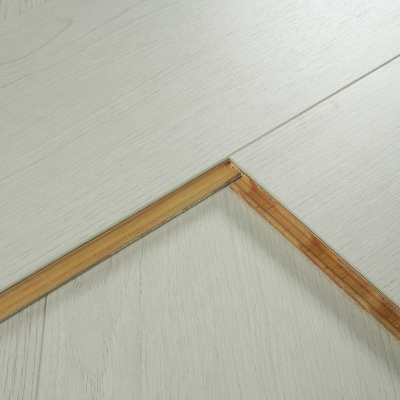
At its core, laminate flooring is a multi-layer composite product, engineered for cost efficiency without sacrificing functional performance.
Typical laminate flooring structure includes:
Wear Layer: Melamine resin overlay for abrasion resistance (AC3–AC5 ratings)
Decorative Layer: High-resolution printed paper simulating wood or stone
Core Layer: High-density fiberboard (HDF) made from recycled wood fibers
Balancing Layer: Stabilizing backing paper for moisture control
Unlike solid hardwood flooring, laminate flooring does not rely on expensive natural timber planks. The use of engineered materials dramatically reduces raw material costs while maintaining dimensional stability.
2. Cost-Efficient Manufacturing Process
The laminate flooring manufacturing process is highly automated and standardized.
Key manufacturing stages include:
Fiberboard production using wood residues and recycled materials
Impregnation of decorative paper with melamine resin
High-pressure pressing at temperatures above 200°C
Precision cutting and click-lock profiling
Automated quality inspection and packaging
Modern laminate flooring factories operate continuous press lines capable of producing millions of square meters annually. High automation reduces labor dependency and minimizes production variance, directly lowering unit costs.
3. Raw Material Availability and Recycling Advantage
A major reason laminate flooring remains cheap is its reliance on abundant, low-cost raw materials. The HDF core primarily uses:
Forestry by-products
Sawmill waste
Recycled wood fibers
This circular material model aligns with sustainability trends while keeping procurement costs low. Compared to natural hardwood flooring, which depends on slow-growing timber species, laminate flooring avoids supply volatility and price spikes.
Technical Parameters That Balance Cost and Performance
Standard Specifications
Despite its affordability, laminate flooring meets internationally recognized technical standards.
Common technical parameters include:
Thickness: 8mm, 10mm, 12mm
Abrasion Class: AC3 (residential) to AC5 (commercial)
Density: 800–880 kg/m³ (HDF core)
Formaldehyde Emission: E1 or CARB Phase 2 compliance
Locking Systems: Unilin, Valinge, or customized click systems
These standardized specifications allow global buyers to source laminate flooring with predictable performance at competitive pricing.
Market Trends Supporting Low Prices
Global Demand Patterns
Several macro trends reinforce the affordability of laminate flooring:
Growth of mass residential housing projects
Rising demand for DIY-friendly flooring
Preference for quick-install renovation materials
Increased acceptance of realistic wood-look laminate flooring
Laminate flooring offers fast installation, low maintenance, and visual consistency—attributes valued in both developed and emerging markets.
Competition and Supplier Density
The global laminate flooring industry is highly competitive. Hundreds of manufacturers—particularly in China, Vietnam, and Eastern Europe—compete on price, quality, and customization. This competitive environment compresses margins and benefits international buyers through stable pricing.
International Buyer Preferences and Pain Points
What Global B2B Buyers Prioritize
International importers and distributors typically focus on:
Stable quality consistency across batches
Compliance with EU and US environmental standards
Competitive FOB pricing and flexible MOQ
Reliable lead times and private-label options
Laminate flooring meets these expectations more easily than premium flooring materials due to its standardized production model.
Common Buyer Concerns
Despite its low cost, buyers often raise concerns such as:
Moisture resistance compared to SPC or vinyl flooring
Long-term durability in high-traffic areas
Perception of “cheap” materials in premium projects
Manufacturers increasingly address these concerns through water-resistant laminate flooring, improved locking systems, and enhanced surface coatings—without significantly increasing costs.
Is Cheap Laminate Flooring a Strategic Advantage?
From a B2B perspective, affordability does not equate to low value. Instead, laminate flooring represents a cost-performance-optimized product category. Its low price point enables distributors to:
Expand product portfolios
Improve inventory turnover
Target mid-market and volume-driven projects
For developers and contractors, laminate flooring reduces overall project costs while meeting functional and aesthetic requirements.
Frequently Asked Questions (B2B FAQ)
Q1: Is laminate flooring suitable for large commercial projects?
Yes. AC4–AC5 rated laminate flooring is widely used in offices, retail spaces, and hospitality projects with controlled moisture conditions.
Q2: How does laminate flooring compare with SPC flooring in price?
Laminate flooring is generally 10–25% cheaper than SPC flooring due to lower raw material and processing costs.
Q3: Can laminate flooring meet EU and US environmental regulations?
Reputable manufacturers offer E1, CARB Phase 2, and even FloorScore-certified laminate flooring suitable for export markets.
Q4: What is the typical lead time for bulk laminate flooring orders?
Standard lead times range from 20–35 days, depending on customization, order volume, and packaging requirements.
Conclusion and Professional Call to Action
The affordability of laminate flooring is the result of engineered product design, scalable manufacturing, abundant raw materials, and intense global competition—not compromised quality. For international buyers seeking a cost-effective, reliable, and market-proven flooring solution, laminate flooring remains a strategic sourcing choice.
If you are evaluating laminate flooring for distribution, project supply, or private labeling, we invite you to request detailed technical specifications, current pricing, and free samples. Our team is available to support your sourcing decisions with transparent data, compliance documentation, and tailored quotations for your target market.