What Thickness of Laminate Flooring is Best? A Technical Guide for Global B2B Buyers
For global importers, project developers, and distributors, specifying the correct laminate flooring involves a crucial technical decision: What thickness of laminate flooring is best? This question becomes even more critical when selecting Fireproof Laminate Wood Flooring, where performance, safety, and durability are paramount. The answer is not universal but depends on a precise understanding of how thickness interplays with structural integrity, fire resistance, acoustic performance, and application requirements.
This guide provides a data-driven analysis to help B2B buyers navigate the global market for fireproof laminate wood flooring, with a focused examination of how thickness choices impact product performance in commercial and residential projects worldwide.
The global wood and la
Global Market Context: The Demand for Performance-Driven Specifications
minate flooring market is a significant and growing sector, valued at USD 59.46 billion in 2024 and projected to reach USD 90.56 billion by 2032, exhibiting a steady compound annual growth rate (CAGR) of 5.40%. This growth is fueled by rising construction activity and a strong consumer preference for aesthetic, durable, and sustainable flooring solutions.
Within this expansion, demand for performance-specific flooring like fireproof laminate is rising sharply. Key markets such as North America (holding a 38.24% share in 2024) and Europe are driven by stringent building safety codes, while rapid urbanization in the Asia-Pacific region is accelerating adoption. Buyers are moving beyond basic aesthetics to demand products with certified performance metrics, where flooring thickness serves as a primary indicator of potential durability, stability, and safety compliance.
Demystifying Thickness: Core Technology and Structural Implications
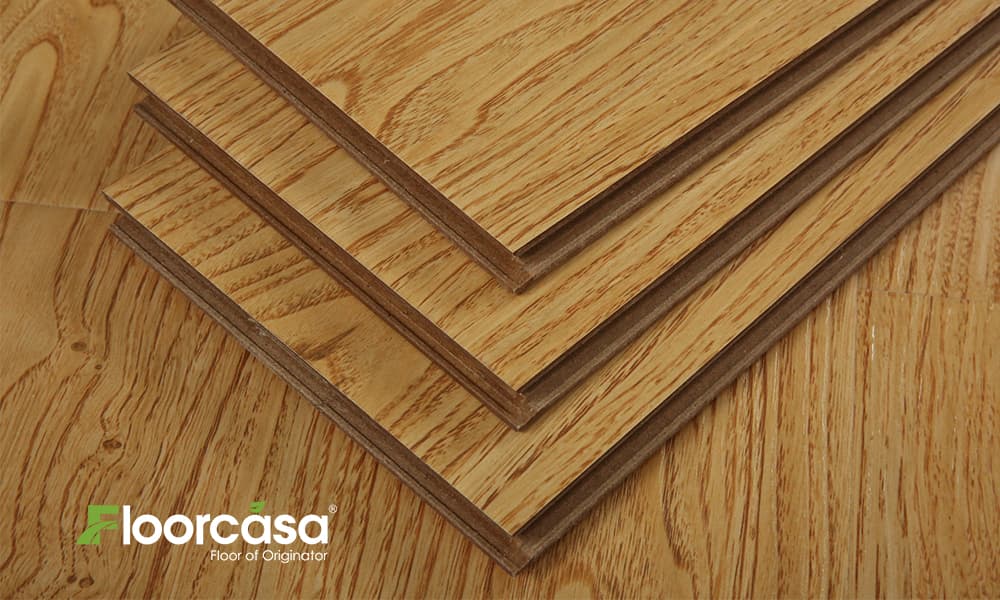
To understand the importance of thickness, one must examine the multi-layer construction of modern Fireproof Laminate Wood Flooring. Each layer contributes to the final profile and performance.
The Anatomy of a Laminate Plank
Wear Layer: The top, transparent coating of aluminum oxide provides scratch and stain resistance. Its quality is measured in revolutions (AC rating), not thickness.
Decorative Layer: A high-resolution printed film that provides the wood, stone, or abstract visual design.
Core Layer (The Critical Component): This is the primary determinant of overall plank thickness and performance. In fireproof laminate, this is typically a High-Density Fiberboard (HDF) core treated with non-halogenated flame retardants. The density and thickness of this core directly influence:
Dimensional Stability: Resists expansion and contraction from temperature and humidity changes.
Impact Resistance & Load Distribution: A thicker core better withstands point loads and heavy furniture without indentation.
Structural Rigidity: Reduces flex underfoot, which is crucial for long-span installations and commercial use.
Fire Resistance: A denser, thicker core can contribute to improved fire-retardant properties by providing more mass and a longer burn-through time.
Balancing Back Layer: Stabilizes the plank to prevent warping.
Attached Underlayment (Optional): Some products feature a pre-attached foam underlayment for noise reduction and minor subfloor smoothing, adding to the total installed height but not the structural thickness of the plank itself.
Standard Thickness Options and Their Applications
The industry has converged on several standard thicknesses, each catering to specific market segments:
8mm Laminate Flooring: Historically the standard in many markets, particularly Europe. It offers a cost-effective, proven solution for residential applications with low to moderate traffic. Its relative thinness can be an advantage in renovations where maintaining clearances with existing doors is a concern.
10mm Laminate Flooring: This has become a highly popular middle-ground option. It provides a noticeable improvement in acoustic performance (reducing hollow-sound footfall noise) and underfoot solidity compared to 8mm, making it suitable for both residential and light commercial projects like offices and boutiques.
12mm (and 12mm+) Laminate Flooring: This is the premium segment, dominant in markets like North America and parts of Asia. The thicker flooring core delivers superior acoustics, exceptional underfoot stability that closely mimics solid wood, and enhanced long-term durability. It is the preferred choice for high-traffic residential areas, premium commercial spaces, and projects where maximizing flooring sound reduction is a priority.
The Buyer's Perspective: Key Criteria and Procurement Pain Points
For international B2B buyers, the decision matrix involves balancing technical specifications with commercial and logistical realities.
Critical Technical & Certification Requirements:
Fire Safety Certifications: Beyond marketing terms, buyers must demand internationally recognized test reports. Key standards include EN 13501-1 (Euroclass Bfl-s1, Cfl-s1) in Europe and ASTM E84 (Surface Burning Characteristics) in North America. The product's fire performance must be certified for its specific thickness and construction.
Thickness and Performance Data: Reputable manufacturers provide data according to standards like ASTM F386, which defines the test method for measuring the thickness of resilient flooring materials. Buyers should look for guaranteed thickness tolerances (e.g., 12mm ± 0.2mm) to ensure installation consistency.
Durability Class (AC Rating): Thickness should be paired with an appropriate abrasion class. For commercial use, Fireproof Laminate Wood Flooring should be AC4 (general commercial) or AC5/AC6 (heavy commercial), regardless of thickness.
Environmental Compliance: Documentation for formaldehyde emission levels (e.g., CARB NAF, E1, E0) and sustainable sourcing is increasingly a non-negotiable requirement for global tenders.
Common Procurement Pain Points:
Misalignment of Specs and Application: Selecting a visually appealing 8mm product for a busy retail space, leading to premature failure and complaints.
Inconsistent Thickness Across Batches: Poor manufacturing quality control resulting in planks of varying thickness, causing installation issues like lipping (edges not aligning smoothly).
Certification Ambiguity: Suppliers claiming "fire-resistant" properties without providing third-party, product-specific certification for the exact thickness being purchased.
Total Cost of Ownership (TCO) Oversight: Focusing solely on the lower per-square-meter cost of a thinner product while overlooking its potentially shorter lifespan and higher maintenance costs in demanding environments.
The Future of Flooring Specifications: Trends Influencing Thickness Choices
The market is evolving toward more intelligent and performance-integrated solutions. One clear trend is the rise of rigid core laminate flooring (like SPC/WPC with a laminate surface), which uses a polymer-based core for extreme water and indentation resistance. These products often come in specific thickness profiles (e.g., 5.5mm, 7mm) that challenge traditional HDF-based thickness paradigms while offering superior stability.
Furthermore, the integration of acoustic underlayments and the demand for heated floor compatibility are influencing system design. A trend toward sustainable material use, including recycled content in core layers, may also impact density and thickness engineering as manufacturers balance eco-goals with performance benchmarks. Forward-thinking suppliers like Floorcasa are investing in these advanced material technologies to offer products that meet future-proof specifications.
B2B Sourcing Frequently Asked Questions (FAQ)
Q1: For a hotel renovation project, should I choose 10mm or 12mm fireproof laminate?
A1: For commercial hospitality settings like hotels, 12mm fireproof laminate flooring is strongly recommended. The primary reasons are superior acoustic insulation to reduce noise transfer between guest rooms and a more substantial, premium underfoot feel that withstands heavy luggage traffic and frequent cleaning. Ensure the product carries a minimum AC4 (preferably AC5) abrasion rating and the relevant fire safety certification for public buildings.
Q2: Does a thicker laminate floor always provide better fire resistance?
A2: While thickness is a factor, the fire-retardant properties are primarily engineered into the materials, especially the HDF core and additives. A well-formulated 10mm fireproof laminate can outperform a standard 12mm product. The key is to rely on the certified fire rating (like Euroclass Bfl-s1) rather than thickness alone. Always request the official test report for the specific product line.
Q3: Are there installation differences between 8mm and 12mm laminate?
A3: Yes, there are subtle but important differences. Thicker laminate flooring (12mm) is generally more forgiving of minor subfloor imperfections due to its inherent rigidity. However, both require a professionally prepared, level subfloor within the manufacturer's tolerance (typically 3mm over 2 meters). The locking systems are designed for their specific thickness, so underlayment and installation tools should be used as specified.
Q4: How do I verify the actual thickness and consistency of a shipment?
A4: Professional buyers should specify adherence to measurement standards like ASTM F386 in their contracts. You can perform random sampling upon container arrival using a calibrated digital caliper. Measure multiple planks from different cartons. Consistent thickness is crucial for a seamless installation. Reputable manufacturers like Floorcasa provide quality assurance certificates with batch-specific data.
In conclusion, determining the best thickness for laminate flooring is a strategic decision that balances application demands, performance certifications, and lifecycle value. For Fireproof Laminate Wood Flooring, the trend is moving decisively toward 10mm and 12mm profiles that deliver the durability, acoustics, and solidity required for modern commercial and premium residential projects.
Ready to specify with precision?
Connect with Floorcasa to access detailed technical dossiers for our fireproof laminate wood flooring series, including independent certification reports for fire safety (EN 13501-1 / ASTM E84) and full physical property data. Request your free, full-size sample kit today to evaluate the authentic texture, locking system quality, and acoustic performance of our 10mm and 12mm solutions. Contact our B2B sales team for a project-specific quotation and comprehensive specification support.