What Flooring is Fire-Resistant? The Rise of Fireproof Laminate Wood Flooring in Global Construction
The question of fire safety in building materials has moved from the periphery to the core of specification decisions for architects, project developers, and B2B buyers worldwide. In an era marked by stringent international building codes and a heightened focus on occupant safety, the demand for fire-resistant flooring is experiencing significant growth. While traditional materials like ceramic tile or concrete offer inherent fire resistance, the market has long sought a solution that combines this critical safety feature with the aesthetic warmth, comfort underfoot, and design versatility of wood. This is where advanced Fireproof Laminate Wood Flooring enters, representing a sophisticated convergence of material science and safety engineering.
The global market for fire-retardant flooring is on a clear upward trajectory, driven by regulatory changes and a growing safety consciousness. This article delves into the technical specifications, manufacturing innovations, and procurement considerations defining this essential segment, providing B2B buyers with the knowledge to source effective and compliant fireproof laminate wood flooring.
Global Market Dynamics and Regulatory Drivers
The push for safer buildings is a universal trend, translating into tangible market growth. Industry analyses indicate a steadily expanding global market for fire-retardant flooring solutions, with projections showing continued growth through 2031. This growth is unevenly distributed but widespread, with significant activity in North America and Europe—regions with historically strict building codes—and accelerating demand in the Asia-Pacific region due to rapid urbanization and the development of more rigorous safety standards.
The regulatory landscape is a primary driver. Standards such as the ASTM E648 test, which measures a material's Critical Radiant Flux (CRF), are internationally recognized benchmarks. For instance, the NFPA 130 standard for rail vehicles mandates a minimum CRF of 5.0 kW/m² for flooring. Similar stringent classifications exist worldwide, including Europe's EN 13501-1 (Euroclass) and various national standards for rail, marine, and commercial construction. These are not mere guidelines but often legal requirements for projects like public transportation hubs, healthcare facilities, schools, and high-rise buildings. For B2B buyers, understanding these certifications is the first step in qualifying suppliers.
Deconstructing Fire Resistance: Technology and Structure
True fire resistance in laminate flooring is not a superficial treatment but a result of integrated material engineering. Modern fireproof laminate wood flooring is built on a multi-layered defense system.
The Core: Engineered for Stability and Resistance. The high-density fiberboard (HDF) core is the foundational layer. In fire-resistant laminates, this core is specially treated. This can involve the incorporation of non-halogenated flame retardants during the fiber blending process. These additives work by diluting flammable gases, promoting char formation that insulates the underlying material, or interrupting the chemical chain reactions of combustion. Leading manufacturers are innovating with mineral-based additives like expanded silicates or alumina trihydrate, which provide effective resistance without compromising on environmental or health goals, moving away from older halogenated systems.
The Surface: The First Line of Defense. The decorative top layer and the wear layer (typically made of melamine or aluminum oxide) are inherently more resistant to ignition than raw wood. In premium fire-rated laminate flooring, these layers are further optimized. The wear layer acts as a barrier, slowing heat penetration and protecting the decorative paper. Some advanced products use chemically modified, heat-resistant resins in this layer to enhance performance.
The Backing: An Added Safety Layer. A stabilizing backing is standard, but in fireproof versions, this layer often contains additional fire-retardant compounds or fire barrier foils. This not only contributes to overall fire performance but also helps prevent the spread of flames should a fire originate in the subfloor or the space below.
The most cutting-edge research points to nanotechnology integration, such as impregnating wood fibers with bentonite nanosheets, which create a protective, insulative char layer that significantly slows combustion and can lead to self-extinguishing properties. While commercially nascent, this direction highlights the industry's innovative drive.
Manufacturing Process: Where Safety is Engineered
The manufacturing of fire-retardant laminate flooring is a precise process where safety is built in from the beginning, not applied as an afterthought.
Fiber Impregnation: The wood fibers are coated or blended with fire-retardant chemicals or mineral additives before the formation of the core board. This ensures uniform distribution of the protective agents throughout the entire thickness of the HDF.
Mat Formation and Pressing: The treated fibers are formed into a mat and subjected to high heat and pressure. This process activates and cures the binding resins and integrates the fire-retardant components into the core's structure.
Layering and Fusion: The fire-resistant core is then fused with the specially formulated decorative layer and a robust wear layer under intense heat and pressure in a short-cycle press. This creates a monolithic panel where each layer contributes to the overall fire performance.
Finishing and Quality Assurance: The pressed boards are milled with precision locking systems. Crucially, every production batch of quality fireproof laminate wood flooring is subject to rigorous quality control, including sample testing to verify compliance with stated fire ratings like ASTM E648 or relevant Euroclass standards.
International Buyer Preferences and Key Procurement Considerations
For B2B buyers—whether importers, distributors, or project contractors—navigating this market requires a focus on verifiable performance and total value.
Certification as a Non-Negotiable: The top priority is independently verified test reports. Buyers must insist on documentation proving compliance with the specific standards required in their target market (e.g., ASTM E648 for North America, EN 13501-1 for Europe). A supplier’s ability to provide these documents transparently is a primary indicator of professionalism and product legitimacy.
Performance Beyond Fire: The best fire-resistant flooring does not sacrifice other essential qualities. Buyers evaluate the balance between fire rating and key commercial attributes like abrasion class (AC rating), impact resistance, water resistance (especially for SPC-based rigid core options), and acoustic performance. A floor must be safe, durable, and practical.
The Sustainability Imperative: There is a growing and decisive shift toward eco-friendly fireproof flooring. Buyers are increasingly avoiding products with halogenated flame retardants or high VOC emissions. They seek solutions that meet safety standards while also aligning with green building principles, such as those using non-toxic, mineral-based retardants and formaldehyde-free adhesives.
Supply Chain Reliability and Technical Support: Given the critical nature of the application, buyers value suppliers with a proven track record of consistent quality and on-time delivery. Furthermore, suppliers who offer comprehensive technical support—including guidance on subfloor preparation, installation methods that preserve the fire rating, and maintenance—become preferred long-term partners.
The Future of Fire-Safe Flooring: Trends and Innovations
The future points toward smarter, more integrated, and more sustainable solutions. The industry is moving beyond simply adding chemicals to re-engineering materials at a nano-level, as seen in the research on bio-based nanocomposite coatings. Furthermore, the concept of multi-functional flooring is gaining ground, where a single product offers a combination of fire resistance, antimicrobial properties, enhanced durability, and environmental benefits. For forward-thinking brands like Floorcasa, investing in these next-generation technologies is key to staying ahead. Another clear trend is the harmonization of global standards, making it easier for manufacturers to produce and buyers to source products that are acceptable in multiple regions.
B2B Sourcing Frequently Asked Questions (FAQ)
Q1: What is the difference between "fire-resistant" and "fireproof" in laminate flooring?
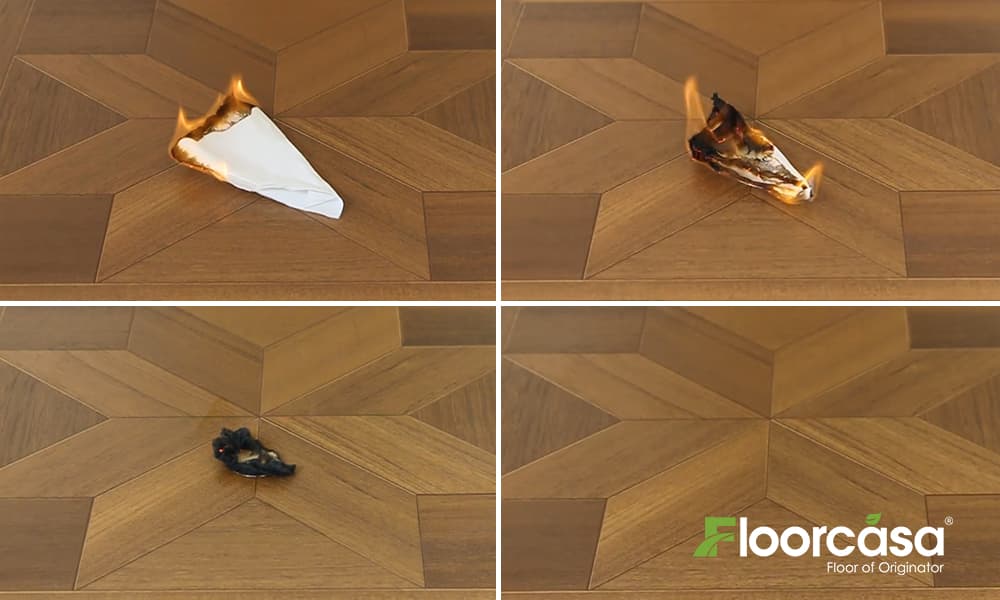
A1: In the industry, "fireproof" is generally an absolute term rarely used for organic materials like wood-based products. "Fire-resistant" or "fire-retardant" are the accurate terms. They indicate that the flooring is specially treated to significantly resist ignition, slow the spread of flames, and often generate less smoke when exposed to fire, compared to standard laminate. Its performance is measured and classified under specific test standards.
Q2: What specific certifications should I request for projects in the European Union and North America?
A2: For the EU, the essential certification is EN 13501-1, which provides Euroclass ratings (e.g., Bfl-s1, Cfl-s1). For North America, key tests include ASTM E648 (Critical Radiant Flux for floorings) and ASTM E84 (Surface Burning Characteristics). Always request the official test report from an accredited laboratory, not just a supplier's claim of compliance.
Q3: Does fire-resistant laminate flooring require special installation methods or adhesives?
A3: It can. To maintain the integrity of the fire-rated system, some specifications may require the use of specific fire-rated underlayments or adhesives. Using non-compliant materials can void the fire-rating warranty. Always follow the flooring manufacturer's installation guidelines precisely and consult their technical department for project-specific advice.
Q4: Can fire-resistant laminate flooring also be waterproof and suitable for commercial high-traffic areas?
A4: Yes, advanced manufacturing allows for the combination of properties. Many fireproof laminate wood flooring products are built on a waterproof SPC (Stone Plastic Composite) rigid core, making them dimensionally stable and moisture-proof. Furthermore, they are available with high abrasion class (AC) ratings (e.g., AC4, AC5, AC6) specifically designed to withstand the demands of commercial and institutional traffic.
In conclusion, specifying fire-resistant flooring is no longer a niche consideration but a fundamental aspect of responsible construction and design. The evolution of Fireproof Laminate Wood Flooring offers a compelling solution that marries essential life-safety performance with the practical and aesthetic demands of modern spaces.
Ready to specify with confidence?
Connect with Floorcasa to explore our range of rigorously tested fire-rated laminate flooring solutions. Request our comprehensive technical documentation packages today, including detailed product specifications and independent third-party ASTM E648/EN 13501-1 test reports. We invite you to evaluate quality firsthand—contact us to order full-size, A-grade samples for your own verification. Let our specialists provide you with a project-specific quotation and guide you toward the optimal, code-compliant flooring solution for your next project.