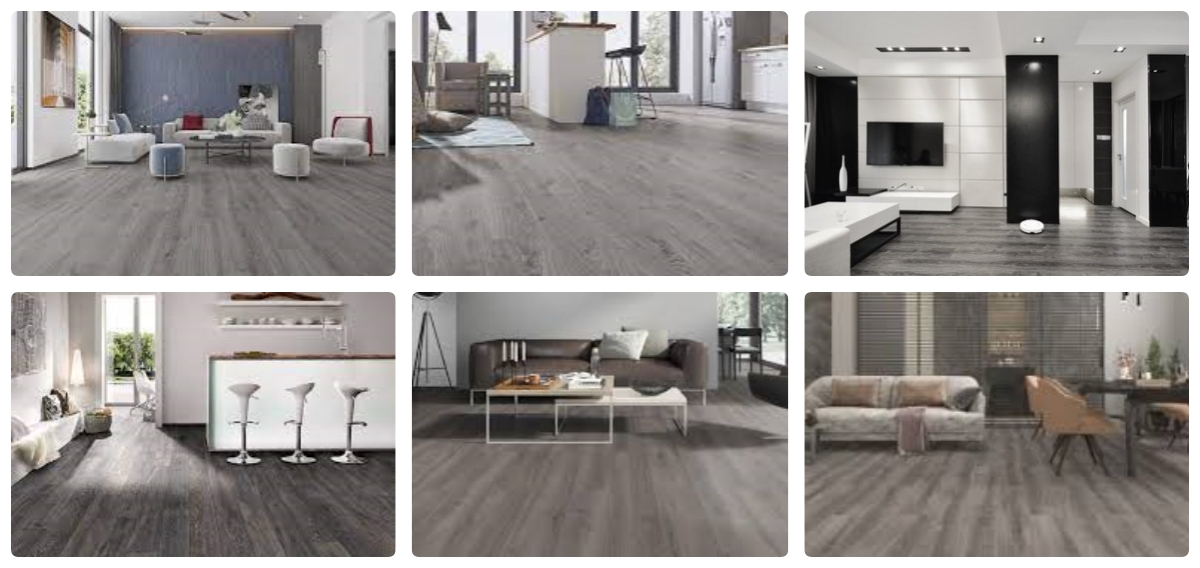
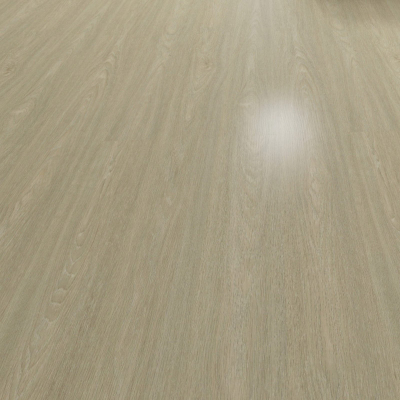
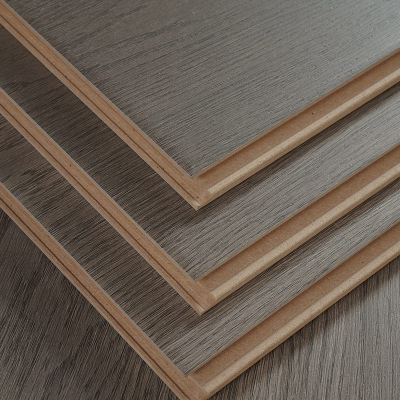
8mm EIR Fireproof Laminate Wood Flooring
Manufacturing Process
Raw Material Preparation: Fiber refining, resin blending, and fire-retardant agent dosing.
HDF Core Pressing: Continuous hot-press lines (1.2–1.5 MPa, 180–200°C).
Impregnation: Overlay and decor paper impregnated with melamine resin.
Lamination: Multi-layer hot pressing to fuse overlay, decor, HDF, and balance layer.
Profiling: CNC milling for Unilin/Välinge click geometry.
EIR Synchronization: Press plates aligned with wood grain patterns.
Quality Testing: Wear resistance, swelling rate, fire-rating verification.
Packing: Shrink wrapping, carton loading, palletization.
8mm EIR laminate flooring is a thin-profile laminate plank with an 8mm HDF core formulated with fire-retardant additives, a printed wood-grain décor and a synchronized embossed-in-register surface in which the pressed texture follows the printed grain. It is specified where a lower installed height, a wood appearance and a documented fire performance are wanted together, typically in multi-unit residential work, retail and office interiors, and renovation projects with door clearance constraints.
Two points about the product name belong at the start. The fire performance of a floor is a property of the finished product as tested, not of the core alone: a fire-retardant HDF core does not by itself establish that the plank reaches a given classification, and the classification is claimed only where a test report for the product supports it. The word "fireproof" is used loosely in the market and can be read as meaning the floor will not burn; the accurate description is fire-rated or fire-performance tested, and the classification is read from the report together with the mounting arrangement it was tested in.
The fire classification system is described on the SPC wall panel fire resistance page, where EN 13501-1 is set out in detail; that page addresses wall panels, and the classification for a floor product is read from the floor product's own report. The EIR technology is explained on the EIR flooring page. This page covers the product: structure, specifications, fire documentation, surface designs, abrasion and moisture performance, applications and supply terms.
Product Specifications
The table states the specification for this 8mm product; entries marked as pending are confirmed for the order and are not final values. Values are published only when the test report for the SKU states them together with the test method and the conditions.
| Specification | Value or status |
|---|---|
| Product type | 8mm EIR laminate flooring |
| Total thickness | 8mm |
| Core material | HDF with fire-retardant additives |
| Core density (core, not the finished plank) | Actual tested value, pending confirmation for the SKU |
| Moisture content | Actual tested value, pending confirmation for the SKU |
| Internal bond strength | Actual tested value where a report is held, pending confirmation |
| Surface texture | Embossed-in-register |
| Abrasion class | Actual class for this configuration, pending confirmation; AC5 only where a production configuration for AC5 is confirmed |
| Surface finish | Actual finish options, pending confirmation |
| Fire classification | Actual classification from the product test report, pending confirmation |
| Moisture swelling | Actual measured result, with the method and duration; distinguish from an internal control target |
| Locking system | Actual locking profile, pending confirmation |
| Plank size | Actual length and width options, pending confirmation |
| Packaging | Pieces per carton and pallet arrangement, pending confirmation |
| Installation | Per the product's installation instructions |
| Customization | Colors, textures and sizes actually supported |
Density, moisture content, internal bond strength, abrasion class, fire classification and moisture swelling are different properties measured in different ways, and one is not evidence of another. How to read the reports is covered on the laminate flooring quality standards page.
The fire classification is specific to the product as tested, and a report for one thickness does not automatically cover another: an 8mm plank and a 12mm plank are different constructions, and the report states the thickness and the build-up it covers. Where the classification is required for a project, the report for this thickness is the document to request.
Fire Performance and Test Documentation
Fire-Retardant HDF Core
The core is a high-density fiberboard made from wood fibres bonded with resin, and in this product the formulation includes fire-retardant additives. The additives change how the core behaves under heat, but they are a formulation feature rather than a classification. The core formulation and the additive system are stated in the product documentation.
EN 13501-1 Fire Classification
EN 13501-1 is the European classification system for the reaction-to-fire performance of construction products, and it expresses the result as a main class, a smoke class and a flaming-droplet class. A classification is only meaningful with the test report that states the product, the construction, the mounting and the test method. The classification for this product is stated from its own report and is not inferred from the presence of fire-retardant additives, and it is not carried over from a wall panel or from another thickness.
Product Testing and Compliance Documents
The fire documentation for the product is the test report from an accredited laboratory for the exact product, together with the report number and the testing laboratory, and, where a classification certificate is held, its scope and validity. The report should state the product model, the thickness, the surface layers, the mounting arrangement and the test method, and the model and thickness should match the product being supplied. Where a test has not been carried out for a particular construction or thickness, that is stated as not held rather than implied.
EIR Surface Texture and Available Designs
The EIR effect is the alignment between the printed grain and the pressed texture, judged on a sample at close range under raking light. How the registration is achieved is explained on the EIR flooring page; this section covers the designs and finishes offered for this product.
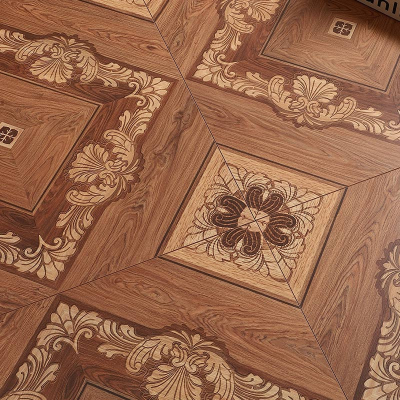
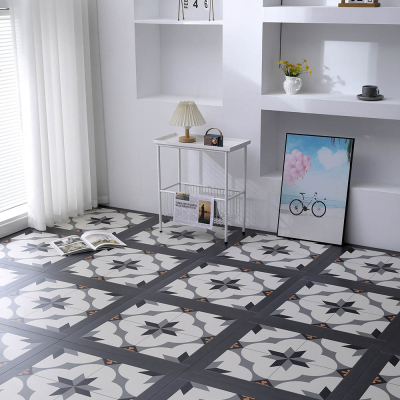
The product is available in a range of wood-grain designs, and the designs actually offered are listed with the product. The print resolution, the number of décor repeats and the colour consistency between planks determine how convincing the floor looks across a large area. Batch consistency is controlled through the décor batch: planks from the same batch are produced from the same print and the same embossing tool, and where a project is supplied over several batches the batch records are requested and compared, because registration and colour can vary between batches even when the specification is unchanged.
The available surface finishes are specified together with the texture rather than chosen separately, because the two together produce the appearance of the plank.
8mm Laminate Flooring Structure and Materials
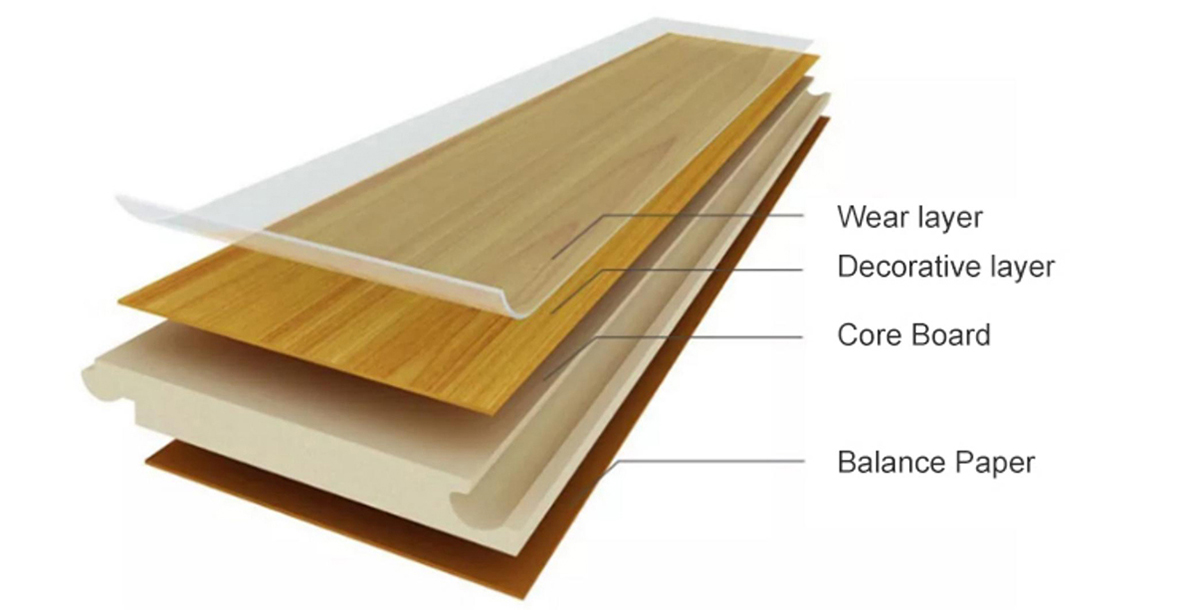
Wear Layer
The wear overlay is the melamine layer that takes the traffic and protects the décor. The abrasion class in the test report describes the wear overlay's performance under the test, and it is separate from the product's fire and water performance. The wear layer and its rating are covered on the laminate flooring wear resistance page.
Decorative Paper
The decorative paper carries the printed wood grain, and its resolution and the number of décor repeats determine how the printed design reads across a floor. The paper is part of the tested construction.
HDF Core
The core is a high-density fiberboard with fire-retardant additives, and it gives the plank its stiffness and flatness. The core specification, the density, the moisture content and the additive system are stated for the product. Density is a property of the core, not of the finished plank, and a higher density does not by itself establish better fire or water performance, because the formulation and the test results are separate properties.
Balance Layer
The balancing layer stabilizes the panel and helps keep it flat, and its specification is part of the product documentation.
Click Locking System
The locking system is milled into the core, and the profile type for this product is stated in the specification. Where the profile is supplied under a licensed design, the licence and the product it covers are stated; where it is an in-house profile, it is described as such rather than by another system's name.
Abrasion Resistance and Moisture Performance
The abrasion class for this product is stated in its test report, and the AC rating describes the wear surface rather than the fire or water performance. Where AC5 is requested, it is offered only if a production configuration for AC5 exists; otherwise the product is supplied in AC4 and the quotation states it. The classes and the test method are explained on the AC4 laminate flooring page.
The product is not a waterproof floor. The HDF core is wood-based and takes up water when water reaches it, and the core and the edges are treated to reduce the rate of uptake under short-term exposure. The moisture swelling figure is published only with the test method, the specimen size, the immersion time and the water temperature, the thickness before and after the test, and the report number and the testing laboratory, and it is stated whether the figure is a measured result or an internal control target. It describes the core's behaviour under that test and does not state how long a floor can resist standing water. Bathrooms with a shower, balconies and any area with standing water are outside the product's intended use.
Applications
The product is used in residential developments, retail interiors, office interiors, hospitality projects and commercial renovation projects, where a wood appearance and a documented fire performance are wanted and the subfloor can be prepared to the installation tolerance.
Where the project is a public building, a school, a hospital or another space with a specific fire requirement, the product's classification and test documentation are reviewed against the project's fire strategy and the local building regulations. The project's compliance depends on the whole construction, not only on the plank's classification, and the product is not promoted as suitable for a given building type without that review. An out-of-tolerance subfloor can stress the locking system whatever the plank thickness.
Underfloor heating compatibility depends on the product's thermal resistance, the subfloor and the heating system, and on the ramp-up procedure the system requires; the permitted surface temperature, the thermal resistance and the installation conditions are confirmed from the product's installation instructions and from the heating system's requirements rather than from a single temperature figure.
Customization and Wholesale Supply
The following items are confirmed for this specific order and stated in writing in the quotation. They are quoted per order rather than published as fixed terms, because the configuration, the order size and the destination market change the answer.
Colors and patterns actually available for the 8mm product.
Plank dimensions and tolerances for the order.
Abrasion class configuration actually supplied, and whether an AC5 configuration is available for the order.
Fire test documentation held for this thickness and this construction.
Packaging details, including pieces per carton and pallet arrangement.
MOQ for standard and customized designs.
Sample availability and the terms that apply.
Customization options, including sizes, textures and private-label supply.
Production lead time for the order size and configuration.
Warranty scope and duration, including commercial use.
Frequently Asked Questions
1. What is 8mm EIR laminate flooring?
It is a laminate floor with an 8mm HDF core, a printed wood-grain décor and a surface texture pressed in register with the print. The EIR effect is the alignment between the print and the texture; it does not by itself change the product's fire, wear or water performance.
2. What does EIR mean in laminate flooring?
EIR stands for embossed-in-register, meaning the pressed texture is positioned to follow the printed grain. The technology is explained on the EIR flooring page.
3. Does this laminate flooring have a Bfl-s1 fire rating?
The fire classification for this product is stated from its own test report, and it applies to the product as tested, at the thickness and in the mounting arrangement the report covers. A fire-retardant core does not by itself establish a classification, a report for another thickness does not automatically cover this one, and the classification is not quoted where a report for this exact product is not held.
4. What is the difference between fire-resistant and fireproof flooring?
"Fire-resistant" describes a product that has some resistance to fire, and "fire-rated" describes a product that has been tested and classified to a stated standard. "Fireproof" is often used loosely and can be read as meaning the floor will not burn at all, which is not what a flooring classification states.
5. Is 8mm laminate flooring suitable for commercial projects?
It can be, where the abrasion class, the joint performance, the fire documentation and the warranty terms match the project requirements, and where the subfloor is prepared to the installation tolerance. Suitability is confirmed from the test data for the product rather than from the thickness alone.
6. What AC ratings are available?
The abrasion class for this product is stated in its test report, and the AC rating describes the wear surface rather than the fire or water performance. AC5 is offered only where a production configuration for AC5 exists; otherwise the product is supplied in AC4 and the quotation states it. The classes are explained on the AC4 laminate flooring page.
7. Can the color and texture be customized?
Customization depends on the design and the order size, and the options available are confirmed in the quotation. The décor and the embossing tool have to be matched, so a custom design requires its own tooling.
8. Can it be installed over underfloor heating?
Compatibility depends on the product's thermal resistance, the subfloor, the heating system and the ramp-up procedure, and the permitted surface temperature is confirmed from the product's installation instructions and the heating system's requirements. A single temperature figure is not a substitute for those limits.


 |  |  |