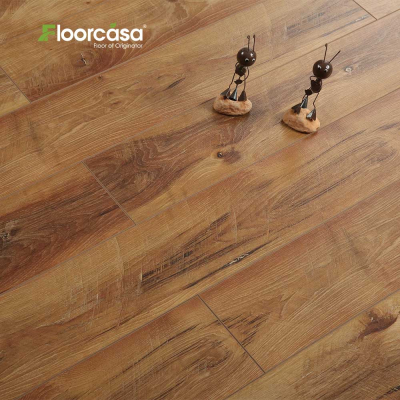
Water-Resistant Laminate Flooring Guide
Product Definition
Water-resistant laminate flooring is an engineered multi-layer flooring product designed to withstand moisture exposure through a sealed locking system, reinforced core technology, and enhanced surface coating suitable for residential and commercial spaces.
Technical Parameters & Specifications
Core Type: High-Density Fiberboard (HDF), moisture-treated
Density: 880–950 kg/m³ (EN 323)
Thickness Options: 7 mm / 8 mm / 10 mm / 12 mm
Wear Rating: AC3 / AC4 / AC5 (EN 13329)
Edge Protection: Waxed or hydrophobic sealed locking
Surface Coating: Melamine resin with anti-swelling additives
Water-Resistance Duration: 48–72 hours (varies by system)
Swelling Rate: ≤ 8% (EN 13329 requirement ≤18%)
Plank Size: 1215 × 195 mm / 1380 × 193 mm
Thermal Resistance: 0.06–0.09 m²K/W (underfloor heating compatible)
Slip Resistance: R9–R10
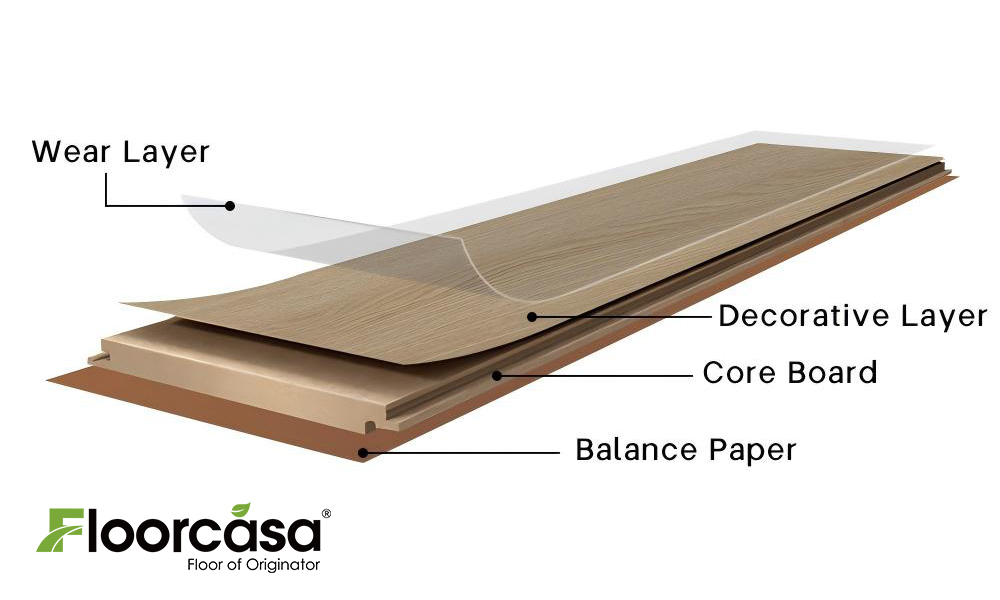
Structure & Material Composition
Wear Layer: Melamine protective surface resisting abrasion and stains
Décor Film: High-definition printed wood texture
HDF Core: Moisture-resistant engineered fiberboard
Balancing Layer: Stabilizing melamine layer preventing warping
Edge Sealing: Hydrophobic wax or polymer sealant for water blocking
Manufacturing Process
Fiber Preparation: Wood fibers dried to 5–7% moisture and mixed with resin.
HDF Board Pressing: High-pressure continuous press forms dense core panels.
Décor Layer Lamination: Wear layer and décor film bonded using heat and pressure.
Cooling & Conditioning: Boards stabilized for 24–48 hours to maintain flatness.
Profiling: CNC machining creates precision locking systems with ±0.02 mm tolerance.
Edge Sealing: Wax or hydrophobic polymer applied to locking surfaces.
Surface Treatment: Final wear coating reinforced for moisture and abrasion.
Quality Control: Swell rate, locking strength, abrasion, and dimensional tests.
Industry Comparison
| Material | Water Resistance | Swell Rate | Durability | Installation |
|---|---|---|---|---|
| Water-Resistant Laminate Flooring | Medium–High | ≤ 8% | AC3–AC5 | Easy |
| SPC Flooring | 100% Waterproof | 0% | High | Easy |
| Engineered Wood | Low | 10–15% | High | Moderate |
| Standard Laminate | Low | 12–18% | Medium | Easy |
Application Scenarios
Distributors expanding moisture-resistant flooring lines
EPC contractors requiring cost-effective water-resistant solutions
Commercial renovation projects: retail, small offices, educational spaces
Residential installations: living rooms, hallways, bedrooms
Light-moisture areas: kitchens, foyers, condo units
Real estate developers seeking stable and scalable flooring supply
Core Pain Points & Solutions
Edge Swelling: Hydrophobic sealing reduces water penetration in joints.
Surface Abrasion: AC4–AC5 wear layers improve commercial durability.
Core Instability: Moisture-treated HDF enhances dimensional stability.
Locking Failure: CNC profiling ensures precise fit even under expansion pressure.
Risk Warnings & Mitigation
Avoid standing water for > 72 hours; wipe spills promptly.
Subfloor moisture must be ≤ 2.0% CM; use moisture barrier if required.
Leave expansion gaps of 10–12 mm around perimeter.
Do not install in bathrooms, saunas, or continuously wet areas.
Use approved underlay for underfloor heating compatibility.
Procurement & Selection Guide
Confirm AC rating based on traffic level (AC4–AC5 for commercial).
Check swell rate certification (≤ 8% preferred).
Inspect HDF density and moisture-resistant treatment.
Evaluate locking system strength and hydrophobic sealing.
Request test reports for EN 13329, dimensional stability, and abrasion.
Verify décor film clarity and surface texture (EIR optional).
Assess supplier’s annual production capacity for project reliability.
Engineering Case Example
An EPC contractor selected water-resistant laminate flooring for a 5,800 m² commercial training center renovation. The project utilized 12 mm AC5 laminate with sealed locking edges. Installation speed reached 200–230 m²/day due to the stable locking system. Swell-rate tests conducted on-site confirmed ≤7% after 24-hour water spill exposure, enabling long-term performance under high foot traffic and occasional moisture.
FAQ
Is water-resistant laminate waterproof? No, but it withstands short-term moisture better than standard laminate.
Can it be used in kitchens? Yes, with proper installation and sealed edges.
How long can it resist water? Typically 48–72 hours depending on product grade.
Is it suitable for commercial spaces? Yes, especially AC4–AC5 models.
Can it be installed over tiles? Yes, if the subfloor is level.
Does it support underfloor heating? Compatible with most systems.
Will the edges swell? Minimal swelling with hydrophobic protection, but not zero.
How long does it last? 12–20 years depending on wear rating.
Can I replace individual planks? Yes, using standard laminate repair methods.
Does sunlight affect it? Slight fading possible; UV protection recommended.
Request Quotation / Technical Documents / Engineering Samples
Provide your project specifications, required square meterage, AC rating, and delivery terms to receive formal pricing, technical data sheets, and engineering-grade samples.
E-E-A-T Author Credentials
Written by a flooring manufacturing consultant with 12 years of experience in HDF processing, EN 13329 certification, moisture-resistant laminate design, and procurement support for large-scale EPC and developer projects across Europe and Southeast Asia.