Waterproof Laminate vs SPC Flooring: Real Performance Comparison
For global distributors, importers, and project contractors, selecting the right flooring material is no longer a simple price-driven decision. Performance, lifecycle cost, installation efficiency, and environmental adaptability now play decisive roles in procurement.
The debate around Waterproof Laminate vs SPC Flooring: Real Performance Comparison has become especially relevant in recent years. While waterproof laminate has improved significantly with enhanced core treatments, SPC (Stone Plastic Composite) flooring continues to gain strong traction in commercial and large-scale engineering projects due to its structural stability and moisture resistance.
This article provides a data-driven, technical comparison tailored for B2B buyers, with a particular focus on why SPC flooring is increasingly becoming the preferred choice in demanding environments.
What is Waterproof Laminate vs SPC Flooring: Real Performance Comparison
The comparison between waterproof laminate and SPC flooring centers on core composition, dimensional stability, and environmental tolerance.
· Waterproof Laminate Flooring:
A high-density fiberboard (HDF) core with surface waterproof coatings and edge sealing technology. Designed to resist spills but still sensitive to prolonged moisture exposure.
· SPC Flooring (Stone Plastic Composite):
A rigid core flooring made from limestone powder (CaCO₃), PVC, and stabilizers. Fully waterproof, dimensionally stable, and highly resistant to temperature fluctuations.
In real-world performance, the distinction lies in material science:
SPC is inherently waterproof, while laminate is engineered to resist water.
Key Technical Specifications
Below is a technical comparison relevant for procurement evaluation:
Specification | Waterproof Laminate | SPC Flooring |
Core Material | HDF (Wood-based) | Stone-plastic composite (rigid) |
Water Resistance | Surface-level (limited time) | 100% waterproof |
Thickness Range | 8–12 mm | 3.5–6.5 mm |
Wear Layer | Melamine overlay | PVC wear layer (0.3–0.7 mm) |
Dimensional Stability | Moderate | Excellent |
Thermal Expansion | High | Very low |
Installation | Click-lock | Click-lock / loose lay |
Underfloor Heating | Limited compatibility | Highly compatible |
Impact Resistance | Moderate | High |
Lifespan (Commercial) | 5–10 years | 10–20 years |
Insight:
From a lifecycle perspective, SPC delivers lower replacement frequency, making it more cost-effective in high-traffic projects.
Main Cost Factors or Performance Factors
When evaluating Waterproof Laminate vs SPC Flooring: Real Performance Comparison, buyers should consider not just unit price but total installed cost.
1. Material Cost
· Laminate: Lower initial cost
· SPC: Slightly higher upfront, but more stable pricing due to mineral-based composition
2. Installation Cost
· SPC reduces subfloor preparation requirements
· Laminate often requires stricter flatness and moisture control
3. Maintenance Cost
· SPC: Minimal maintenance, no swelling risk
· Laminate: Potential replacement in moisture-exposed zones
4. Failure Risk Cost
· Laminate swelling = full board replacement
· SPC deformation risk = extremely low
Conclusion:
SPC offers better cost predictability, which is critical for contractors managing large-scale bids.
Product Structure or Core Technology
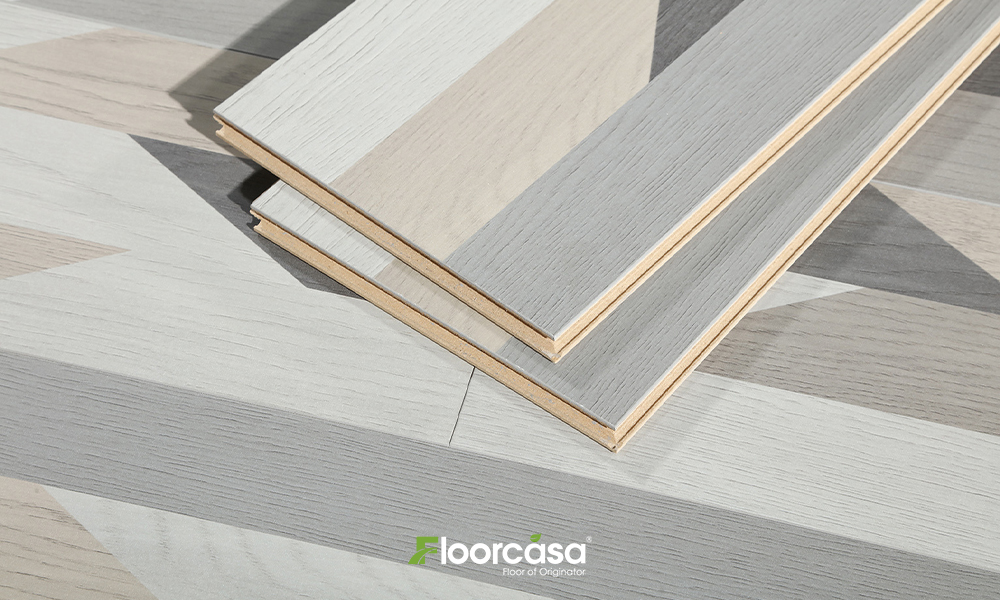
Waterproof Laminate Structure
1. Wear layer (melamine)
2. Decorative paper
3. HDF core
4. Balancing layer
SPC Flooring Structure
1. UV coating
2. Wear layer (PVC)
3. Printed film layer
4. SPC rigid core
5. IXPE/EVA underlayment (optional)
Key Advantage of SPC:
· No organic material → no swelling
· Rigid core → prevents telegraphing of subfloor imperfections
Manufacturing Process Overview
Waterproof Laminate
· Wood fiber processing → HDF pressing
· Decorative layer impregnation
· High-pressure lamination
· Edge sealing treatment
SPC Flooring
· Raw material mixing (PVC + CaCO₃)
· High-temperature extrusion
· Calendering and layer bonding
· UV coating and cutting
Industry Insight:
SPC production lines are highly automated, ensuring consistent thickness tolerance and density control—critical for export-quality flooring.
Industry Comparison
Beyond laminate, buyers often compare SPC with:
Product Type | Strengths | Limitations |
WPC Flooring | Softer, quieter | Less rigid, higher cost |
LVT Flooring | Flexible, cost-effective | Lower indentation resistance |
Ceramic Tiles | Durable, waterproof | High installation cost |
Engineered Wood | Natural appearance | Moisture-sensitive |
SPC Positioning:
A balance of durability, cost-efficiency, and installation simplicity, making it ideal for B2B bulk procurement.
Application Scenarios
SPC Flooring (Recommended)
· Commercial buildings (offices, malls)
· Hotels and hospitality projects
· Healthcare facilities
· Education institutions
· High-humidity regions (Southeast Asia, Middle East)
Waterproof Laminate
· Residential bedrooms
· Light-traffic areas
· Dry indoor environments
Practical Insight:
Many contractors now specify SPC as a standard material for mixed-use developments to avoid project risk.
Common Buyer Concerns
1. Is SPC environmentally safe?
Yes. High-quality SPC complies with E0/E1 formaldehyde standards and can meet FloorScore certification.
2. Will SPC feel too hard underfoot?
Compared to WPC, yes—but adding IXPE backing improves comfort.
3. Can laminate truly be waterproof?
It is water-resistant, not fully waterproof. Prolonged exposure still causes core swelling.
4. Is SPC suitable for cold climates?
Yes. It maintains dimensional stability even under temperature fluctuations.
Procurement and Selection Guide
When selecting between laminate and SPC, consider:
1. Project Type
· Commercial → SPC
· Residential (low moisture) → Laminate optional
2. Climate Conditions
· Humid / coastal → SPC mandatory
· Dry → Both acceptable
3. Budget Strategy
· Short-term projects → Laminate
· Long-term ROI → SPC
4. Technical Parameters to Check
· Wear layer thickness (≥0.5 mm for commercial)
· Click system strength
· Core density
· Fire rating (B1 recommended)
Pro Tip:
Always request third-party test reports (SGS, Intertek) before bulk purchasing.
Case Study or Example
Project: Southeast Asia Commercial Complex
Area: 18,000 m²
Initial Plan: Waterproof laminate
Final Choice: SPC flooring (5.0 mm, 0.5 mm wear layer)
Results:
· Installation time reduced by 20%
· Zero swelling issues after 2 years
· Maintenance cost reduced by 35%
· Client satisfaction improved due to durability
Conclusion:
SPC provided higher long-term value despite slightly higher upfront cost.
FAQ
1. Is SPC better than waterproof laminate?
For commercial and moisture-prone environments, yes—due to full waterproof capability.
2. How long does SPC flooring last?
Typically 10–20 years in commercial settings.
3. Can SPC be installed over uneven floors?
Minor imperfections are acceptable due to rigid core structure.
4. Does SPC require expansion gaps?
Minimal compared to laminate.
5. Is laminate cheaper than SPC?
Yes initially, but may incur higher replacement costs.
6. What thickness is best for SPC?
4–5 mm for residential, 5–6 mm for commercial.
7. Can SPC be used with underfloor heating?
Yes, it performs better than laminate in thermal stability.
8. Is SPC slippery?
No, wear layers are designed for slip resistance (R9–R10).
9. What certifications should buyers request?
CE, FloorScore, ISO9001, SGS test reports.
10. How to ensure consistent quality in bulk orders?
Audit factory production lines and request pre-shipment inspection.