Types of Rigid Core Flooring
Product Definition
Types of rigid core flooring refer to engineered resilient flooring systems built with a high-density composite core that enhances dimensional stability, water resistance, and indentation performance. Common categories include SPC (Stone Plastic Composite), WPC (Wood Plastic Composite), and hybrid polymer cores, primarily used in commercial and residential construction.
Technical Parameters and Specifications
Understanding the technical specifications of different types of rigid core flooring is essential for procurement managers and EPC contractors.
Total Thickness: 4.0 mm – 8.5 mm
Wear Layer Thickness: 0.2 mm – 0.7 mm (commercial grade ≥0.5 mm)
Core Density (SPC): 1900–2100 kg/m³
Core Density (WPC): 900–1200 kg/m³
Click System: Unilin / Valinge 2G / 5G profiles
Formaldehyde Emission: E0 / CARB Phase II compliant
Fire Rating: Bfl-s1 (EN 13501-1 typical)
Impact Resistance: ≥1600 mm (EN 13329 reference)
Dimensional Stability: ≤0.1%
Underlayment: IXPE or EVA (1–1.5 mm optional)
Specifications vary across the main types of rigid core flooring, especially in density and acoustic performance.
Structure and Material Composition
The structural design determines the performance differences among various types of rigid core flooring.
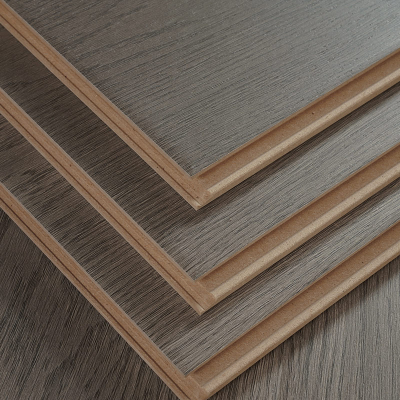
Typical Layer Structure (SPC Example)
UV Coating: Scratch and stain resistance
Wear Layer: Transparent PVC protective layer
Decor Film: High-resolution printed design layer
Rigid Core: Limestone powder + PVC stabilizers
Balance Layer: Stabilizing backing
Optional IXPE Pad: Acoustic reduction
Core Composition Differences
SPC: 60–70% calcium carbonate, high rigidity
WPC: Foamed PVC + wood/plastic composite agents
Hybrid Polymer Core: Advanced polymer blends without limestone
The structural variation explains why different types of rigid core flooring perform differently under load and temperature changes.
Manufacturing Process
The manufacturing of various types of rigid core flooring follows an engineered multi-step extrusion and lamination system.
Production Steps
Raw material mixing (PVC resin, stabilizers, CaCO₃)
High-temperature twin-screw extrusion
Calendering and hot pressing
UV coating line processing
Cooling and dimensional stabilization
CNC slotting for click profile
Online quality inspection (thickness, density, locking precision)
Equipment Used
Twin-screw extruder (≥92 mm screw diameter)
Four-roll calender system
UV curing line
Automatic profiling machines
Process control is critical to ensure consistent quality across all types of rigid core flooring.
Industry Comparison
| Parameter | SPC | WPC | LVT | Laminate |
|---|---|---|---|---|
| Core Type | Stone composite | Foamed composite | Flexible PVC | HDF board |
| Water Resistance | Excellent | Excellent | High | Moderate |
| Indentation Resistance | High | Medium | Low | Medium |
| Acoustic Comfort | Moderate | High | Moderate | Low |
| Thermal Stability | High | Moderate | Moderate | Low |
This comparison clarifies how the different types of rigid core flooring compete against traditional materials.
Application Scenarios
The selection of types of rigid core flooring depends on project requirements.
Distributors: Residential renovation and retail chains
EPC Contractors: Hotels, offices, schools
Developers: Multi-family housing
Importers: Mid-range commercial flooring markets
SPC is commonly used in high-traffic commercial areas, while WPC may suit hospitality projects requiring acoustic comfort.
Core Pain Points and Solutions
1. Indentation Under Heavy Load
Solution: Select SPC with ≥0.5 mm wear layer and density ≥2000 kg/m³.
2. Expansion in High Temperature
Solution: Ensure expansion gaps of 5–8 mm per 100 m².
3. Click Lock Failure
Solution: Use certified locking systems and conduct on-site flatness checks.
4. Acoustic Performance Concerns
Solution: Specify IXPE backing ≥1 mm thickness.
Risk Warnings and Mitigation
Avoid installation on uneven subfloors (>2 mm deviation per 2 m).
Do not expose to direct sunlight without expansion allowance.
Verify fire rating for commercial compliance.
Check moisture content of concrete (<3%).
Procurement Selection Guide
Define traffic classification (AC4/AC5 equivalent).
Confirm required fire and emission certifications.
Assess project climate conditions.
Specify wear layer thickness ≥0.5 mm for commercial use.
Request density test reports.
Evaluate click system patent or license documentation.
Review acoustic requirements.
A structured procurement approach ensures correct selection among types of rigid core flooring.
Engineering Case Study
Project: 18,000 m² commercial office building
Location: Southeast Asia
Requirement: High traffic resistance, moisture stability
SPC rigid core flooring (5.0 mm thickness, 0.5 mm wear layer) was selected. After 24 months of operation, no significant expansion or locking failure was recorded. Acoustic backing reduced impact sound by 17 dB, meeting project compliance standards.
FAQ
Q: Which core is most dimensionally stable?
A: SPC offers the highest density stability.Q: Is rigid core flooring waterproof?
A: The core resists water, but joints must be installed correctly.Q: Suitable for underfloor heating?
A: Yes, surface temperature ≤27°C.Q: Commercial lifespan?
A: 10–20 years depending on wear layer.Q: Glue-down required?
A: Typically floating installation.Q: Maximum plank size?
A: Usually 1220–1830 mm length.Q: Fire rating standards?
A: EN 13501-1 Bfl-s1 typical.Q: Slip resistance?
A: R9–R10 range.Q: VOC emission level?
A: E0 compliant products available.Q: Export packaging options?
A: Carton + palletized export packaging.
Request Technical Support or Quotation
For detailed specifications, engineering samples, certification documents, or project quotations related to types of rigid core flooring, please submit your project drawings, required thickness, wear layer grade, and estimated volume. Technical teams will respond with structured documentation suitable for tender submission.
Author & Industry Expertise (E-E-A-T)
This article was prepared by a flooring engineering consultant with over 12 years of experience in resilient flooring manufacturing, international procurement support, and commercial project specification drafting. Technical data referenced reflects commonly accepted industry standards and engineering practices.