SPC vs. LVP: Decoding the Superior Rigid Core Flooring for Global Markets
Introduction: Navigating the Core Decision in Resilient Flooring
In the dynamic world of modern flooring, the debate between SPC Flooring (Stone Plastic Composite) and LVP (Luxury Vinyl Plank) is pivotal for architects, contractors, and B2B buyers worldwide. The question, "What is better, SPC or LVP?" is not merely about preference but a strategic decision impacting project longevity, performance, and total cost of ownership. While both fall under the resilient flooring category and offer convincing wood or stone aesthetics, their core differences define their ideal applications. This analysis cuts through the marketing to provide a data-driven comparison, highlighting why SPC rigid core flooring has become the dominant choice for demanding global commercial and residential projects.
Part 1: Market Landscape and the Rise of Rigid Core Flooring
The global shift towards waterproof, durable, and easy-to-install flooring has fueled explosive growth in the resilient sector. The luxury vinyl tile flooring market, encompassing both LVP and SPC, is projected to grow significantly, driven by renovation activities and new construction in both residential and commercial spaces.
Regional Demand: North America and Europe remain mature markets with high adoption rates, particularly for waterproof flooring solutions. The Asia-Pacific region is experiencing the fastest growth, fueled by urbanization and a rising middle class seeking modern, low-maintenance materials.
Trend Drivers: Key trends include the demand for hyper-realistic wood and stone visuals, increased specification of flooring for commercial use in retail and offices, and a strong preference for formaldehyde-free flooring with Greenguard or similar certifications. The market is moving decisively away from materials prone to water damage and towards 100% waterproof solutions.
Part 2: Technical Dissection - Core Differences Between SPC and LVP
The fundamental difference lies in the core layer's composition, which dictates nearly all performance characteristics.
Feature | SPC Flooring (Stone Plastic Composite) | Traditional LVP (Luxury Vinyl Plank) |
Core Composition | Limestone (Calcium Carbonate) powder, PVC, and stabilizers. High mineral content (up to 60-70%). | Primarily PVC plastics with plasticizers for flexibility. Lower density. |
Core Density | Extremely High (Often > 2000 kg/m³). Rock-like density. | Moderate. Softer and more flexible. |
Dimensional Stability | Exceptional. Minimal expansion/contraction with temperature swings. Ideal for large areas and climates with high temperature variance. | Good, but more susceptible to expansion under heat due to higher PVC content. |
Indentation Resistance | Superior. Highly resistant to furniture legs, heels, and heavy objects. | Good, but permanent indentation is possible under extreme, sustained pressure. |
Underfoot Feel | Very solid, rigid. | Softer, more yielding. |
Primary Application | High-traffic residential, commercial waterproof flooring, areas requiring maximum stability. | Residential, light commercial, areas where underfoot comfort is prioritized. |
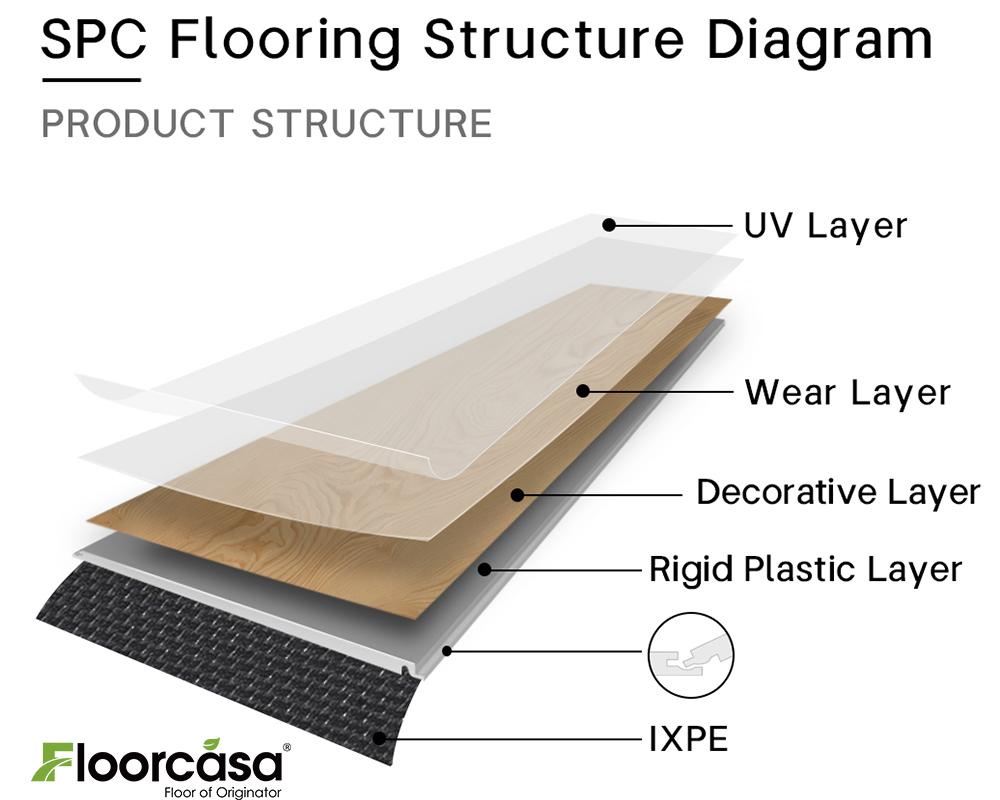
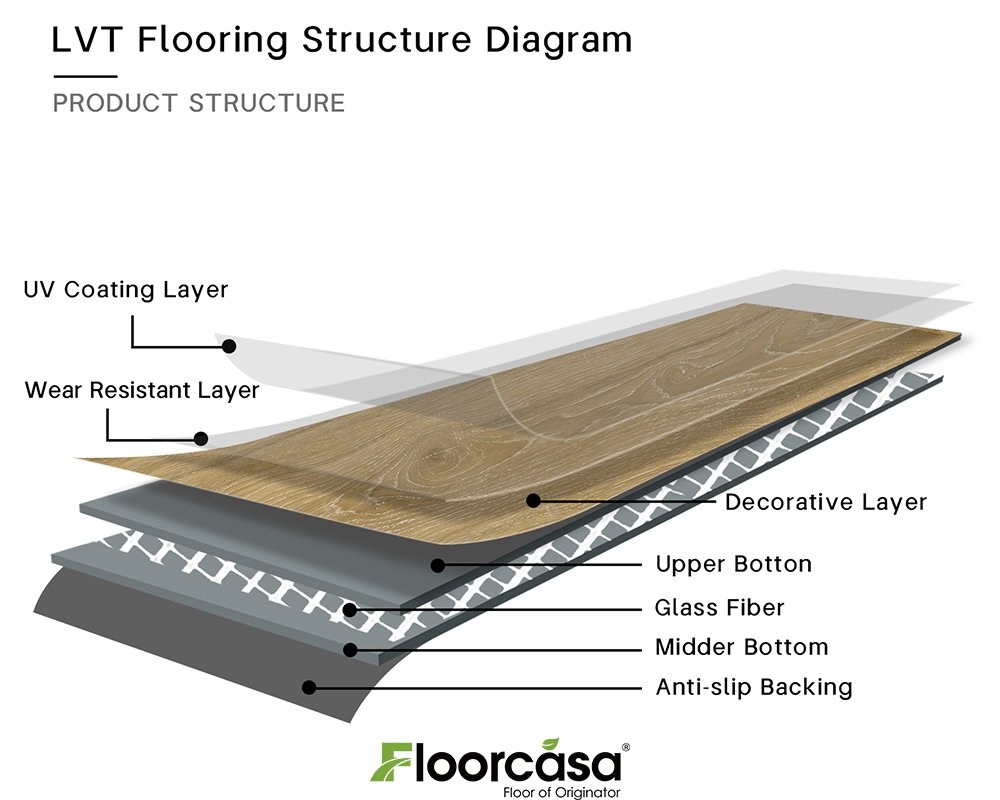
Structural Analysis of SPC Flooring:
A premium SPC vinyl plank is a marvel of engineering:
UV-Cured Wear Layer: A transparent, ultra-durable coating resistant to scratches, stains, and wear. Rated by commercial standards (AC ratings: AC3-AC6).
Realistic Decor Layer: High-resolution photographic film that provides authentic wood or stone aesthetics.
The SPC Rigid Core: The defining layer. The high limestone content makes it completely inert to water, preventing swelling, warping, or mold growth. This core is the source of its superior indentation resistance.
Attached Underlayment: Often pre-fused with an IXPE or cork pad for sound absorption, moisture barrier, and underfoot comfort.
Part 3: Manufacturing Excellence and Quality Assurance
The superiority of SPC Flooring is locked in during manufacturing. The process begins with the precise mixing of fine limestone powder, premium PVC resins, and eco-friendly stabilizers into a dry blend. This blend is then extruded and calendered under high heat and pressure to form a dense, homogeneous slab. The decor film and wear layer are thermally fused to this core in a precise lamination process. Finally, the planks are precision-milled with click-lock installation system profiles, ensuring a tight, seamless fit. Leading manufacturers like Floorcasa employ automated optical inspection systems to ensure every plank meets strict tolerances for thickness, locking integrity, and visual perfection, guaranteeing the dimensional stability promised to buyers.
Part 4: Global Buyer Preferences and Sourcing Intelligence
Informed B2B buyers evaluate suppliers based on a matrix of performance, compliance, and reliability.
Key Procurement Criteria:
Certification Portfolio: Buyers mandate international certifications: CE Marking (EU), FloorScore (IAQ), CARB NAF (formaldehyde), and fire ratings (Class A, EN 13501-1). These are non-negotiable for market access.
Total Cost of Ownership (TCO): Smart buyers look beyond price per square meter. They factor in installation efficiency, long-term durability reducing replacements, and minimal maintenance. SPC's durability offers a lower TCO for demanding applications.
Supply Chain Transparency: Buyers prioritize partners with vertical integration—control over raw materials, production, and logistics—to ensure consistency and on-time delivery for large container orders.
Technical Support & Samples: The ability to provide full-scale samples, detailed technical data sheets (TDS), and installation videos is a mark of a professional supplier.
Common Sourcing Pain Points:
Inconsistent Core Density: Some suppliers use filler to reduce cost, resulting in brittle, low-density planks that fail under stress.
Weak Locking Systems: Poorly engineered locks lead to installation failures, seam separation, and customer complaints.
Visual Inconsistency: Color and texture variation between production batches can derail large projects.
Conclusion: SPC - The Engineered Choice for the Future
The verdict on "What is better, SPC or LVP?" is clear for projects where ultimate durability, stability, and commercial-grade performance are required. While LVP retains a place in certain residential settings, SPC rigid core flooring stands as the technologically advanced successor. Its mineral-based core delivers unmatched resistance to indentation, thermal expansion, and moisture—a trifecta of benefits that align perfectly with the needs of global export markets, commercial fit-outs, and quality-conscious homeowners.
For B2B buyers, the choice extends beyond the product to the partner. A brand like Floorcasa, which invests in advanced SPC formulation, rigorous testing, and supply chain integrity, doesn't just sell flooring; it delivers certified performance and peace of mind.
B2B Buyer FAQ
Q1: Can SPC flooring be installed in bathrooms or basements with potential moisture?
A1: Yes, absolutely. This is a key advantage. SPC Flooring is 100% waterproof throughout its entire thickness, not just on the surface. Its limestone-PVC core is impervious to water, making it ideal for wet areas like full bathrooms, kitchens, and below-grade basements where traditional flooring or even some LVP would be at risk.
Q2: Is SPC flooring suitable for commercial high-traffic areas like retail stores?
A2: Yes, it is an excellent choice. The extreme density of the SPC core provides outstanding indentation resistance against heavy rolling loads and foot traffic. When specified with a commercial-grade wear layer (AC5 or AC6 rating), it meets the demands of retail spaces, offices, and light institutional settings, offering durability that far exceeds traditional LVP.
Q3: How does the installation process for SPC compare to LVP?
A3: Both typically feature a floating, click-lock system, making them DIY-friendly. However, due to its extreme rigidity, SPC flooring requires a perfectly level subfloor. Any significant unevenness can lead to a "bridging" effect where the plank doesn't fully contact the subfloor, potentially causing noise or lock failure. Proper subfloor preparation is critical for SPC. LVP is more forgiving due to its flexibility.
Q4: What are the key certifications we should request when sourcing SPC flooring for the EU or US market?
A4: For the EU: Insist on the Declaration of Performance (DoP) with CE marking under CPR, including fire reaction (e.g., Euroclass Bfl-s1) and slip resistance. For the US: Look for CARB NAF or TSCA Title VI for formaldehyde, and FloorScore for indoor air quality. General certifications like ISO 9001 for quality management are also a good indicator of a reputable factory.
Ready to experience the superior stability and durability of professional-grade SPC flooring?
Contact Floorcasa today to elevate your supply chain. We provide:
Comprehensive technical documentation and international certification packages.
Free, full-size A-grade samples for you to test lock strength, dent resistance, and visual quality.
Competitive, volume-based quotations and dedicated support for container orders.
Request your sample kit and quotation now to see why our SPC rigid core flooring is the smart choice for your market.