Seamless Laminate Flooring: Design, Edges and Installation
What Is Seamless Laminate Flooring?
Seamless laminate flooring is a laminate floor designed so that the joints between planks are as inconspicuous as possible. The floor still has joints: every plank meets the next at an edge, and a floating floor moves as the indoor conditions change. What "seamless" describes is the visual result, not the absence of joints. It is achieved through three things working together: the edge profile of the plank, the precision of the locking system, and the quality of the installation.
The plank itself is a conventional laminate construction: an HDF core, a printed décor layer and a wear overlay, sometimes with an attached backing. Seamless is not a different core; it is a combination of how the edge is cut, how the pattern is printed across the edge and how tightly the locking system holds the planks together. The layer structure of laminate is explained on the laminate flooring guide; this page stays with the edge, the joint and the installation.
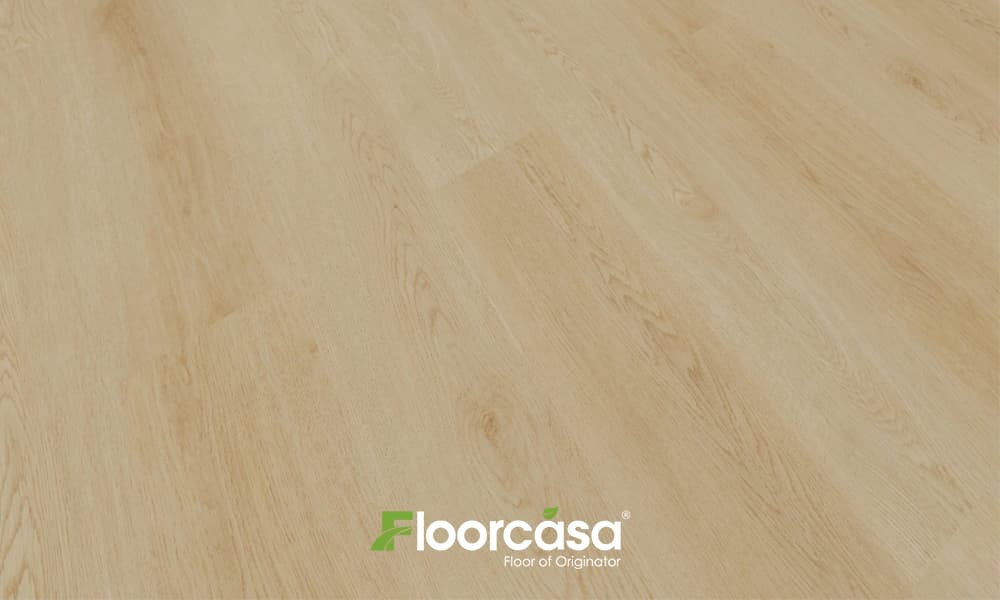
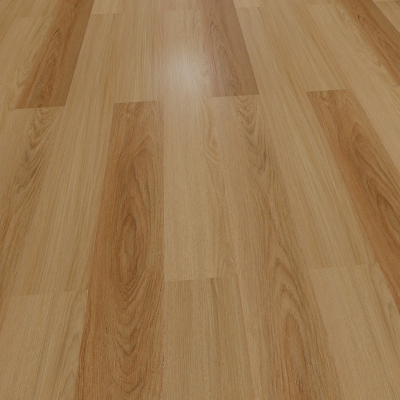
A seamless-look plank usually has a square edge or a very shallow micro-bevel, rather than the deeper V-groove used on some laminate floors to imitate the gap between solid boards. The décor is printed to continue across the joint, and the locking system holds the planks tightly together so that the joint line is thin. The combination gives a continuous surface appearance, which is why the product is chosen for open-plan rooms and commercial spaces where a unified floor is wanted.
How Does Seamless Laminate Flooring Work?
The seamless look depends on the joint being tight, straight and consistent. Three factors decide whether that happens.
The first is the plank itself. The edge profile is milled to a tolerance, and the locking profile is cut to a matching tolerance; if either varies between planks, the joint line will vary with it. The décor print also has to be positioned consistently relative to the edge, so that the pattern continues across the joint rather than stepping.
The second is the subfloor. A floating floor follows the subfloor beneath it, and an uneven subfloor makes the planks sit at slightly different heights, which shows at the joints as a shadow line or a lip. The flatter the subfloor, the more consistent the joint line.
The third is the installation. The planks have to be engaged fully along the joint, the rows have to be straight, and the expansion gap has to be maintained at the perimeter. A joint that is not fully engaged, or a floor laid tight against a wall, will show gaps or open later, and no edge profile can compensate for that. The perimeter gap is normally covered by the skirting or baseboard, so it does not affect the seamless appearance as long as the skirting is fitted correctly and fixed to the wall rather than to the floor.
Laminate Flooring Edge Profiles: Square Edge vs. Beveled Edge
The edge profile is the most visible design decision in a seamless-look floor.
A square edge has no bevel at all: the plank edge is cut at right angles, and when two planks meet, the joint line is a thin, straight line. This gives the most continuous appearance, but it also shows any height difference between planks more clearly, and it places more demand on the subfloor and the installation.
A micro-bevel is a very small chamfer at the edge, usually a fraction of a millimetre. It softens the joint line slightly and hides minor height differences, while still reading as a continuous surface from normal viewing distance. It is the common choice where a seamless look is wanted without the demands of a true square edge.
A beveled edge, or V-groove, is a larger chamfer that is visible as a groove along each plank. It is a design choice that imitates the gap between solid boards, and it is the opposite of a seamless look. Some products combine a bevel with a printed shadow line to emphasise the plank format.
The choice between them is a design decision, but it has a practical consequence: the squarer the edge, the more the finished appearance depends on the subfloor flatness and the installation quality.
What Causes Visible Gaps Between Laminate Flooring Planks?
Gaps between planks have several causes, and they are not all the same problem.
Manufacturing tolerance is one: if the plank length, width or edge profile varies beyond the stated tolerance, the joints will vary with it. This is why the dimensional tolerance should be stated in the specification and checked on a sample.
Locking profile quality is another: a profile that is not precisely milled, or that is damaged during installation, will not hold the planks tightly, and the joint can open under movement or load.
Subfloor flatness matters because a floating floor follows the subfloor: an uneven subfloor changes the height of adjacent planks, and the joint line shows it.
Installation quality matters because a joint that is not fully engaged, or a floor laid without the specified expansion gap, will open. A floor installed tight against a wall has nowhere to move, and the movement appears at the joints instead.
Changes in indoor humidity and temperature cause the floor to move; if the expansion gap is inadequate, that movement shows as gaps or as buckling.
Two further problems are common and are often confused with gaps. Row misalignment happens when a row is not kept straight as the floor is laid, so the short ends of the planks step out of line; it is an installation issue and is visible as a zigzag along the end joints rather than as a gap. Edge lifting, or peaking, happens when the edge of a plank sits higher than its neighbour, usually because the subfloor is uneven, the joint is not fully engaged or the plank has taken up moisture at the edge; it shows as a lip rather than as a gap, but it breaks the continuous appearance in the same way. Both should be corrected at the cause, not covered with filler.
How to Install Laminate Flooring for a Seamless Appearance
The installation method decides whether the design potential of the product is realised. The detailed method, including the subfloor preparation and the expansion gap calculation, is covered on the laminate flooring installation guide; this section gives the points that affect the seamless appearance.
The subfloor should be flat within the tolerance stated for the product, sound and dry, and the flatness should be measured with a straightedge rather than judged by eye.
The planks should be acclimated as the installation instructions require, and the layout should be planned before the first row is laid: the direction of the planks, the width of the first and last rows, and the position of the joints relative to the room and the light. Laying the planks parallel to the main window or the longest wall is a common choice, but the direction should be decided first, because changing it later is not possible.
The planks should be engaged fully along the joint, using the tapping block specified for the locking system, and the rows should be checked for straightness as the work proceeds.
The expansion gap should be maintained at the perimeter and at fixed objects, and the skirting or baseboard should be fixed to the wall, not to the floor.
How to Prevent Gaps and Joint Separation
Gaps and joint separation are prevented by getting the three factors right before the floor is laid.
Check the product: confirm the dimensional tolerance, the edge profile and the locking system type from the specification, and check the joint quality on a sample.
Prepare the subfloor: measure the flatness against the tolerance in the installation instructions, and level where needed.
Install correctly: engage the joints fully, keep the rows straight, maintain the expansion gap and use the specified tools.
Control the indoor conditions: keep the indoor humidity within the range stated for the product, because the floor moves with humidity, and an inadequate expansion gap turns that movement into gaps or buckling.
Where a gap has already appeared, the cause should be identified before any repair: a gap caused by an inadequate expansion gap is handled differently from a gap caused by a damaged locking profile or an uneven subfloor. The repair options and the maintenance requirements are covered on the laminate flooring maintenance guide.
How to Choose Seamless Laminate Flooring
Edge profile: confirm whether the product has a square edge, a micro-bevel or a bevel, and view a sample under the room's lighting, at a low angle along the joint, and compare two planks from the same batch to judge the joint line and any height difference.
Dimensional tolerance: check the stated tolerance on length, width and thickness, and confirm it on a sample.
Locking system: confirm the profile type and check the joint quality on a sample.
Wear layer and abrasion class: confirm from the test report for the product, because the surface performance is separate from the edge design.
Moisture limits: confirm the product's water resistance and its limits in wet areas from the test data and the installation instructions.
Subfloor requirements: confirm the flatness and moisture requirements, because a seamless look depends on them.
Décor and pattern repeat: check how the design continues across the joint, how obvious the repeat is across a large floor, and how the texture depth and the embossing alignment affect the visual continuity, because a deeper texture or a misaligned emboss reads as a break at the joint.
Thickness: confirm the available thicknesses and their selection factors, which are covered on the laminate flooring thickness guide.
The laminate flooring product series pages list the edge profiles, thicknesses and surface options currently offered, and the laminate flooring guide covers the layer structure and the general selection method.
Frequently Asked Questions
1. Is seamless laminate flooring really seamless?
No. Every laminate floor has joints between planks, and a floating floor moves with the indoor conditions. "Seamless" describes the visual result: the joints are made as inconspicuous as possible through the edge profile, the locking system and the installation.
2. Does laminate flooring have visible joints?
It has joints, and how visible they are depends on the edge profile, the locking quality, the subfloor flatness and the installation; the edge profile section above explains how the profiles differ.
3. Is square-edge laminate flooring more seamless?
A square edge gives the most continuous appearance, because there is no bevel to catch the light. It also shows any height difference between planks more clearly, so it places more demand on the subfloor flatness and the installation quality than a micro-bevel does.
4. Why are gaps appearing between laminate flooring planks?
Gaps can come from an inadequate expansion gap, an uneven subfloor, a damaged or poorly milled locking profile, or movement from changes in indoor humidity. Row misalignment and edge lifting are different problems that can look similar; the causes section above explains both.
5. Can laminate flooring joints be repaired?
It depends on the cause. A joint that has opened because the planks were not fully engaged can sometimes be closed, and a plank with a damaged profile is replaced rather than forced. A gap caused by an inadequate expansion gap is corrected at the perimeter, and a gap caused by an uneven subfloor requires the subfloor to be addressed.
6. Does installation direction affect the seamless appearance?
Yes. The direction of the planks affects how the joints read in the room and how the light falls across them. The direction should be planned before the first row is laid, together with the room layout, because it cannot be changed afterwards.