Laminate Hardwood Flooring
Manufacturing Process
The manufacturing of laminate hardwood flooring relies on controlled industrial processes and specialized equipment to ensure consistency and performance.
Wood Fiber Preparation: Softwood and hardwood fibers are refined, dried, and graded
HDF Board Production: Fibers are bonded under high pressure and temperature
Decor Paper Printing: Hardwood visuals printed using gravure or digital printing systems
Overlay Impregnation: Wear layer treated with melamine resins
Hot Press Lamination: Multi-layer assembly pressed in short-cycle or continuous presses
Cooling and Conditioning: Boards stabilized to relieve internal stress
Profiling: CNC milling of tongue-and-groove or click-lock edges
Quality Control: Abrasion, impact, dimensional, and emission testing
What Is Laminate Hardwood Flooring?
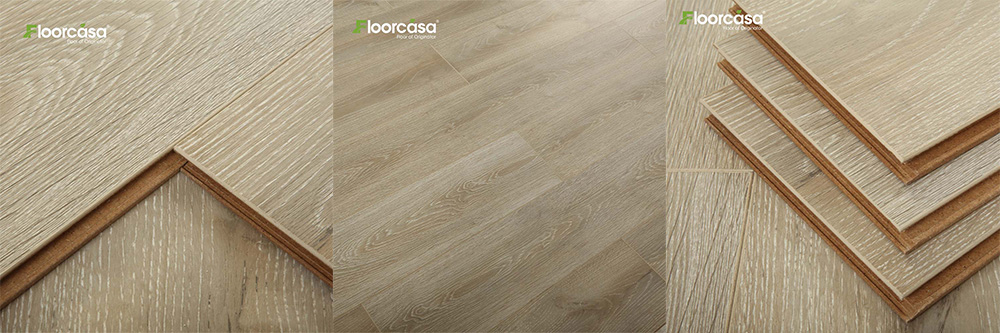
Laminate hardwood flooring is an engineered flooring system designed to replicate the appearance of natural hardwood. It is not solid wood—it is a multi-layer composite product with a printed wood décor, a high-density fiberboard (HDF) core, and a wear layer.
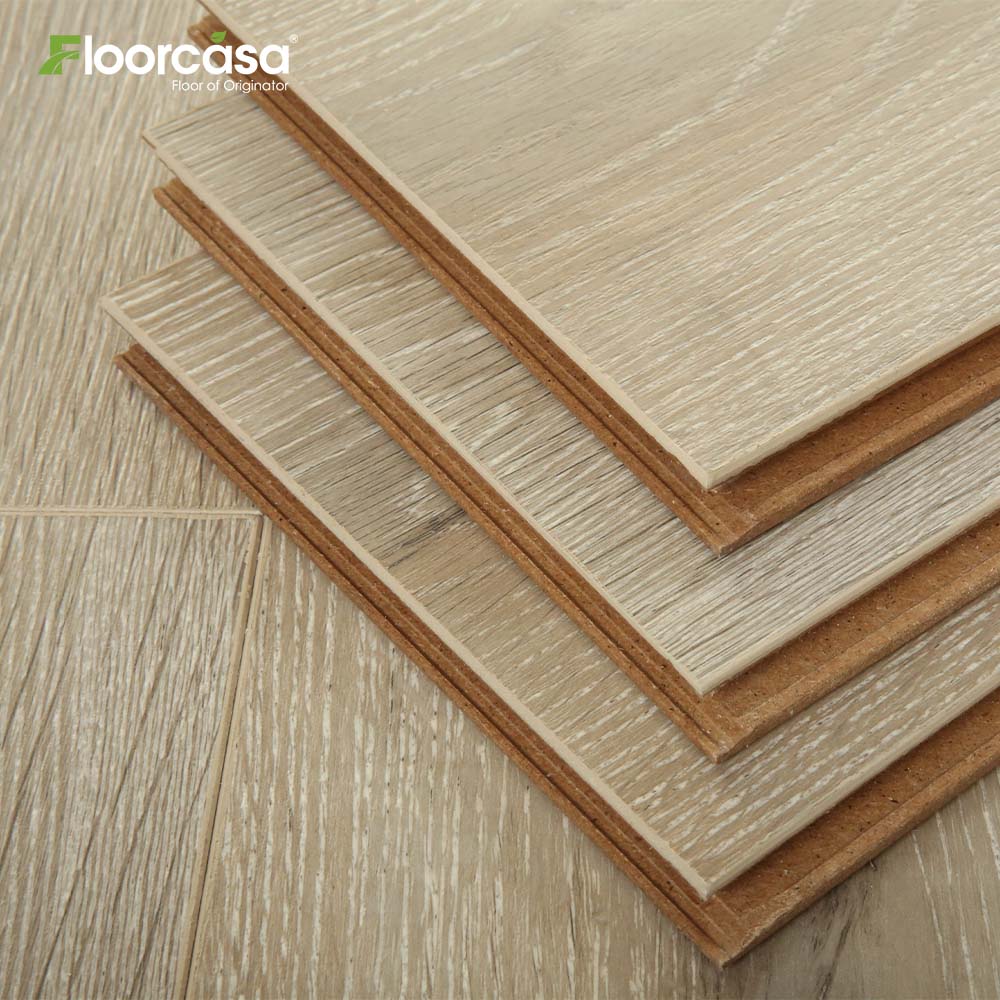
The product is built from several layers bonded together under heat and pressure. The decorative layer is printed with a hardwood grain pattern—oak, walnut, maple, or other species. The wear layer protects the surface from abrasion. The HDF core provides structural stability, load-bearing strength, and the material into which the locking profile is machined. The balancing layer prevents warping.
Most laminate hardwood flooring uses a click-lock system, which allows the panels to be connected without adhesive. This is called a floating installation.
Laminate hardwood flooring is suitable for residential and commercial projects where a wood appearance, durability, and cost control are required. It is generally less expensive than engineered hardwood or solid hardwood, and it provides a more consistent appearance across boards and batches. It is not suitable for wet areas such as bathrooms, kitchens, or basements, because the HDF core is moisture-sensitive.
For surface technology options, including standard embossed, EIR, and matte finishes, see the surface and design options section below. For EIR-specific products, see the EIR laminate flooring page.
Laminate Hardwood Flooring Specifications
Laminate hardwood flooring is produced in compliance with international performance standards. The following table provides typical values.
| Parameter | Typical Value Range | Standard Reference |
|---|---|---|
| Total Thickness | 7 mm / 8 mm / 10 mm / 12 mm | EN 13329 |
| Core Density | 820–900 kg/m³ | EN 323 |
| Abrasion Resistance | AC3–AC5 | EN 13329 |
| Surface Overlay | Melamine + Aluminum Oxide | ISO 10545 |
| Surface Options | Standard Embossed / EIR / Matte | Internal QC |
| Formaldehyde Emission | E1 / ≤ 0.124 mg/m³ | EN 717-1 |
| Thickness Swelling (24h) | ≤ 18% (lower values indicate better moisture resistance) | EN 13329 |
| Fire Classification | Cfl-s1 | EN 13501-1 |
Contact us for the complete technical datasheet, test reports, and OEM specifications. Technical values vary by production specification, and the appropriate specification depends on the project requirements. We provide test reports with each shipment.
For EIR surface technology, see the EIR laminate flooring page.
Laminate Hardwood Flooring Structure
Laminate hardwood flooring is built using a layered engineering concept to balance visual authenticity with mechanical performance. Each layer performs a specific function.
Wear Layer
A transparent melamine overlay reinforced with aluminum oxide for scratch and abrasion resistance. The wear layer protects the decorative layer from surface wear and determines the product's abrasion class (AC3, AC4, AC5). Typical thickness: 0.2–0.5 mm.
Decorative Layer
A high-definition printed hardwood grain pattern. The print resolution and colour accuracy determine the visual realism of the surface. Common décor options include oak, walnut, maple, and other hardwood species. Typical thickness: 0.07–0.10 mm.
HDF Core
A high-density fiberboard core that provides structural strength and load distribution. The core is the material into which the locking profile is machined. Core density typically ranges from 820–900 kg/m³, depending on the product specification. Typical thickness: 7–12 mm.
Balance Layer
A resin-impregnated backing paper applied to the underside of the core. It controls expansion and warping and contributes to dimensional stability. Typical thickness: 0.1–0.2 mm.
Click Locking System
A precision-milled click profile that connects the panels without adhesive. The locking system allows floating installation and determines joint engagement and long-term locking performance.
Layer thickness values are typical ranges. Verify with the manufacturer for the specific product.
Laminate Hardwood Flooring Surface & Design Options
Laminate hardwood flooring is available in a range of surface finishes and designs. Availability depends on the specific product range—contact us for current options.
Standard embossed. A textured surface that provides a wood-like feel. The embossing is not synchronized with the printed grain. Suitable for cost-sensitive projects where surface realism is secondary.
EIR (Embossed in Register). A surface where the embossing is synchronized with the printed grain. This provides higher surface realism and a stronger tactile effect. Suitable for projects where surface realism is a design priority. For EIR-specific products, see the EIR laminate flooring page.
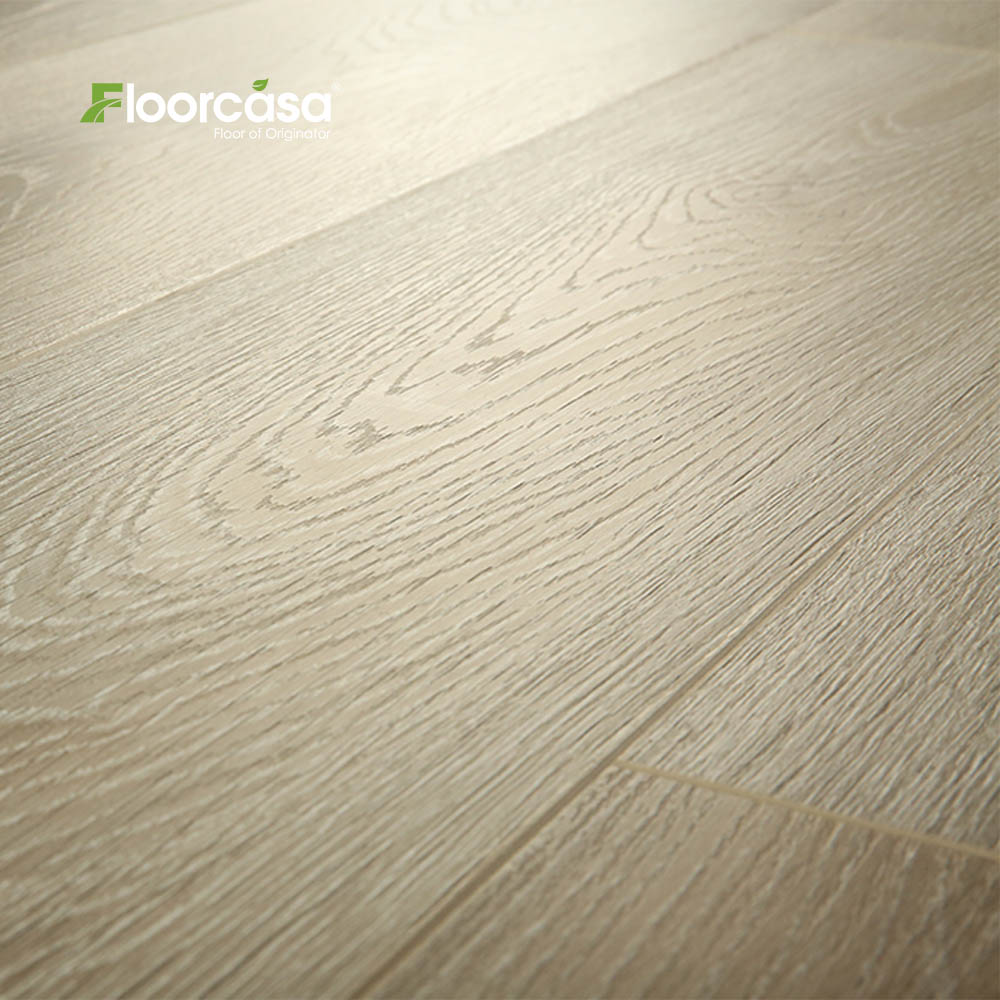
Matte. A low-glare surface that reduces artificial shine and enhances the realism of the wood appearance. Suitable for projects where glare reduction is important.
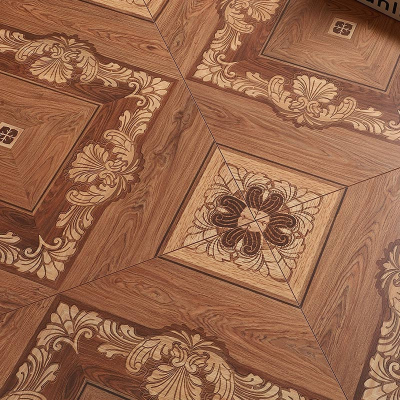
Wood species options. Common décor options include oak, walnut, maple, and other hardwood species. Custom décor is available for OEM/ODM projects.
Plank dimensions. Standard plank dimensions vary by product. Custom plank sizes are available for OEM/ODM projects.
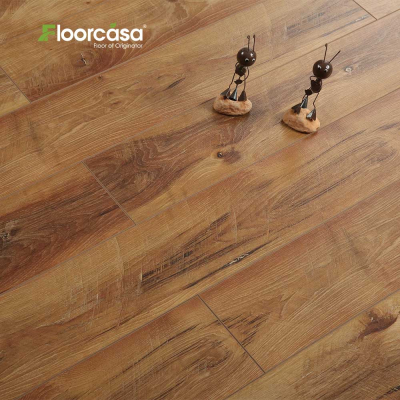
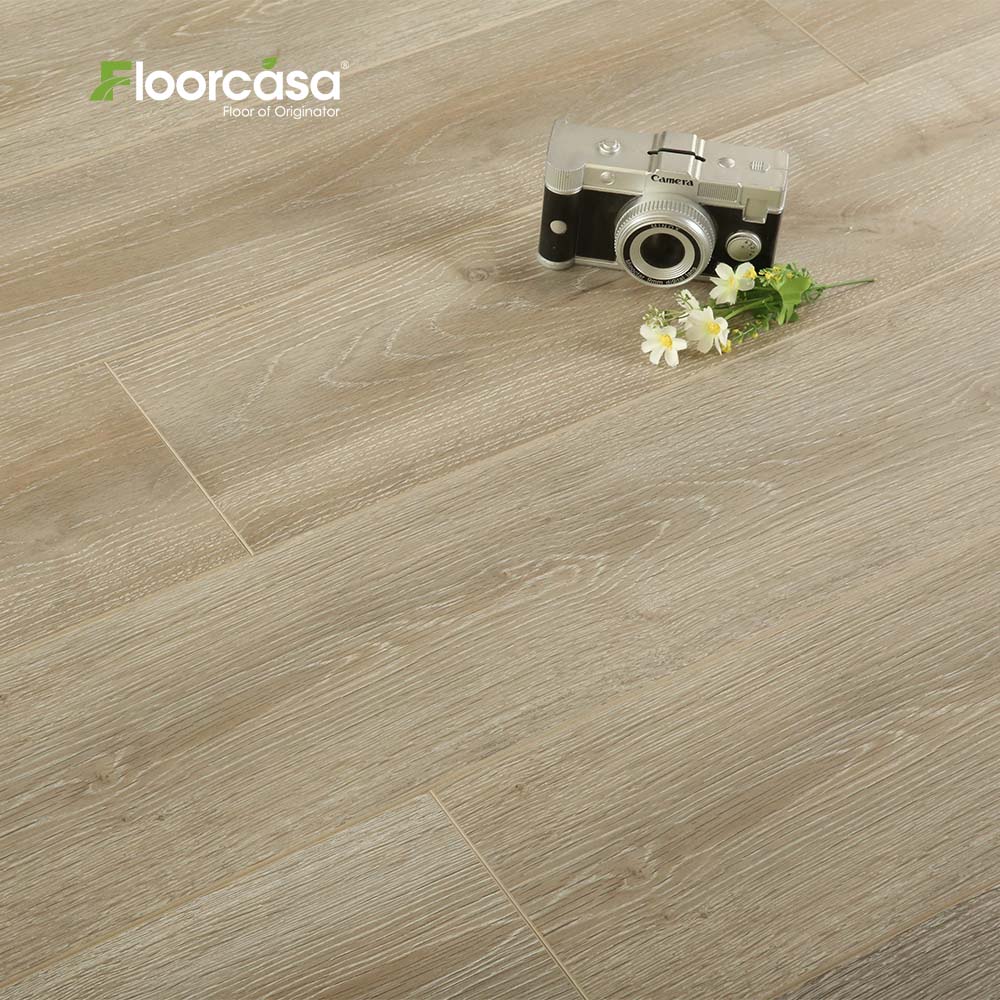
Color options. Available colours depend on the current product range. Common directions include natural oak, medium brown, dark brown, grey, and whitewashed. Request physical samples before specification.
How Laminate Hardwood Flooring Is Manufactured
Wood fibers are processed into HDF, and the decorative paper and wear layers are laminated under controlled pressure and temperature. The panels are then cooled, conditioned, profiled, finished, and inspected.
For the complete laminate flooring manufacturing process, see the laminate flooring manufacturing page. For EIR-specific manufacturing steps, see the EIR laminate flooring page.
Laminate Hardwood Flooring vs Other Flooring
The following table compares laminate hardwood flooring with engineered hardwood, solid hardwood, and SPC flooring.
| Feature | Laminate Hardwood | Engineered Hardwood | Solid Hardwood | SPC |
|---|---|---|---|---|
| Wood appearance | Printed décor | Real veneer | Natural wood | Printed décor |
| Moisture tolerance | Moderate | Moderate | Lower | Higher |
| Wear resistance | High | Medium | Medium | High |
| Maintenance | Low | Medium | High | Low |
| Cost | Low–Medium | High | Very High | Medium |
| Installation | Click | Various | Various | Click |
Moisture tolerance levels: Moderate = moisture-resistant but not waterproof; Lower = more moisture-sensitive; Higher = waterproof or highly moisture-resistant.
Important note: The appropriate flooring choice depends on the specific project requirements, including traffic level, moisture exposure, acoustic requirements, and budget. Laminate hardwood is not equivalent to solid hardwood in moisture resistance. Verify product test reports before specification.
Where Is Laminate Hardwood Flooring Used?
Laminate hardwood flooring is specified in projects where visual wood effect, durability, and budget control are critical. The following sections explain product selection for each application.
Residential
Application: Living areas, bedrooms, hallways.
Why laminate hardwood works here: Laminate hardwood provides a wood appearance at a lower cost than engineered or solid hardwood, with consistent appearance across rooms. The click-lock system allows fast installation, and routine maintenance is minimal.
Typical specification: 8–10 mm thickness / AC3–AC4.
Commercial
Application: Offices, retail chains, hotels, education facilities.
Why laminate hardwood works here: Laminate hardwood provides a professional wood appearance with wear resistance suitable for commercial traffic. AC4 and AC5 grades provide durability for customer-facing and staff areas.
Typical specification: 10–12 mm thickness / AC4–AC5.
High-Traffic Areas
Application: Corridors, entrances, public areas.
Why laminate hardwood works here: High-traffic areas require maximum abrasion resistance. AC5 laminate hardwood provides the highest level of wear resistance for these areas.
Typical specification: AC5.
Residential Developments
Application: Apartment developments, housing projects.
Why laminate hardwood works here: Laminate hardwood provides a consistent, cost-effective wood appearance for multi-unit developments. The click-lock system allows fast installation across many units, and colour consistency can be controlled through batch production.
Typical specification: 8–10 mm thickness / AC3–AC4.
Mixed-Use Developments
Application: Residential compounds, mixed-use buildings.
Why laminate hardwood works here: Mixed-use developments require a floor that can handle both residential and light commercial traffic. AC4 laminate hardwood provides durability for shared areas and consistent appearance across the development.
Typical specification: 10 mm thickness / AC4.
For specific project recommendations, contact us with your requirements.
Laminate Hardwood Flooring Buying Considerations
The following factors should be considered when specifying laminate hardwood flooring.
Thickness. Total thickness affects rigidity, underfoot feel, and floor height. 7–8 mm is common for residential; 10–12 mm for commercial and premium applications.
AC rating. Abrasion class determines suitability for different traffic levels. AC3 for residential; AC4 for general commercial; AC5 for heavy commercial.
HDF density. Core density affects structural stability, joint strength, and indentation resistance. Higher density is recommended for commercial applications.
Surface finish. Choose standard embossed, EIR, or matte based on the design intent and budget. See the Surface & Design Options section above for details.
Plank dimensions. Plank size affects the visual scale of the floor. Verify the available plank dimensions for the specific product.
Locking system. Verify the locking system type and locking test reports. The precision of the locking profile determines joint engagement and long-term performance.
Moisture performance. Laminate hardwood flooring is moisture-resistant but not waterproof. It is not suitable for wet areas. Laminate hardwood is not equivalent to solid hardwood in moisture resistance. Verify the product's moisture resistance for the intended application.
Emission. Verify the formaldehyde emission class for the target market (E1, E0, ENF, or CARB Phase 2).
Fire rating. Verify the fire rating against local building codes. Cfl-s1 is common for laminate hardwood flooring.
Color consistency. Colour consistency across production batches is important for large projects. Verify batch control procedures and request batch test reports.
Packaging. Verify the packaging specifications—carton design, pallet configuration, labelling, and batch coding.
Warranty. Verify the warranty scope and technical support capability.
How to Choose Laminate Hardwood Flooring
The following steps provide a practical selection sequence for laminate hardwood flooring.
Determine application. Identify the application—residential, commercial, high-traffic, or development.
Select AC rating. Match the abrasion class to the expected traffic level.
Select thickness. Choose 7–12 mm based on the application and budget.
Check HDF density. Verify the HDF density against the product specification.
Select surface finish. Choose standard embossed, EIR, or matte based on the design intent.
Confirm plank dimensions. Confirm the plank size and review a physical sample.
Confirm locking system. Verify the locking system type and locking test reports.
Check emission and fire certificates. Verify compliance with the target market requirements.
Request samples. Review physical samples under the actual lighting conditions of the space.
Confirm color consistency. Confirm batch control procedures and colour consistency requirements.
Review packaging. Verify packaging specifications and container loading efficiency.
Confirm OEM/private label. If custom design is required, confirm the OEM/ODM scope, MOQ, and lead time.
Confirm warranty. Verify the warranty scope and technical support capability.
Payment and delivery terms. Payment terms and delivery terms are confirmed at the quotation stage. Typical terms are 30% deposit with the balance against shipping documents. Delivery terms are typically FOB, CIF, or as agreed.
For OEM/ODM inquiries, contact us with your project requirements. For pricing and lead times, submit a formal inquiry.
Laminate Hardwood Flooring Project Case
The following case illustrates a project using laminate hardwood flooring.
Project type: Residential development.
Floor area: 20,000 m².
Project background: The project required a durable, consistent wood-look floor for a large residential development. Laminate hardwood was selected over engineered hardwood for cost predictability and consistent appearance.
Product: Laminate hardwood flooring.
Thickness: 10 mm.
AC rating: AC4.
Colour: Natural oak.
Installation system: Click-lock floating installation.
Production quantity: 20,000 m², produced in multiple batches with batch codes recorded for traceability.
Packaging: Panels packed in cartons, stacked on pallets, and loaded into containers according to the loading plan.
Delivery: Delivered to the project site according to the agreed schedule.
Installation efficiency: Click-lock installation reduced installation time by approximately 30% compared to the original schedule.
Result: The project achieved consistent visual quality, met fire and emission standards required by local building regulations, and was completed on schedule. The floor maintained surface integrity under residential traffic after installation.
For reference projects in your market, contact us.
FAQ: Laminate Hardwood Flooring
1. What is laminate hardwood flooring?
Laminate hardwood flooring is an engineered flooring system with a printed hardwood décor, an HDF core, and a wear layer. It replicates the appearance of natural hardwood but is not solid wood.
2. Is laminate hardwood real wood?
No. Laminate hardwood is an engineered product with a printed wood décor. It is not solid wood and does not contain a real wood veneer.
3. What should I check in a laminate hardwood specification?
Check the thickness, AC rating, HDF density, surface finish, plank dimensions, locking system, moisture resistance, emission class, fire rating, and colour consistency. Request test reports and a physical sample before specification.
4. Is laminate hardwood suitable for bedrooms?
Yes. Laminate hardwood is commonly specified for bedrooms, living areas, and hallways. 8 mm thickness with AC3 or AC4 rating is typically sufficient for residential use.
5. Is it suitable for commercial projects?
Yes, with AC4 or AC5 rating. 10–12 mm thickness with AC4 or AC5 is commonly specified for offices, retail, hotels, and education facilities.
6. What thicknesses are available?
7 mm, 8 mm, 10 mm, and 12 mm. 7–8 mm is common for residential; 10–12 mm for commercial and premium applications.
7. What AC ratings are available?
AC3, AC4, and AC5. AC3 is suitable for residential use; AC4 for general commercial use; AC5 for heavy commercial use.
8. How long does laminate hardwood flooring last?
Service life depends on the product specification and application. With appropriate specification and maintenance, laminate hardwood is commonly specified for 10–20 years in residential use and 5–15 years in commercial use. Verify product test data and project references for the specific application.
9. Is laminate hardwood scratch resistant?
Yes, the aluminum oxide overlay provides good scratch resistance. Higher AC ratings provide better scratch and abrasion resistance.
10. Can it be installed over concrete?
Yes, with a moisture barrier. The concrete must be dry, flat, and clean. Verify subfloor moisture content before installation.
11. Is underfloor heating compatible?
Yes, within specified temperature limits. Verify the product's underfloor heating compatibility and follow the underfloor heating manufacturer's instructions.
12. Is laminate hardwood water resistant?
It is moisture-resistant but not waterproof. It is not suitable for wet areas such as bathrooms, kitchens, or basements. For wet areas, consider waterproof SPC flooring.
13. Can the design and color be customized?
Yes. Custom décor paper, custom colours, custom surface finishes, and custom plank sizes are available for OEM/ODM projects. Contact us with your design reference.
14. Can you provide OEM/private-label production?
Yes. OEM services include custom décor, custom colour, custom surface finish, custom plank size, custom packaging, and private label. Contact us for details.
15. What is the MOQ?
MOQ depends on the specific product and customization requirements. Typical MOQ for standard products is one 20ft container; for custom products, MOQ may be higher. Contact us for current MOQ.
16. What is the production lead time?
Lead time for bulk orders is typically 20–35 days after sample approval, depending on the order volume and customization scope. Contact us for current lead times.
CTA
To receive technical datasheets, commercial pricing, OEM options, or engineering samples of laminate hardwood flooring, please submit your project details to request a formal quotation and technical documentation package.