SPC vs WPC vs Laminate: Full Guide for Importers
In today’s highly competitive flooring market, selecting the right product category is no longer just a technical decision—it directly impacts margins, customer satisfaction, and long-term business growth. For distributors, importers, engineering contractors, and procurement managers, understanding the differences between SPC, WPC, and laminate flooring is essential to making strategic sourcing decisions.
As global demand shifts toward waterproof, durable, and low-maintenance materials, buyers are increasingly focused on performance, installation efficiency, and lifecycle cost rather than just initial pricing.
This guide provides a clear and practical comparison of SPC, WPC, and laminate flooring, helping B2B buyers identify the most suitable solution for different markets and project requirements.
What is SPC, WPC, and Laminate Flooring
Before comparing performance, it is important to understand the fundamental differences in composition:
· SPC (Stone Plastic Composite) is a rigid core vinyl flooring made from limestone powder and PVC. It is known for its high density, excellent stability, and full waterproof capability.
· WPC (Wood Plastic Composite) features a foamed core made from wood flour and polymers. It provides a softer, more comfortable feel underfoot and better acoustic performance.
· Laminate flooring is built on a high-density fiberboard (HDF) core with a printed decorative layer. It offers a cost-effective alternative with a realistic wood appearance but limited moisture resistance.
The main distinctions lie in core structure, durability, and suitability for different environments.
Key Technical Specifications
Specification | WPC Flooring | Laminate Flooring | |
Core Material | Limestone + PVC | Wood-based foamed core | HDF (wood-based) |
Thickness Range | 3.5–8 mm | 5–10 mm | 7–12 mm |
Water Resistance | 100% waterproof | 100% waterproof | Limited |
Wear Layer | 0.2–0.7 mm | 0.2–0.5 mm | AC rating system |
Stability | Very high | Moderate | Moderate |
Sound Insulation | Medium | High | Medium |
Installation | Click-lock | Click-lock | Click-lock |
Subfloor Requirement | Low | Low | Higher |
From a technical perspective, SPC stands out in terms of dimensional stability, particularly in areas exposed to temperature fluctuations or moisture.
Main Cost and Performance Factors
When evaluating flooring options, focusing solely on price per square meter can be misleading. A more complete assessment should include total cost of ownership.
Raw Material Impact
SPC benefits from a high proportion of limestone, which reduces reliance on petroleum-based materials. WPC, by contrast, requires more polymers and foaming agents, making it relatively more expensive to produce. Laminate pricing is closely tied to wood fiber costs.
Logistics Considerations
SPC’s high density increases shipping weight, which can affect freight costs. WPC is lighter but occupies more volume, influencing container efficiency. Laminate generally offers a balanced logistics profile.
Installation and Maintenance
All three options typically use click-lock systems, but SPC and WPC are more forgiving when it comes to subfloor conditions. Laminate requires a more even and dry base, increasing installation complexity.
Lifecycle Value
From a long-term perspective, SPC flooring often delivers the best value due to its durability, moisture resistance, and minimal maintenance requirements.
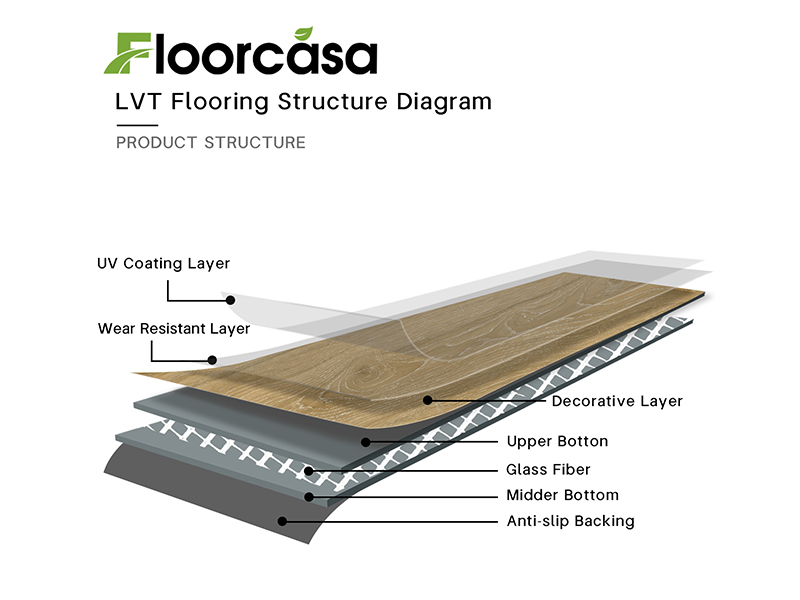
Product Structure and Core Technology
The internal structure of each product determines its performance characteristics:
SPC Flooring Structure
· UV coating for scratch resistance
· Transparent wear layer
· Decorative film
· High-density rigid core
· Optional acoustic backing
WPC Flooring Structure
· Wear layer
· Decorative layer
· Foamed core
· Integrated sound-absorbing backing
Laminate Flooring Structure
· Protective overlay
· Printed decorative layer
· HDF core
· Stabilizing bottom layer
Rigid core construction gives SPC a clear advantage in stability and load-bearing performance.
Manufacturing Process Overview
SPC Production
SPC flooring is produced through extrusion, where limestone and PVC are combined under high temperature and pressure. The boards are then laminated, coated, and cut with precision.
WPC Production
WPC manufacturing includes a foaming process that creates a lightweight and cushioned core structure, followed by surface lamination.
Laminate Production
Laminate flooring is manufactured using high-pressure technology, bonding decorative paper onto HDF boards.
Compared to the others, SPC production is typically more automated, ensuring consistent quality across large batches—an important factor for bulk procurement.
Industry Comparison
In the broader flooring market, each material competes with several alternatives:
Flooring Type | Key Advantage | Limitation |
SPC | Durability & waterproof | Harder feel |
WPC | Comfort & sound absorption | Lower rigidity |
Laminate | Cost-effective | Moisture sensitivity |
LVT | Flexible design | Less stable |
Tile | Extremely durable | High installation cost |
In recent years, SPC has gained significant market share, particularly in regions with high humidity or demanding usage conditions.
Application Scenarios
Different flooring types are suited to different environments:
SPC Flooring
· Commercial spaces with heavy traffic
· Retail chains and supermarkets
· Kitchens, bathrooms, and basements
WPC Flooring
· Residential living areas
· Hospitality projects such as hotels
· Offices where noise reduction is important
Laminate Flooring
· Bedrooms and living rooms in dry environments
· Budget housing developments
· Low-traffic commercial applications
Common Buyer Concerns
Buyers often focus on several practical issues:
· Durability vs comfort: SPC offers strength, while WPC provides better foot comfort
· Water resistance: SPC and WPC are fully waterproof, unlike laminate
· Environmental compliance: Certifications such as FloorScore, CE, and low formaldehyde ratings are essential
· Customization: Most manufacturers offer OEM branding and flexible packaging options
Procurement and Selection Guide
Selecting the right flooring requires aligning product performance with project needs.
Key factors to evaluate:
· Climate conditions in the target market
· Type of application (residential, commercial, industrial)
· Budget constraints and expected lifespan
· Installation environment and labor cost
· Certification and regulatory requirements
Practical Recommendations
· Use SPC in humid climates or high-traffic environments
· Choose WPC where comfort and acoustics are priorities
· Opt for laminate in cost-sensitive, low-moisture markets
FAQ
1. What is the main difference between SPC and WPC?
SPC has a rigid core, while WPC has a softer, foamed core.
2. Which option is best for commercial projects?
SPC is typically the most suitable due to its durability.
3. Is laminate flooring waterproof?
No, it is only resistant to minor moisture.
4. Which product offers the best long-term value?
SPC generally provides the highest return over time.
5. Can these floors be used with underfloor heating?
SPC performs particularly well in such systems.
6. Is WPC suitable for high-traffic areas?
It can be used, but may not match SPC in durability.
7. What certifications should buyers check?
CE, ISO, and FloorScore are commonly required.
8. How can importers ensure consistent quality?
Through supplier audits, sample testing, and clear specifications.
9. What thickness is recommended?
SPC flooring is commonly used at 5–6 mm for most applications.
10. Are these products easy to install?
Yes, all three typically use click-lock systems for efficient installation.