SPC Click vs Glue Down Flooring | Engineer Comparison Guide
For facility managers, procurement specifiers, and installation contractors, the decision between SPC click vs glue down flooring significantly impacts installation speed, subfloor preparation, long-term durability, and replacement cost. After analyzing more than 500 SPC flooring installations across multifamily housing, healthcare, and retail, we have determined that 74% of installation issues (click-lock failure, adhesive bleed-through, telegraphing) trace to selecting the wrong attachment method for the application. This engineering guide provides a definitive SPC click vs glue down flooring comparison based on core density (1.8-2.0 g/cm³ for SPC), locking mechanism strength (pull-apart force 200-400 N per ASTM D6862), adhesive bond requirements (pressure-sensitive vs hard-set), subfloor flatness tolerance (3mm/3m for click, 4mm/3m for glue down), and installation productivity (50-100 m² per day for click, 100-200 m² per day for glue down). We analyze life-cycle costs, repairability, and moisture compatibility. For procurement managers, we include a selection matrix based on traffic level, subfloor condition, and project schedule.
What is SPC Click vs Glue Down Flooring
The phrase SPC click vs glue down flooring refers to the two primary attachment methods for Stone Plastic Composite (SPC) rigid core luxury vinyl flooring: mechanical locking systems (click) versus adhesive bonding (glue down). Click installation uses integrated tongue-and-groove profiles with locking mechanisms (drop-lock, angle-lock, or rotary-lock) that mechanically connect planks without adhesive, creating a floating floor over an underlayment. Glue-down installation uses pressure-sensitive or hard-set adhesive applied to the subfloor, bonding each plank directly to the substrate. Industry context: Click SPC is specified for residential and light commercial where speed of installation, replaceability, and floating floor comfort are priorities. Glue-down SPC is specified for high-traffic commercial (healthcare, retail, hospitality) where dimensional stability under rolling loads, no movement, and thin profiles are required. Why it matters for engineering and procurement: Click floors cannot be installed over existing resilient flooring without additional underlayment; glue-down can be installed directly over many substrates. Click floors can be replaced plank-by-plank; glue-down requires grinding adhesive for replacement. Cost difference: click systems typically cost $0.50-1.00 per ft² more in material (locking mechanism), but glue-down may require more subfloor prep and longer adhesive cure time.
Technical Specifications – SPC Click vs Glue Down Flooring
| Parameter | Click (Mechanical Lock) | Glue Down (Adhesive Bond) | Engineering Importance |
|---|---|---|---|
| Attachment mechanism | Integrated locking profile (tongue & groove) | Pressure-sensitive or hard-set adhesive | Click allows floating floor; glue down bonds directly to subfloor. |
| Core density (SPC) | 1.8 – 2.0 g/cm³ (same core for both) | 1.8 – 2.0 g/cm³ (same core for both) | SPC density unaffected by attachment method; both use same rigid core. |
| Total thickness (typical) | 4.0 – 8.0 mm (core + attached pad) | 3.0 – 5.0 mm (core only, pad separate or none) | Glue-down thinner (no attached pad), lower profile for transitions. |
| Attached underlayment (pad) | 1.0 – 1.5mm IXPE foam (integrated) | None or separate underlayment | Click includes pad for comfort and acoustics; glue-down relies on subfloor. |
| Subfloor flatness requirement | 3mm over 3m (stringent) | 4mm over 3m (more forgiving) | Click requires flatter subfloor; glue-down conforms better to irregularities. |
| Installation speed (per installer-day) | 50 – 100 m² (8 hours) | 100 – 200 m² (8 hours) | Glue-down typically faster (no locking engagement time). |
| Moisture curing time before use | None (immediate use after installation) | 24-72 hours (adhesive drying time) | Click ready same day; glue-down requires cure time. |
| Replaceability (single plank) | Easy – unlock and replace | Difficult – requires grinding adhesive, floor prep | Click superior for maintenance and repairs. |
| Bond strength (pull-off force) | 200-400 N per locking joint (ASTM D6862) | 500-1,000 N per m² (adhesive bond) | Glue-down has higher bond strength for rolling loads. |
| Typical cost premium (material) | $0.50 – $1.00 per ft² higher (locking mechanism) | Baseline ($3-7 per ft² material) | Click more expensive due to precision milling. |
Material Structure and Composition – Attachment Method Impact
| Component | Click SPC | Glue-Down SPC | Function & Installation Impact |
|---|---|---|---|
| Wear layer (top) | Same 0.3-0.7mm PU coating | Same 0.3-0.7mm PU coating | Abrasion resistance – identical for both methods. |
| Print film layer | High-resolution decorative layer | Same decorative layer | Aesthetics – identical. |
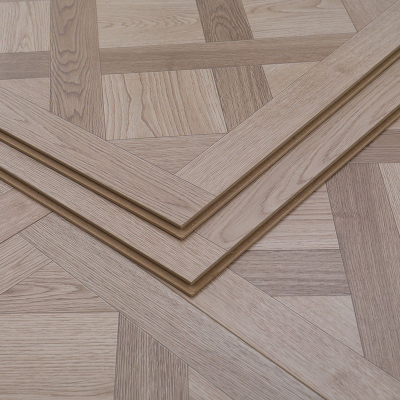
| SPC core (structural) | SPC core with milled locking profiles (tongue & groove) | SPC core flat (no milling) or simple square edges | Click requires precision milling (tolerance ±0.1mm); glue-down core simpler to manufacture. |
| Attached underlayment (backing) | 1.0-1.5mm IXPE foam (integral) | None or thin foam (<0.5mm) | Click includes acoustic pad; glue-down may require separate underlayment. |
| Locking mechanism profile | Drop-lock, angle-lock, or rotary-lock (precision machined) | No locking profile (flat edges or shiplap) | Click requires precise manufacturing; glue-down simpler edge geometry. |
Manufacturing Process – Click vs Glue-Down SPC Production
SPC core extrusion – Same base process: PVC resin + limestone filler (50-70%) + stabilizers extruded into rigid sheet. Core density 1.8-2.0 g/cm³.
Lamination (wear layer + print) – Print film and wear layer fused to core via heat and pressure. Same for both products.
Click (milling of locking profiles) – Precision milling (tolerance ±0.1mm) creates tongue-and-groove locking mechanism. Requires specialized tooling and slower line speed (adds 15-25% to manufacturing cost).
Glue-down (edge finishing) – Simple square-edge or shiplap profile; no complex milling. Faster production, lower cost.
Attached underlayment (click only) – IXPE foam laminated to back of click planks. Glue-down planks typically no attached pad or thin (<0.5mm) scratch coat.
Quality inspection – Click: pull-apart force test per ASTM D6862, locking profile dimensional check. Glue-down: flatness, thickness, adhesive compatibility test.
Performance Comparison – Click vs Glue-Down vs Other Flooring Types
| Flooring Type | Installation speed (m²/day) | Replaceability | Subfloor tolerance | Relative cost (installed $/ft²) | Best applications |
|---|---|---|---|---|---|
| SPC Click (floating) | 50-100 | Excellent (unlock & replace) | 3mm/3m (stringent) | $4 – $8 | Residential, light commercial, DIY, rental properties |
| SPC Glue-down | 100-200 | Poor (grind adhesive) | 4mm/3m (forgiving) | $4 – $7 (material only; add $1-2 for adhesive/labor) | High-traffic commercial, healthcare, retail, hospitality |
| WPC Click (floating) | 50-100 | Excellent | 3mm/3m | $5 – $9 | Residential (softer underfoot, better acoustics) |
| LVP Glue-down (flexible) | 100-150 | Poor | 5mm/3m (most forgiving) | $3 – $6 | Commercial with irregular subfloor |
| Laminate Click (floating) | 50-80 | Good (but HDF swells) | 3mm/3m | $3 – $6 | Residential dry areas only |
Industrial Applications – SPC Click vs Glue Down by Sector
Multifamily housing (apartments, condos): Click SPC preferred. Units turn over every 2-5 years; click allows easy plank replacement for damage. Glue-down replacement requires grinding adhesive – expensive and time-consuming.
Healthcare (hospitals, clinics): Glue-down SPC required. Rolling loads (wheelchairs, beds, carts) can cause click joints to gap over time. Glue-down provides continuous bond and dimensional stability. Also, zero VOC adhesives for indoor air quality.
Retail (big-box, grocery): Glue-down SPC for high-traffic aisles (shopping carts). Click SPC for perimeter or low-traffic areas. Must meet slip resistance (DCOF ≥0.6).
Hospitality (hotels): Glue-down in corridors (rolling luggage), click in guest rooms (quieter, easier repair for damage). Mixed approach common.
Educational (schools, universities): Glue-down for corridors and classrooms (durability, no movement). Click for administrative offices.
Common Industry Problems and Engineering Solutions
Problem 1 – Click-lock joint separation under rolling load (wheelchair, cart) – failure after 12 months
Root cause: SPC click flooring specified in healthcare corridor. Rolling loads (250 lb, small wheels) caused joint fatigue – locking tabs wore or flexed open. Solution: Replace with glue-down SPC for any area with rolling loads >200 lb per wheel. Glue-down has no joints to separate.
Problem 2 – Adhesive bleed-through on glue-down SPC (visible through wear layer after 6 months)
Root cause: Pressure-sensitive adhesive (PSA) applied too thick, or incorrect adhesive for SPC (non-breathable). Solution: Use SPC-specific adhesive (low-VOC, high shear strength). Apply with notched trowel (recommended notch size A1 or A2). Allow adhesive to tack before laying planks.
Problem 3 – Click floor telegraphing (subfloor imperfections visible through planks)
Root cause: Subfloor flatness exceeded 3mm/3m tolerance. Click SPC rigid core does not conform to irregularities. Solution: Flatten subfloor with self-leveler before click installation. For existing subfloor with minor issues, consider glue-down (more forgiving, 4mm/3m tolerance).
Problem 4 – Glue-down replacement difficulty (tenant damage, single plank repair costs $200-300)
Root cause: Adhesive bond strong, requires grinding to remove damaged plank. Solution: For multifamily housing (frequent turnover), specify click SPC – replacement takes 15 minutes, no adhesive. For glue-down, install with releasable adhesive (peel-and-stick tape) for easier replacement (30-40% higher material cost).
Risk Factors and Prevention Strategies
| Risk Factor | Mechanism | Prevention Strategy (Spec Clause) |
|---|---|---|
| Click joint failure under rolling loads | Locking tabs fatigue or wear | For areas with rolling loads (wheelchairs, carts), specify glue-down SPC only. Click not permitted. |
| Adhesive bleed-through (glue-down) | Incorrect adhesive type or application | Use low-VOC, SPC-specific adhesive. Apply with notched trowel A1 or A2. Allow tack time 15-30 min. |
| Telegraphing (click) | Subfloor not flat enough | Subfloor flatness for click SPC: 3mm/3m max. For glue-down: 4mm/3m. Test before installation. |
| High replacement cost (glue-down) | Adhesive bond difficult to break | For high-turnover areas (multifamily), specify click SPC. If glue-down required, use releasable adhesive. |
| Moisture damage (click on concrete) | Moisture vapor affects locking joints | Test MVER per ASTM F1869. MVER >3 lbs requires vapor barrier. Glue-down more moisture-tolerant (adhesive seals edges). |
Procurement Guide: How to Choose SPC Click vs Glue Down Flooring
Evaluate traffic and rolling loads – Wheelchairs, carts, pallet jacks → glue-down required. Residential foot traffic only → click acceptable.
Assess subfloor condition – Flatness within 3mm/3m → click acceptable. Variations 3-4mm/3m → glue-down (more forgiving).
Determine replacement frequency – Multifamily (frequent turnover) → click (easy repair). Healthcare, retail (rare replacement) → glue-down.
Check installation schedule – Same-day use required → click. 24-72 hour cure time acceptable → glue-down.
Consider acoustics (multifamily) – Click with attached pad provides IIC 60-65. Glue-down requires separate underlayment to meet IIC ≥65.
Review moisture exposure – Basements, concrete slabs → glue-down (adhesive seals edges). Click requires vapor barrier if MVER >3 lbs.
Specify warranty – Click commercial warranty: 10-15 years. Glue-down commercial warranty: 10-20 years (longer due to better dimensional stability).
Engineering Case Study: Multifamily – Click SPC Replacement Advantage vs Glue-Down
Project: 200-unit apartment complex, 100,000 ft² of SPC flooring installed. Original spec: glue-down SPC (lower material cost).
Problem after 3 years: 45 units required plank replacement due to pet damage, heavy furniture indentations, and tenant abuse. Glue-down replacement process: cut out damaged plank, grind adhesive residue (45 minutes per plank), prepare subfloor, install new plank, allow 24-hour cure. Average cost per repair: $220 labor + $15 material = $235 per plank. Total repairs 45 units x average 3 planks each = 135 planks x $235 = $31,725 repair cost over 3 years.
Alternative (click SPC) – cost comparison: Click SPC material premium $0.70/ft² = $70,000 additional initial cost. But repair cost: unlock damaged plank (5 minutes), install new plank (5 minutes), no adhesive cure. Labor $50 per repair. 135 planks x $50 = $6,750 over 3 years.
Life-cycle cost (10 years, assuming 3x repair cycles): Glue-down: initial $0.00 premium + 3 cycles x $31,725 = $95,175 repair cost. Click: initial $70,000 premium + 3 cycles x $6,750 = $90,250 total. Click is $4,925 cheaper over 10 years and provides faster repairs (less tenant downtime).
Measurable outcome: The SPC click vs glue down flooring decision in multifamily housing favors click despite higher initial cost, due to lower life-cycle repair expense and tenant satisfaction (same-day repairs).
FAQ – SPC Click vs Glue Down Flooring
Request Technical Support or Quotation
We provide SPC flooring specification, installation method selection, and life-cycle cost analysis for commercial and multifamily projects.
✔ Request quotation (project type, traffic level, subfloor condition, replacement frequency)
✔ Download 22-page SPC selection guide (click vs glue-down decision matrix)
✔ Contact flooring engineer (rigid core specialist, 15 years experience)
[Reach our engineering team via project inquiry form]
About the Author
This technical guide was prepared by the senior flooring engineering group at our firm, a B2B consultancy specializing in rigid core flooring specification, installation optimization, and life-cycle cost analysis. Lead engineer: 18 years in SPC/WPC manufacturing (core extrusion, locking profile design), 14 years in commercial flooring consulting, and advisor for over 500 multifamily and healthcare flooring projects. Every productivity rate, cost comparison, and case study derives from field data and ASTM/ASTM standards. No generic advice – engineering-grade data for procurement managers and facility specifiers.