SPC Flooring vs Laminate: Which Is Better for Your Project?
For global distributors, importers, and engineering contractors, selecting between SPC flooring vs laminate is a recurring procurement decision that directly affects project durability, lifecycle cost, and client satisfaction.
While both materials are widely used in residential and commercial applications, their core structures, performance characteristics, and cost profiles differ significantly. Choosing the wrong option can lead to moisture-related failures, excessive maintenance costs, or reduced service life.
This article provides a technical and procurement-focused comparison of SPC flooring vs laminate, helping B2B buyers determine which solution is better based on real-world project requirements.
What is SPC Flooring vs Laminate?
When evaluating SPC flooring vs laminate, the fundamental difference lies in their core materials and structural behavior.
SPC Flooring (Stone Plastic Composite)
· Rigid core made of limestone powder + PVC
· 100% waterproof
· High dimensional stability
· Click-lock installation system
Laminate Flooring
· Core made of high-density fiberboard (HDF)
· Surface protected by melamine wear layer
· Not waterproof (only water-resistant in premium grades)
· Susceptible to swelling under moisture exposure
Key Insight:
SPC flooring is engineered for moisture resistance and structural stability, while laminate focuses on cost efficiency and aesthetic wood replication.
Key Technical Specifications
A direct technical comparison helps clarify performance differences.
Parameter | SPC Flooring | |
Core Material | Limestone + PVC | HDF (wood fiber) |
Thickness Range | 3.5–8 mm | 7–12 mm |
Water Resistance | 100% waterproof | Water-resistant only |
Wear Layer | 0.2–0.7 mm | AC3–AC5 rating |
Dimensional Stability | ≤0.1% | Higher expansion rate |
Impact Resistance | High | Moderate |
Thermal Stability | Excellent | Sensitive to humidity |
Installation | Click-lock | Click-lock |
Performance Interpretation
· SPC flooring performs better in humidity, temperature variation, and wet environments
· Laminate offers better rigidity feel and often lower initial cost
Main Cost Factors and Performance Drivers
1. Material Cost
· Laminate: Lower raw material cost due to wood fiber core
· SPC flooring: Slightly higher cost due to composite formulation
2. Installation Cost
· Both use click systems, but SPC flooring is:
o Easier to install on imperfect subfloors
o Less prone to installation damage
3. Lifecycle Cost
· SPC flooring has lower maintenance and replacement costs
· Laminate may require replacement in moisture-prone environments
4. Warranty and Risk
· SPC flooring: Typically 15–25 years commercial warranty
· Laminate: Shorter warranty in high-moisture areas
Procurement Insight:
When evaluating SPC flooring vs laminate, total cost of ownership (TCO) often favors SPC in commercial applications.
Product Structure and Core Technology
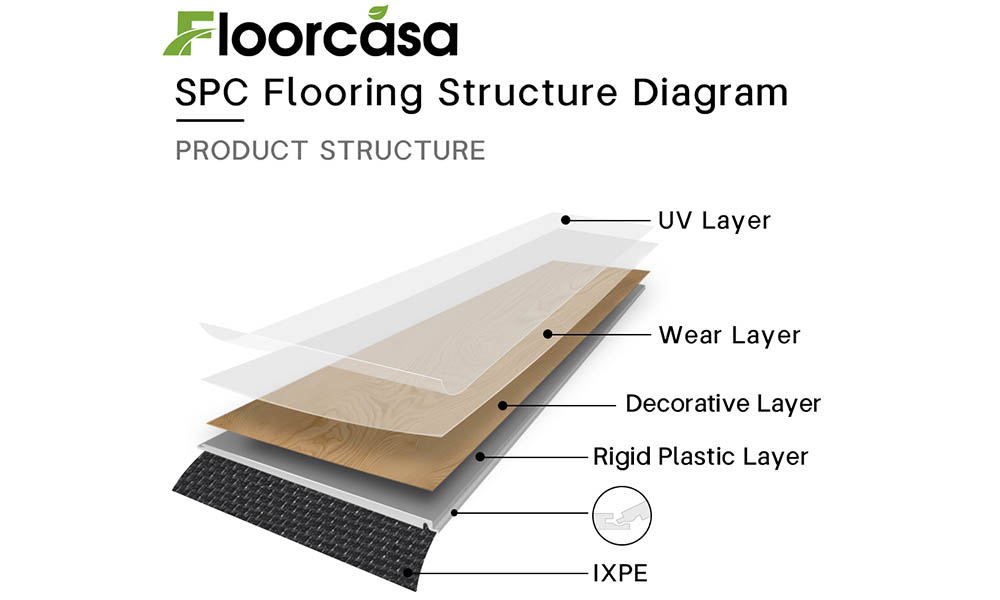
SPC Flooring Structure
· UV coating
· Wear layer
· Decorative film
· SPC rigid core
· Optional IXPE backing
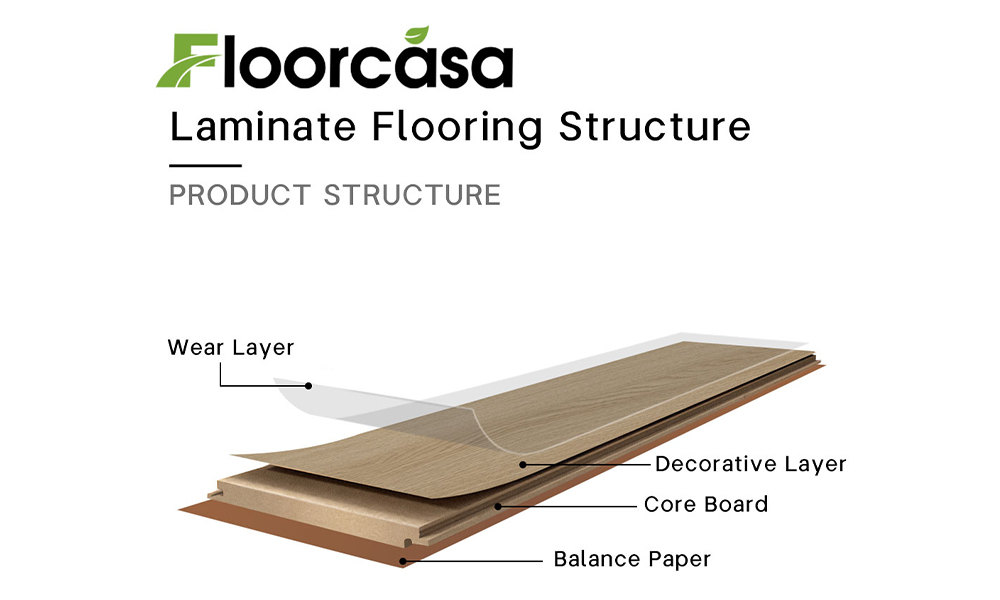
Laminate Flooring Structure
· Wear layer (melamine)
· Decorative paper
· HDF core
· Balancing layer
Core Technology Comparison
Feature | SPC Flooring | Laminate |
Flexibility | Low but stable | Moderate |
Moisture Resistance | Excellent | Limited |
Core Density | High (≥2.0 g/cm³) | Medium |
Engineering Perspective:
SPC’s mineral-based core prevents swelling and deformation, a common failure mode in laminate flooring.
Manufacturing Process Overview
SPC Flooring Production
1. Raw material mixing
2. High-temperature extrusion
3. Layer lamination
4. UV coating
5. Precision slotting
Laminate Production
1. HDF board pressing
2. Decorative paper impregnation
3. High-pressure lamination
4. Surface finishing
5. Cutting and profiling
Quality Implications
· SPC requires strict control of extrusion temperature and density
· Laminate depends heavily on HDF quality and moisture control
Industry Comparison
Criteria | SPC Flooring | Laminate Flooring | Vinyl (LVT) |
Waterproof | Yes | No | Yes |
Durability | High | Medium | Medium |
Cost | Medium | Low | Medium |
Installation | Easy | Easy | Moderate |
Stability | Excellent | Moderate | Lower |
Conclusion:
In the SPC flooring vs laminate debate, SPC is increasingly replacing laminate in commercial and moisture-sensitive markets.
Application Scenarios
SPC Flooring Best For:
· Kitchens and bathrooms
· Commercial retail spaces
· Basements and humid regions
· Hotels and offices
Laminate Flooring Best For:
· Dry residential areas
· Bedrooms and living rooms
· Low-budget housing projects
Common Buyer Concerns
Is SPC flooring always better than laminate?
Not always. Laminate can be more cost-effective for dry, low-traffic environments.
Why is SPC flooring gaining market share?
Due to:
· Waterproof properties
· Lower maintenance
· Better durability in diverse climates
Does laminate flooring fail easily?
It performs well in dry conditions but is vulnerable to:
· Water exposure
· High humidity
Procurement and Selection Guide
Step 1: Evaluate Environment
· Wet or humid → SPC flooring
· Dry → Laminate acceptable
Step 2: Analyze Traffic Level
· High traffic → SPC flooring
· Low traffic → Either option
Step 3: Budget Planning
· Tight budget → Laminate
· Long-term ROI → SPC flooring
Step 4: Check Subfloor Condition
· Uneven subfloor → SPC performs better
Decision Matrix
Scenario | Recommended Option |
Residential (dry) | Laminate |
Commercial retail | SPC flooring |
Hospitality | SPC flooring |
Low-cost housing | Laminate |
Case Study: Retail Chain Upgrade
A Middle Eastern distributor upgraded flooring for a chain of retail stores (8,000 m²).
Initial Material:
Problem:
· Swelling and edge damage due to cleaning moisture
Solution:
· Switched to 5.5 mm SPC flooring with 0.5 mm wear layer
Results:
· 30% reduction in maintenance costs
· No moisture-related failures
· Improved customer satisfaction
Key Takeaway:
SPC flooring provided better long-term value despite higher upfront cost.
FAQ
1. Which is more durable, SPC or laminate?
SPC flooring is more durable, especially in commercial environments.
2. Is laminate cheaper than SPC flooring?
Yes, typically 10–30% cheaper.
3. Can laminate be waterproof?
No, only water-resistant.
4. Is SPC flooring suitable for bathrooms?
Yes, it is fully waterproof.
5. Which is better for underfloor heating?
SPC flooring performs better due to stability.
6. Does laminate scratch easily?
It has good scratch resistance but weaker edge durability.
7. Is SPC flooring environmentally friendly?
Yes, when produced with virgin materials and certified processes.
8. Which lasts longer?
SPC flooring generally has a longer lifespan.
9. Can SPC replace laminate in all cases?
Technically yes, but cost considerations may apply.
10. What should buyers prioritize?
Application suitability and lifecycle cost.
Request a Quote or Technical Information
Choosing between SPC flooring vs laminate requires a clear understanding of your project’s environmental conditions, performance expectations, and budget constraints.
For professional support:
· Request technical datasheets and samples
· Share your project specifications
· Get customized product recommendations
Contact us today to receive:
· Competitive wholesale pricing
· Tailored product solutions
· Expert technical consultation