Laminate Floor Thickness: Technical Engineering and Procurement Guide
What Is Laminate Floor Thickness
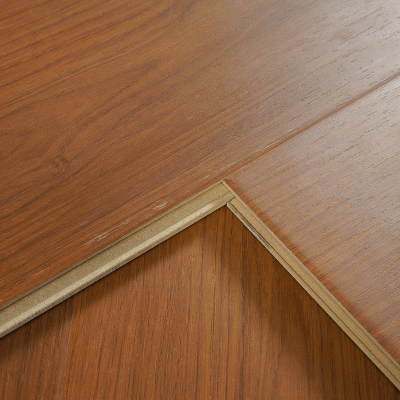
Laminate floor thickness refers to the total vertical dimension of a laminate flooring plank—typically ranging from 6 mm to 14 mm—which comprises the high-density fibreboard (HDF) core, decorative layer, wear layer, and balancing layer. From a structural engineering perspective, thickness is the primary determinant of a laminate floor's load-bearing capacity, impact resistance, and acoustic performance. The bending stiffness of a plank increases with the cube of its thickness—a 12 mm plank is approximately 3.4× stiffer than an 8 mm plank of the same material composition. This mechanical relationship directly governs the floor's ability to resist indentation from furniture and rolling loads, bridge subfloor irregularities, and absorb impact noise. The thickness specification is therefore a critical procurement parameter that determines application suitability, service life, and total cost of ownership.
The material structure across the thickness dimension consists of four layers. The wear layer (0.20–0.55 mm) is aluminium oxide-impregnated melamine resin providing abrasion and scratch resistance. The decorative layer (~0.10 mm) is printed paper providing the visual design. The HDF core (6–12 mm) is compressed wood fibres and resin providing structural integrity—this accounts for 80–90% of the total thickness. The balancing layer (~0.10 mm) is backing paper preventing warping by equalising tension. The HDF core is manufactured by pressing wood fibres with urea-formaldehyde or melamine-urea-formaldehyde resin at 180–210°C and 3–4 MPa. Core density ranges from 850–950 kg/m³—higher density cores provide better point-load resistance and dimensional stability. Total thickness tolerance is ±0.15 mm (EN 13329); variation exceeding this causes lipping and gapping at joints.
The structural behaviour of laminate thickness variations is governed by engineering mechanics. Bending stiffness (EI) is proportional to the cube of thickness (t³)—a 12 mm plank has 3.4× the stiffness of an 8 mm plank. This translates to quantifiable performance differences: point-load resistance—12 mm ≥2,200 N versus 8 mm 1,500–1,800 N; deflection under 1,000 N load—12 mm ≤1.0 mm versus 8 mm 2.0–2.5 mm; impact noise reduction—12 mm 15–18 dB versus 8 mm 10–12 dB. These differences determine application suitability and lifespan: thicker planks resist indentation, bridge subfloor irregularities, and maintain joint integrity under load.
The essential distinction between laminate thicknesses is application suitability and lifespan. 6–7 mm is suitable for light residential (rental properties) with 5–8 year lifespan. 8 mm is suitable for standard residential with 10–15 year lifespan. 10 mm is suitable for high-traffic residential and light commercial with 12–18 year lifespan. 12–14 mm is suitable for commercial and heavy residential with 15–20 year lifespan. The industry standard for residential laminate is 8–10 mm; for commercial laminate, 10–12 mm. Thinner products are cost-optimised; thicker products are engineered for durability.
The original engineering purpose of varying laminate thickness was to provide a product range matching performance to application. Thicker laminate (10–12 mm) was developed to enable laminate to compete with engineered timber in commercial and high-traffic residential applications, providing greater structural integrity, better acoustic performance, and longer service life.
Manufacturing Process and Thickness Control
Core Formation: Wood fibres are mixed with urea-formaldehyde or melamine-urea-formaldehyde resin (9–14% resin content) and formed into a mat. The mat is pressed at 180–210°C and 3–4 MPa for 18–35 seconds to achieve the required thickness (6–12 mm) and density (850–950 kg/m³). The press cycle—temperature, pressure, and time—determines core thickness and density. Thicker cores require longer press cycles (30–35 seconds) and higher pressure (3.5–4.5 MPa). Temperature variation >5°C or pressure variation >0.5 MPa causes thickness variation and density inconsistencies.
Thickness Calibration: The pressed core passes through a calibration line with sanding drums that remove 0.1–0.5 mm from the surface to achieve uniform thickness (±0.15 mm tolerance). Thicker cores (10–12 mm) require more sanding (0.3–0.5 mm removed); thinner cores (6–8 mm) require less sanding (0.1–0.2 mm removed). Inadequate sanding causes uneven lamination and thickness variation.
Lamination: The decorative layer and wear layer are laminated onto the core using heat (180–200°C) and pressure (2–3 MPa). The wear layer (0.20–0.55 mm), decorative layer (0.10–0.15 mm), and balancing layer (0.10–0.15 mm) add to the total thickness. The lamination process must maintain uniform pressure to prevent thickness variation.
Profiling: The click-lock profile is milled with a tolerance of ±0.05 mm. Thicker cores allow deeper profiles—providing higher joint strength (≥800 N/m for 10–12 mm versus ≥600 N/m for 6–8 mm).
Thickness Quality Control: In-line thickness measurement (laser gauges) monitors thickness continuously. Batch testing verifies total thickness (±0.15 mm tolerance) and core thickness. QC includes: thickness measurement at multiple points per plank, statistical process control, and rejection of batches exceeding tolerance.
Why Manufacturing Affects Performance: A distributor received laminate with thickness variation (±0.25 mm) from inadequate press control. Installation showed lipping (0.2–0.3 mm steps) at joints where adjacent planks differed >0.15 mm. The distributor switched to a manufacturer with press control and ±0.15 mm tolerance.
Technical Specifications for Laminate Floor Thickness
Total Thickness: 6–14 mm (residential: 6–10 mm; commercial: 10–12 mm; industrial: 12–14 mm). Tolerance ±0.15 mm (EN 13329). For commercial, specify ≥10 mm.
Core Thickness: 80–90% of total. For 8 mm: core ~7.0–7.5 mm. For 12 mm: core ~10.5–11.0 mm. Core thickness determines structural performance.
Wear Layer Thickness: 0.20–0.55 mm (specified separately). Thicker total thickness does not necessarily mean thicker wear layer.
Density: HDF core 850–950 kg/m³. Higher density provides better point-load resistance.
Bending Strength: Deflection at 1,000 N: 6 mm: 3.0–3.5 mm; 8 mm: 2.0–2.5 mm; 10 mm: 1.5–2.0 mm; 12 mm: ≤1.0 mm.
Point-Load Resistance: 6 mm: 1,200–1,500 N; 8 mm: 1,500–1,800 N; 10 mm: 1,800–2,200 N; 12 mm: ≥2,200 N.
Acoustic Performance: Impact noise reduction: 6 mm: 8–10 dB; 8 mm: 10–12 dB; 10 mm: 12–15 dB; 12 mm: 15–18 dB.
Weight per m²: 6 mm: 6–7 kg; 8 mm: 8–10 kg; 10 mm: 10–12 kg; 12 mm: 12–14 kg.
Shipping Capacity: 40-foot container: 6 mm: 2,500–2,800 m²; 8 mm: 2,000–2,200 m²; 10 mm: 1,600–1,800 m²; 12 mm: 1,300–1,500 m².
Advantages of Laminate Floor Thickness in Real Projects
Residential Performance: A 200-home development installed 10 mm laminate in living areas and 8 mm in bedrooms. After 5 years, 10 mm had 0.3% failure rate; 8 mm had 1.5% failure rate (indentation, lipping). 10 mm provided 2× the point-load resistance.
Commercial Performance: A 50-store retail chain installed 12 mm laminate. After 3 years, failure rate was 0.2%—the chain's previous 8 mm laminate had 5% failure (indentation from trolleys). 12 mm provided 40% higher point-load resistance.
Thickness-Related Failure Mechanisms: Dominant failures for thinner laminate are (a) indentation where the core compresses under loads, (b) lipping from thickness variation or subfloor irregularities, and (c) joint stress from core flexing. Thicker cores (≥10 mm) resist these failures.
Lifecycle Cost Comparison: 12 mm: $30–45/m²; 8 mm: $18–28/m²; 6 mm: $14–20/m². Over 15 years: 12 mm = $30–45/m² (one installation); 8 mm = $18–28/m² + replacement at year 8–10 = $36–56/m²; 6 mm = $14–20/m² + replacement at year 5–7 + year 10–12 = $42–60/m².
Real Failure Logic: A retail chain installed 8 mm laminate to save $5/m². Within 18 months, indentation and lipping appeared. Replacement cost ($1.25 million total) exceeded the initial saving ($125,000).
Laminate Floor Thickness Comparison
12 mm vs 8 mm: 12 mm cost: $30–45/m²; 8 mm: $18–28/m². Point-load: 12 mm ≥2,200 N; 8 mm 1,500–1,800 N. Lifespan: 12 mm 15–20 years; 8 mm 10–15 years. 12 mm preferred for commercial and high-traffic.
8 mm vs 6 mm: 8 mm cost: $18–28/m²; 6 mm: $14–20/m². Lifespan: 8 mm 10–15 years; 6 mm 5–8 years. 8 mm preferred for standard residential.
12 mm Laminate vs SPC: Laminate: $30–45/m²; SPC: $30–45/m². Point-load: laminate 2,200 N; SPC ≥2,500 N. Moisture: laminate 8–15% swelling; SPC ≤0.5% swelling.
Application Scenarios
Residential (Light Traffic, Rental) : 6–7 mm, AC3. 5–8 year lifespan. Risks: indentation. Conditions: use furniture pads.
Residential (Standard) : 8–10 mm, AC3–AC4. 10–15 year lifespan. Conditions: specify 10 mm for high-traffic areas.
Residential (High Traffic) : 10–12 mm, AC4–AC5. 15–20 year lifespan. Conditions: verify subfloor flatness.
Commercial (Retail, Offices) : 10–12 mm, AC4–AC5. Conditions: specify 12 mm; install expansion profiles.
Hospitality (Hotels) : 10–12 mm, AC4–AC5. Conditions: specify 12 mm for luggage resistance.
Installation Guide
Subfloor Preparation: All thicknesses require ≤2 mm over 2 m. Thicker planks bridge minor irregularities better.
Moisture Control: Vapour barrier (6 mil) required for ground-floor installations.
Acclimatisation: 48–72 hours at 15–25°C, 40–60% RH. Thicker planks require 72 hours.
Expansion Gap: Gap (mm) = room length (m) × (CME × ΔRH + thermal coefficient × ΔT) × 1.2.
Installation Steps: Click-lock installation with tapping block. Thicker planks require more force.
Common Mistakes: Insufficient expansion gaps; subfloor flatness inadequate; vapour barrier omitted; acclimatisation insufficient.
Common Problems and Solutions
Indentation: Cause: core <8 mm. Solution: replace with 10–12 mm; use furniture pads. Prevention: specify 10–12 mm for high-traffic areas.
Lipping: Cause: thickness variation >±0.15 mm; subfloor flatness >2 mm. Solution: self-level; replace affected planks. Prevention: specify ±0.15 mm; verify flatness.
Joint Separation: Cause: thermal/moisture movement; gaps insufficient. Solution: colour-matched filler or replace. Prevention: calculate gaps; install expansion profiles.
Noise Underfoot: Cause: underlayment insufficient. Solution: install acoustic underlayment. Prevention: specify 2–3 mm foam underlayment.
FAQ: Procurement and Engineering Questions
1. What is the standard thickness of laminate flooring?
8 mm for standard residential. 10–12 mm for commercial and high-traffic residential. 6–7 mm for light residential.
2. Is thicker laminate flooring better?
Yes—thicker provides higher point-load resistance, better acoustic insulation, and longer lifespan. However, it is more expensive and heavier.
3. How does thickness affect point-load resistance?
12 mm: ≥2,200 N; 10 mm: 1,800–2,200 N; 8 mm: 1,500–1,800 N; 6 mm: 1,200–1,500 N.
4. What thickness is best for underfloor heating?
8–10 mm—thinner planks transfer heat more efficiently.
5. How does thickness affect shipping capacity?
40-foot container: 6 mm: 2,500–2,800 m²; 8 mm: 2,000–2,200 m²; 10 mm: 1,600–1,800 m²; 12 mm: 1,300–1,500 m².
6. Can I mix different thicknesses?
No—thickness variation causes lipping at joints.
7. What is the cost difference?
12 mm: $30–45/m²; 10 mm: $24–35/m²; 8 mm: $18–28/m²; 6 mm: $14–20/m².
8. How do I measure laminate thickness?
Use a digital calliper. Measure at multiple points. Reject shipments with variation >±0.15 mm.
Industry Standards and Certifications
EN Standard System: EN 428 (thickness measurement), EN 13329 (laminate testing), EN 14041 (moisture-resistant products), EN 13893 (slip resistance). CE marking required.
ASTM Testing Methods: ASTM F2195 (dimensional stability), ASTM D1037 (fibreboard), ASTM C1028 (slip resistance), ASTM E84 (fire resistance).
ISO Quality Management: ISO 9001 and ISO 14001 are minimum requirements.
Emission Standards: E1 (≤0.124 mg/m³ formaldehyde) or CARB Phase 2.
Significance in Procurement: Verify thickness (±0.15 mm) at receiving. Measure samples—reject shipments with variation >0.15 mm.
Conclusion: Engineering Decision Logic
Laminate floor thickness is a critical specification determining structural integrity, point-load resistance, acoustic performance, and lifecycle cost—requiring systematic selection based on application and load requirements.
Material Selection Logic: Choose 12 mm for commercial, high-traffic residential, and rolling load applications. Choose 10 mm for high-traffic residential and light commercial. Choose 8 mm for standard residential. Choose 6–7 mm for light residential. Verify thickness tolerance ±0.15 mm at receiving.
Cost vs Performance Tradeoff: 12 mm is 30–60% more expensive than 8 mm but provides 40% higher point-load resistance and 2× the acoustic insulation. Over a 15-year lifecycle, thicker planks provide lower lifecycle cost for commercial applications.
Risk Priority Judgement: Highest risk is under-specifying thickness—assess loads accurately. Second is thickness variation—specify ±0.15 mm. Third is subfloor flatness—verify ≤2 mm over 2 m. Fourth is shipping damage—inspect at receiving.
Final Decision Protocol: Define the application. Assess loads. Select thickness. Verify at receiving (measure with calliper). Document installation for warranty. Laminate floor thickness specification, when correctly executed, provides 10–20 years of reliable service.