Environmental Friendliness of SPC Flooring: A Practical Guide for Sustainable Projects
Environmental performance has become a decisive criterion for commercial and residential construction projects worldwide. Developers, architects, and procurement managers increasingly require flooring systems that combine durability, safety, cost efficiency, and verifiable sustainability credentials. Among rigid core products, SPC Flooring has emerged as a widely specified solution for retail, hospitality, healthcare, and multi-family developments.
This article provides a professional and evidence-based review of the environmental friendliness of SPC Flooring, covering raw materials, manufacturing processes, supply chain practices, and international procurement considerations. It also explains why sourcing SPC wall panels and flooring systems from China—especially through an experienced manufacturer such as Floorcasa—can support both sustainability targets and commercial performance.
Global Market Background and Sustainability Drivers
The global flooring industry is undergoing a structural shift driven by stricter environmental regulations, green building certification programs, and corporate ESG commitments. Green building standards such as LEED, BREEAM, and WELL have pushed project owners to evaluate not only product performance, but also material transparency, emissions, and lifecycle impact.
In this context, SPC Flooring has gained strong acceptance because it offers a stable rigid core structure with low maintenance requirements and a long service life. Compared with traditional PVC flooring and some engineered wood alternatives, SPC Flooring can deliver lower lifecycle costs while meeting increasingly demanding indoor environmental quality requirements.
From a market perspective, demand growth is strongest in commercial renovation projects, residential rental housing, healthcare facilities, and education buildings—segments where durability and low environmental risk are essential purchasing criteria.
What Makes SPC Flooring Environmentally Friendly?
Material Composition and Core Structure
SPC Flooring is manufactured from a stone-plastic composite core, typically composed of natural limestone powder combined with polymer binders and stabilizers. The high mineral content significantly reduces the proportion of petroleum-based materials when compared with conventional vinyl flooring.
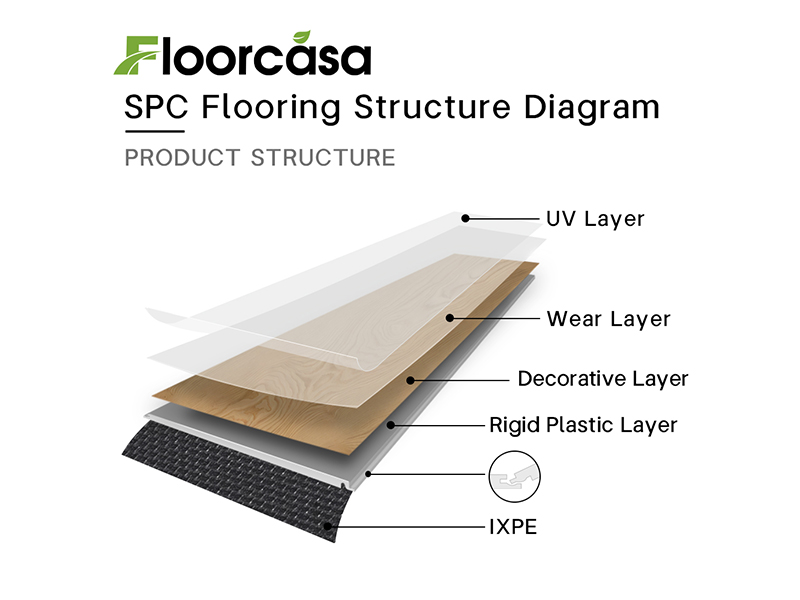
A standard SPC Flooring structure consists of:
l UV protective coating
l Transparent wear layer
l Decorative printed film
l Rigid SPC core
l Integrated underlayment (optional)
This multilayer construction allows SPC Flooring to achieve high dimensional stability, long service life, and resistance to moisture-related deformation—key factors for reducing material replacement frequency over the building lifecycle.
Low-Emission Performance and Indoor Air Quality
One of the most important sustainability indicators for flooring is indoor air quality. Reputable SPC Flooring manufacturers formulate products to meet international VOC emission requirements such as:
l FloorScore
l GREENGUARD
l European EN 16516
Modern production lines for SPC Flooring avoid high-solvent adhesives and apply closed-loop surface coating systems, helping to minimize emissions during manufacturing and installation.
For projects such as hospitals, schools, and residential developments, low-emission SPC Flooring directly supports compliance with green building certification programs and local building codes.
Environmental Advantages Compared with Traditional Flooring
SPC Flooring vs. Laminate and PVC Flooring
When evaluating sustainability, SPC Flooring offers several advantages over conventional laminate and standard PVC flooring:
l Better moisture resistance reduces replacement rates in wet environments.
l Higher dimensional stability minimizes failure risk during temperature fluctuations.
l Longer service life reduces material waste generation over time.
In contrast, laminate flooring typically relies on wood-based substrates that are more vulnerable to water damage, while traditional PVC flooring contains higher proportions of plasticizers.
SPC Flooring vs. Natural Wood Products
Although natural wood flooring is often perceived as environmentally friendly, it requires intensive forest resource management, higher maintenance, and frequent refinishing. In many commercial environments, wood products face higher wear rates.
From a lifecycle perspective, SPC Flooring provides a balanced solution by reducing raw material consumption through durability and offering consistent performance in high-traffic areas.
Why Import SPC Wall Panels and SPC Flooring from China?
Advanced Manufacturing Infrastructure
China has developed one of the world’s most complete manufacturing ecosystems for SPC Flooring and SPC wall panels. Leading factories operate fully automated extrusion lines, precision calendering systems, and in-line quality inspection equipment.
These capabilities allow manufacturers to:
l Maintain stable formulations for SPC cores
l Control thickness tolerances
l Reduce material waste during production
l Improve energy efficiency per production unit
For international buyers, this manufacturing maturity directly translates into reliable environmental performance and consistent product quality.
Scale, Supply Chain Integration, and Cost Efficiency
China’s vertically integrated supply chain for SPC Flooring covers raw materials, decorative films, wear layers, and packaging. This integration reduces transportation distances between upstream suppliers and production facilities, helping to optimize logistics-related emissions.
At the same time, economies of scale enable competitive pricing without compromising environmental and quality standards—an essential factor for large-scale commercial and residential projects.
Product Knowledge: Technical Parameters Related to Sustainability
When evaluating environmentally responsible SPC Flooring, buyers should focus on the following technical parameters:
l Wear layer thickness (0.3 mm–0.7 mm for commercial applications)
l Core density and dimensional stability performance
l Fire resistance classification (commonly Bfl-s1 or equivalent)
l Slip resistance ratings
l Formaldehyde and VOC emission reports
High-performance SPC Flooring not only improves operational safety but also reduces the risk of early replacement, supporting long-term sustainability objectives.
Manufacturing Process and Environmental Control Measures
The production of SPC Flooring generally follows several controlled stages:
1. Raw material blending and formulation
2. Extrusion of rigid SPC core
3. Calendering and thickness control
4. Decorative film lamination
5. Wear layer pressing and UV coating
6. Profiling and click system machining
7. Final inspection and packaging
Environmentally responsible factories apply:
l Closed-loop water circulation systems
l Dust collection and filtration equipment
l Automated material feeding to reduce waste
l Energy-efficient curing and drying systems
These measures significantly improve the environmental footprint of SPC Flooring production.
Supplier Selection: How to Identify a Responsible SPC Flooring Manufacturer
Selecting the right SPC Flooring supplier is critical to achieving sustainability targets. Buyers should evaluate:
l Environmental management certifications (ISO 14001)
l Product emission certifications
l Traceability of raw materials
l Waste management and recycling policies
l Experience with international compliance requirements
As an established manufacturer and exporter, Floorcasa provides transparent product documentation, third-party test reports, and customized solutions for international projects requiring certified SPC Flooring systems.
International Logistics and Packaging Considerations
Transportation is an important part of the environmental footprint of imported SPC Flooring. Reputable suppliers optimize container loading configurations to reduce empty space and use standardized pallet systems to minimize packaging materials.
Where possible, recycled cartons and low-ink packaging solutions are increasingly adopted. Efficient logistics planning also reduces shipment frequency and associated carbon emissions.
Cost and Sustainability: A Practical Procurement Balance
While environmentally certified SPC Flooring may involve a slightly higher unit price than entry-level products, the total cost of ownership is typically lower. Key cost drivers include:
l Reduced maintenance and replacement costs
l Lower failure rates in moisture-prone environments
l Improved project acceptance in green-certified buildings
For procurement teams, sustainability and commercial competitiveness are no longer mutually exclusive when sourcing SPC Flooring from a qualified supplier.
Tips for a Smooth and Sustainable Purchasing Experience
To ensure a successful procurement process for SPC Flooring and SPC wall panels, international buyers should:
l Request complete technical and environmental documentation before sampling
l Conduct factory audits, either onsite or through accredited third parties
l Validate packaging and logistics solutions during pre-shipment inspections
l Confirm post-sales support and warranty policies
Working with an experienced partner such as Floorcasa simplifies technical communication, certification coordination, and production scheduling.
Frequently Asked Questions (B2B)
1. Is SPC Flooring suitable for green building projects?
Yes. Certified SPC Flooring products with verified VOC emission reports and responsible manufacturing practices are widely accepted in green building projects and commercial developments.
2. Can SPC Flooring be recycled after use?
Many SPC core materials can be mechanically recycled under controlled conditions. Buyers should consult their SPC Flooring manufacturer for recycling pathways and local processing compatibility.
3. How can I verify the environmental claims of an SPC Flooring supplier?
Request third-party test reports, ISO environmental management certificates, and product emission certifications. A reliable SPC Flooring supplier should provide full documentation.
4. Does sourcing SPC Flooring from China compromise sustainability?
No. When selecting qualified factories with modern production facilities and environmental management systems, importing SPC Flooring from China can support both sustainability and cost efficiency.
Work with Floorcasa for Responsible SPC Flooring Solutions
If your project requires environmentally responsible, certified SPC Flooring and integrated SPC wall panel systems, Floorcasa offers professional technical support, transparent documentation, and flexible OEM and project-based services.
Contact the Floorcasa team today to request detailed specifications, environmental test reports, and project samples—and discover how sustainable SPC Flooring can enhance the long-term value of your next development.