Best Waterproof Flooring for Basement Over Concrete
Product Definition: Best Waterproof Flooring for Basement Over Concrete
The best waterproof flooring for basement over concrete refers to moisture-resistant rigid or resilient floor systems engineered to withstand vapor transmission, hydrostatic pressure, and temperature fluctuations typical of below-grade concrete slabs.
Technical Parameters and Specifications
Selecting the best waterproof flooring for basement over concrete requires evaluating moisture tolerance, dimensional stability, compressive strength, and thermal resistance. The following parameters are commonly applied in commercial procurement.
| Parameter | Recommended Value | Reference Standard |
|---|---|---|
| Total Thickness | 4.0 – 8.0 mm (rigid core) | ISO 24346 |
| Water Absorption | ≤ 0.1% | ISO 62 |
| Dimensional Stability | ≤ 0.15% | ISO 23999 |
| Compressive Strength | > 400 kPa | ASTM D695 |
| Residual Indentation | ≤ 0.10 mm | ISO 24343 |
| Concrete Moisture Tolerance | Up to 90% RH (with vapor barrier) | ASTM F2170 |
Rigid core SPC and high-density vinyl systems are widely specified as the best waterproof flooring for basement over concrete due to low permeability and structural stability.
Structure and Material Composition
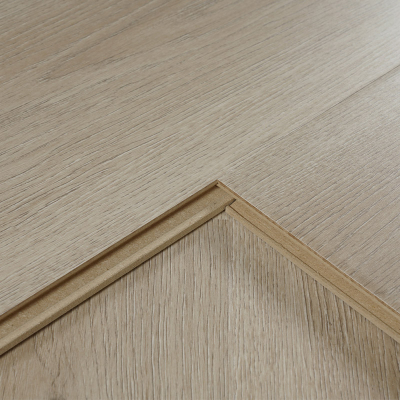
Typical multi-layer configuration of rigid waterproof flooring:
UV Protective Coating: Scratch and stain resistance
Wear Layer (0.3–0.7 mm): Abrasion protection
Decor Film: Wood or stone visual layer
Rigid Core (SPC or high-density vinyl): Waterproof structural body
Integrated IXPE/EVA Pad (optional): Acoustic and minor moisture buffering
The dense mineral-filled core prevents swelling, making it suitable as the best waterproof flooring for basement over concrete installations exposed to seasonal humidity changes.
Manufacturing Process
Raw Material Preparation: PVC resin, calcium carbonate, stabilizers.
High-Speed Mixing: Uniform compound blending.
Twin-Screw Extrusion: Formation of rigid waterproof core.
Calendering & Surface Embossing: Texture synchronization.
Lamination: Wear layer and decor film bonding under heat and pressure.
UV Coating & Curing: Surface hardening.
Precision Click Profiling: CNC slotting for floating installation.
Controlled cooling and dimensional calibration are critical to ensure the product qualifies as the best waterproof flooring for basement over concrete applications.
Industry Comparison
| Flooring Type | Water Resistance | Basement Suitability | Dimensional Stability |
|---|---|---|---|
| SPC Rigid Core | Excellent | Highly Recommended | Very High |
| WPC Flooring | Good | Recommended | High |
| Laminate Flooring | Moderate | Conditional | Medium |
| Engineered Hardwood | Limited | Not Ideal | Low |
| Ceramic Tile | Excellent | Recommended | Very High |
Among resilient options, rigid SPC systems are frequently specified as the best waterproof flooring for basement over concrete due to lower installation cost compared to tile and better thermal comfort.
Application Scenarios
Residential basement renovations
Multi-family housing developments
Commercial storage and archive rooms
Hospitality and serviced apartment basements
Retail lower-ground floors
Distributors and EPC contractors often prioritize the best waterproof flooring for basement over concrete in renovation markets with high groundwater exposure.
Core Pain Points and Solutions
1. Concrete Moisture Vapor Transmission
Solution: Install PE vapor barrier or epoxy moisture mitigation system.
2. Hydrostatic Pressure Risk
Solution: Address drainage and sub-slab waterproofing before flooring installation.
3. Uneven Subfloor Surface
Solution: Self-leveling compound to achieve ≤2 mm deviation over 2 m.
4. Mold and Odor Development
Solution: Ensure adequate ventilation and antimicrobial underlayment.
Risk Warnings and Mitigation
Do not install over active water leakage.
Measure in-situ relative humidity before installation.
Avoid excessive underlayment thickness.
Maintain perimeter expansion gap (8–10 mm).
Follow manufacturer acclimatization requirements.
Procurement and Selection Guide
Assess concrete slab moisture (RH or calcium chloride test).
Confirm building usage load classification.
Verify product water absorption rate ≤0.1%.
Request dimensional stability and indentation test reports.
Evaluate locking system strength for floating systems.
Confirm compliance with indoor air emission standards.
Calculate total floor build-up thickness for renovation constraints.
These steps help procurement teams determine the best waterproof flooring for basement over concrete while minimizing long-term failure risk.
Engineering Case Example
Project: 8,500 m² mixed-use residential basement redevelopment Location: Northern climate zone with high seasonal humidity Subfloor Condition: 85–88% RH concrete slab System Selected: 5.5 mm SPC rigid core with 0.5 mm wear layer Installation: Floating system over 0.2 mm PE vapor barrier Outcome: No swelling, joint separation, or surface deformation after 24 months of monitoring.
FAQ – Best Waterproof Flooring for Basement Over Concrete
Is SPC fully waterproof? The core is waterproof; installation quality remains critical.
Can flooring be installed directly on concrete? Yes, with moisture barrier.
What moisture level is acceptable? Typically ≤90% RH with proper barrier.
Is glue-down required? Floating systems are common in basements.
Does thickness affect performance? Thicker cores improve stability.
Can underfloor heating be used? Yes, within temperature limits.
How to prevent mold? Ensure vapor barrier and ventilation.
Is tile better? Tile is durable but higher cost and colder surface.
What expansion gap is required? 8–10 mm perimeter gap.
What warranty is typical? 10–25 years depending on grade.
Request Quotation or Technical Documentation
For technical datasheets, moisture performance certificates, installation manuals, engineering samples, or commercial quotations regarding the best waterproof flooring for basement over concrete, please provide project area, slab moisture data, and intended usage classification.
Authoritative Statement (E-E-A-T)
This article is prepared by flooring engineers and international project supply specialists with more than a decade of experience in rigid core manufacturing and basement renovation systems. All specifications are aligned with recognized ISO and ASTM testing frameworks to ensure engineering reliability and procurement transparency.