3.5mm SPC Flooring and Thickness Selection Explained
In global resilient flooring procurement, one of the most frequently asked technical questions is what thickness of SPC flooring is best. While SPC flooring is available in a wide range of thicknesses, 3.5mm SPC flooring has emerged as a highly competitive option for international buyers seeking a balance between performance, cost efficiency, and installation flexibility.
Rather than assuming thicker always means better, professional buyers increasingly evaluate SPC flooring thickness based on application scenario, structural design, and total project cost. In this context, 3.5mm SPC flooring plays a critical role in modern commercial and residential specifications.
Global SPC Flooring Industry Background
Growth of SPC Flooring in Global Markets
SPC flooring has become one of the fastest-growing segments in the global resilient flooring market. Demand is driven by:
l Renovation and replacement projects
l Commercial fit-outs with tight timelines
l Markets requiring moisture resistance and dimensional stability
According to industry data, SPC flooring continues to gain market share from traditional laminate and LVT, particularly in North America, Europe, and the Middle East.
Thickness as a Key Differentiator
As SPC flooring adoption expands, thickness differentiation has become a central product positioning strategy. Options typically range from 3.2mm to over 6mm, with 3.5mm SPC flooring representing a mainstream choice for volume-driven export markets.
What Thickness of SPC Flooring Is Best?
There Is No Universal “Best” Thickness
From a B2B perspective, the best SPC flooring thickness depends on:
l Subfloor condition
l Foot traffic level
l Installation method
l Budget constraints
While thicker SPC flooring may offer increased underfoot feel, it also raises material cost, shipping weight, and installation complexity.
Why 3.5mm SPC Flooring Is Widely Preferred
3.5mm SPC flooring is often considered the optimal balance point because it delivers:
l Adequate structural rigidity from the stone-plastic core
l Compatibility with most click-lock systems
l Lower raw material and logistics costs
This makes 3.5mm SPC flooring particularly attractive for large-scale projects and distribution-focused buyers.
Technical Parameters of 3.5mm SPC Flooring
Core Density and Stability
The performance of SPC flooring is driven more by core density than overall thickness. High-quality 3.5mm SPC flooring uses a dense calcium carbonate and polymer composite that ensures:
l Minimal expansion and contraction
l Strong impact resistance
l Excellent dimensional stability
Floorcasa specifies strict density controls to maintain consistent performance across production batches.
Wear Layer and Surface Protection
In 3.5mm SPC flooring, the wear layer typically ranges from 0.3mm to 0.5mm. For most residential and light-commercial environments, this thickness provides sufficient abrasion resistance when paired with a UV-coated surface.
Product Structure Overview
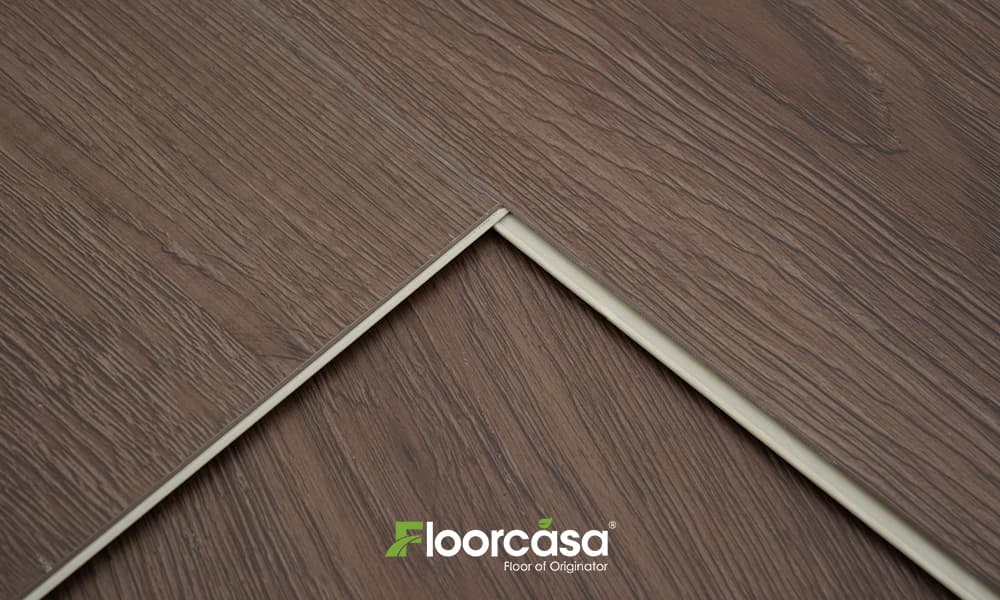
A standard 3.5mm SPC flooring construction includes:
1. UV protective coating
2. Wear layer
3. Decorative film
4. SPC rigid core
5. Optional IXPE or EVA underlayment
This multi-layer structure allows thinner SPC flooring to maintain performance characteristics traditionally associated with thicker products.
Manufacturing Process of 3.5mm SPC Flooring
Extrusion and Calendering
SPC flooring manufacturing begins with high-temperature extrusion of the SPC core. For 3.5mm SPC flooring, precise calendering is essential to maintain thickness tolerance and flatness.
Profiling and Click System Accuracy
Thinner SPC flooring requires higher precision during click-lock profiling. Floorcasa employs CNC profiling to ensure:
l Secure locking strength
l Reduced risk of joint failure
l Faster installation on-site
Cost Efficiency and Logistics Advantages
Material and Shipping Cost Benefits
Compared with thicker SPC flooring, 3.5mm SPC flooring offers:
l Lower raw material consumption
l Reduced pallet weight
l Improved container utilization
These factors significantly improve landed cost for international buyers.
Installation Efficiency
Thinner SPC flooring is easier to handle and cut, reducing labor time during installation. This is especially beneficial for commercial renovation projects with limited downtime.
Market Trends Influencing SPC Flooring Thickness
Shift Toward Value-Engineered Products
Market trends indicate a shift away from over-engineered flooring toward value-optimized solutions. 3.5mm SPC flooring aligns with this trend by delivering reliable performance without unnecessary thickness.
Growth in Renovation Applications
Renovation projects often require flooring that can be installed over existing substrates. The reduced height of 3.5mm SPC flooring minimizes door trimming and transition issues.
International Buyer Preferences and Pain Points
What Buyers Prefer
Global buyers increasingly look for:
l Stable SPC flooring with controlled thickness
l Clear technical documentation
l Consistent locking performance
3.5mm SPC flooring meets these expectations when produced under strict quality standards.
Common Buyer Concerns
Buyers often worry that thinner SPC flooring may compromise durability. In reality, properly engineered 3.5mm SPC flooring performs reliably when matched to appropriate use cases.
Comparing 3.5mm SPC Flooring with Thicker Options
While 5mm or 6mm SPC flooring may offer enhanced acoustic comfort, 3.5mm SPC flooring remains the preferred choice for:
l High-volume residential projects
l Retail chains
l Export markets sensitive to pricing
The decision should be driven by application needs rather than thickness alone.
Frequently Asked Questions (B2B)
Is 3.5mm SPC flooring durable enough for commercial use?
Yes. With an appropriate wear layer, 3.5mm SPC flooring is suitable for light-commercial environments.
Does thicker SPC flooring last longer?
Not necessarily. Core density, wear layer thickness, and installation quality are more important than total thickness.
Is 3.5mm SPC flooring suitable for uneven subfloors?
SPC flooring requires a reasonably flat subfloor. Thicker products may mask minor imperfections, but proper preparation is always recommended.
Which thickness is best for large-scale export projects?
For most large-scale projects, 3.5mm SPC flooring offers the best balance of cost, performance, and logistics efficiency.
Conclusion and Professional Call to Action
When evaluating what thickness of SPC flooring is best, international buyers increasingly recognize that performance is not defined by thickness alone. 3.5mm SPC flooring delivers a proven balance of stability, cost efficiency, and installation flexibility, making it a strategic choice for global distribution and project-based procurement.
Floorcasa supplies export-grade 3.5mm SPC flooring with controlled tolerances, reliable click systems, and comprehensive technical support.
For pricing, detailed specifications, or samples tailored to your target market, contact Floorcasa to support your next SPC flooring project with confidence and clarity.