U Groove Laminate Flooring: Profile, Benefits, Problems & Selection Guide
What Is a U Groove Edge?
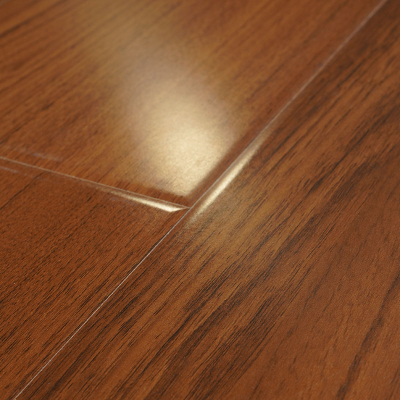
A U groove edge is a concave, U-shaped profile milled into the edges of laminate planks—typically 0.3–1.5 mm deep (product-specific; verify with supplier)—creating a visible shadow line between adjacent planks when installed. The groove is cut into the long and short edges during manufacturing, forming a continuous profile around the plank perimeter. When two planks are locked together, the opposing grooves form a V-shaped valley with a rounded bottom—the "U" refers to the cross-sectional shape of the individual groove, not the joint assembly.
The U groove is not a decorative afterthought. It is a precision-machined feature that serves multiple engineering functions: it simulates the visual separation of individual timber planks, it reduces the visual impact of minor height variations (lipping) between planks, and it provides a tactile edge that mimics the feel of real hardwood. The groove is typically milled after the wear layer is applied—the machining process exposes the HDF core, which must then be sealed to prevent moisture ingress.
The essential distinction between U groove laminate and square-edge laminate is the visual and tactile realism. Square-edge laminate has flat, flush edges—the planks join seamlessly, creating a continuous surface that reveals the product's artificial nature. U groove laminate has a defined edge profile—the groove creates shadow lines and depth, making the floor look like individual timber planks laid side-by-side.
U Groove Profile: Technical Parameters
| Parameter | U Groove Specification |
|---|---|
| Profile shape | Concave U-shaped cross-section |
| Typical depth | 0.3–1.5 mm (product-specific; verify with supplier) |
| Typical width | 1.5–3.0 mm (proportional to depth; product-specific) |
| Edge treatment | Milled with CNC router or profiler |
| Groove finish | Printed (colour-matched) / sealed / unpainted |
| Sealing | Hydrophobic wax, resin, or paint |
| Visual effect | Pronounced plank separation |
| Cleaning requirement | Depends on groove depth |
| Main design direction | Rustic / traditional / natural |
| Tolerance | ±0.05 mm (manufacturer specification; verify with supplier) |
Note: The values above are typical for U groove laminate products. Actual specifications vary by manufacturer. Always verify groove depth, width, and sealing method with the supplier before specification.
U Groove vs Micro Bevel
The choice between U groove and micro bevel is a design decision that affects the floor's visual character, cleaning requirements, and application suitability.
| Parameter | U Groove | Micro Bevel |
|---|---|---|
| Profile | U-shaped (concave) | Angled shallow bevel |
| Visual separation | Strong—clearly defined planks | Subtle—slight plank definition |
| Groove depth | Deeper (0.3–1.5 mm) | Shallower (0.2–0.5 mm) |
| Style | Rustic / natural / traditional | Modern / refined / contemporary |
| Cleaning | More attention required—dirt can collect in deeper grooves | Easier—shallow bevel does not trap dirt |
| Lipping concealment | Strong—shadow line hides height variation | Moderate—less shadow effect |
| Best for | Wood-look / rustic interiors | Contemporary interiors |
| Typical applications | Residential, hospitality, retail | Residential, offices, commercial |
Selection guidance: If the design intent is for the floor to look like individual timber planks laid side-by-side—with pronounced visual separation—U groove is appropriate. If the design intent is for a subtle plank definition—with a more contemporary, refined appearance—micro bevel is appropriate. The choice is aesthetic, not functional—both profiles perform identically in terms of structural integrity.
U Groove vs V Groove
U groove and V groove are both bevelled edge profiles, but they differ in cross-sectional shape, visual effect, and cleaning requirements.
| Parameter | U Groove | V Groove |
|---|---|---|
| Profile shape | U-shaped (concave) | V-shaped (angular) |
| Visual effect | Softer shadow line; subtle definition | Sharper shadow line; more pronounced definition |
| Depth | 0.3–1.5 mm (product-specific) | 0.5–2.0 mm (typical range; actual specification varies by manufacturer) |
| Cleaning | Easier—concave shape does not trap dirt as readily | More difficult—angular shape traps dirt |
| Appearance | Refined, natural | Rustic, dramatic |
| Manufacturing | CNC milling with rounded tool | CNC milling with angled tool |
| Target market | Contemporary, transitional interiors | Rustic, traditional, farmhouse interiors |
| Typical applications | Residential, commercial, hospitality | Residential, hospitality, retail |
Selection guidance: U groove is preferred for interiors where a natural, refined appearance is desired—the concave shape creates a softer shadow line and is easier to clean. V groove is preferred for interiors where a more dramatic, rustic appearance is desired—the angular shape creates a sharper shadow line but requires more cleaning attention.
Manufacturing Process: U Groove-Specific Steps
The manufacturing process for U groove laminate includes several steps that are specific to the groove profile—not generic laminate manufacturing.
Edge milling: The U groove is milled using a CNC router or high-speed profiler with custom tooling. The tool creates a U-shaped (concave) cross-section with a depth of 0.3–1.5 mm and a width of 1.5–3.0 mm (product-specific). The groove is cut into the long and short edges of each plank, creating a continuous profile around the entire plank perimeter. The profile is cut with a tolerance of ±0.05 mm (manufacturer specification)—variation greater than this causes inconsistent groove depth and width, affecting aesthetic consistency.
Groove depth control: The depth of the U groove determines the visual impact and cleaning requirements. Deeper grooves (1.0–1.5 mm) provide more pronounced plank separation and shadow lines but can collect dirt. Shallower grooves (0.3–0.5 mm) provide a subtler, more refined look and are easier to clean. The depth is controlled by the milling tool position and the number of passes.
Groove width control: The width of the U groove should be proportional to the depth—deeper grooves require wider profiles. The width is controlled by the tool geometry and the milling parameters. Inconsistent width causes uneven shadow lines and visual inconsistency.
Groove sealing: The exposed HDF core (from the U groove) is sealed with a hydrophobic wax, resin, or paint to prevent moisture ingress. The sealant is colour-matched to the wood grain (printed) or left unpainted (revealing the core colour). Printed grooves provide a more realistic appearance—the groove colour matches the plank colour, mimicking the natural shadow of a timber gap. Unpainted grooves are less realistic but may be more durable if properly sealed.
Groove printing: For printed grooves, the groove surface is printed with a colour that matches the wood grain. This creates a more realistic appearance—the groove looks like a natural shadow rather than a machined edge. The printing process must be aligned with the groove profile—misalignment causes colour inconsistency.
Quality inspection: The U groove is inspected for depth consistency, width consistency, sealing integrity, and colour matching. Groove chipping (from worn tooling) is inspected—chipped grooves are rejected.
Why manufacturing affects real-world performance: A manufacturer using worn CNC tooling produced U groove planks with inconsistent groove depth—the pattern showed visible variation after installation. The manufacturer replaced the tooling and re-machined the batch. For U groove, profile precision is more critical than for square-edge laminate—groove consistency determines aesthetic quality.
U Groove-Specific Problems
The following problems are specific to U groove laminate—not generic laminate issues.
1. Groove Swelling
Cause: Unsealed groove absorbs moisture; moisture ingress from cleaning or spills.
Symptom: Visible swelling (0.3–0.5 mm) at the groove edges; groove becomes wider and more pronounced.
Solution: Replace affected boards; address moisture source.
Prevention: Specify sealed grooves (printed or hydrophobic wax); install vapour barrier; maintain RH 40–60%.
2. Groove Dirt Accumulation
Cause: Deep grooves trap dirt, dust, and debris; inadequate cleaning.
Symptom: Visible dirt in the grooves; aesthetic degradation.
Solution: Clean with a soft brush or mop; use a vacuum with a soft brush attachment.
Prevention: Specify shallow grooves (0.3–0.5 mm) for commercial applications; maintain regular cleaning.
3. Uneven Groove Depth
Cause: Worn tooling; inconsistent milling parameters; variation in core density.
Symptom: Visible variation in groove depth; inconsistent shadow lines.
Solution: Reject affected batches; verify tooling condition.
Prevention: Specify groove depth tolerance ±0.05 mm; request sample verification.
4. Poor Groove Colour Matching
Cause: Inadequate printing alignment; colour mismatch between groove and plank surface.
Symptom: Groove colour does not match the wood grain; visible inconsistency.
Solution: Reject affected batches; verify printing process.
Prevention: Specify printed grooves with colour matching (ΔE ≤1.0); request samples.
5. Unsealed Groove
Cause: Manufacturer omitted sealing process; cost-cutting.
Symptom: Exposed HDF core visible in the groove; moisture absorption.
Solution: Replace affected boards; apply sealant (preventive, not curative).
Prevention: Specify sealed grooves; verify sealing process through sample inspection.
6. Groove Chipping During Profiling
Cause: Worn tooling; excessive feed rate; low core density.
Symptom: Chipped or rough groove edges; visible defects.
Solution: Reject affected batches; verify tooling and core density.
Prevention: Specify core density ≥850 kg/m³; verify tooling condition.
7. Groove Width Inconsistency
Cause: Tool wear; inconsistent milling parameters.
Symptom: Visible variation in groove width; uneven shadow lines.
Solution: Reject affected batches; verify tooling.
Prevention: Specify groove width tolerance ±0.05 mm; request sample verification.
Installation Considerations for U Groove
The U groove does not affect the installation method—U groove laminate installs using the same click-lock system as square-edge laminate. However, the following U groove-specific considerations apply:
Edge protection: The U groove is a machined profile—it is more vulnerable to damage during handling than square edges. Protect the groove during transport and installation—avoid dropping planks or dragging them across rough surfaces.
Avoid damaging the groove: Do not use the groove as a lever point during installation. Use a tapping block (not a mallet directly on the groove) to engage locks. Do not strike the groove edge with a hammer—this causes chipping.
Correct alignment: Ensure the groove profiles align correctly during installation—misaligned grooves cause visible pattern inconsistency. Check alignment every 2–3 rows.
Groove appearance consistency: Inspect the groove appearance as installation proceeds—inconsistent groove depth or colour matching indicates a defective batch. Stop installation and verify with the supplier.
Moisture protection: Ensure the groove is sealed—unsealed grooves are the most vulnerable point for moisture ingress. Verify sealing before installation.
Cleaning after installation: Clean the grooves after installation to remove construction dust and debris. Use a soft brush or vacuum with a soft brush attachment.
FAQ: U Groove Laminate Flooring
1. What is U groove laminate flooring?
Laminate flooring with a U-shaped (concave) groove milled into the plank edges—typically 0.3–1.5 mm deep (product-specific). The groove creates visual separation between planks, simulating the gaps between individual timber boards.
2. Is U groove better than square edge?
For aesthetic realism, yes—U groove laminate achieves 80–90% of the visual realism of real wood, compared to 50–60% for square-edge laminate. The groove creates depth, shadow lines, and plank separation, making the floor look like individual timber boards. Square-edge laminate looks flat and artificial.
3. U groove vs micro bevel—which is better?
Neither is better—they are different. U groove provides strong visual separation (rustic, natural style). Micro bevel provides subtle plank definition (modern, refined style). Choose based on the design intent.
4. U groove vs V groove—which is better?
Neither is better—they are different. U groove has a concave shape—softer shadow line, easier to clean. V groove has an angular shape—sharper shadow line, more difficult to clean. Choose based on the desired aesthetic and cleaning requirements.
5. Does U groove collect dirt?
Deeper U grooves (1.0–1.5 mm) can collect dirt and require more cleaning attention. Shallower grooves (0.3–0.5 mm) are easier to clean. For commercial applications, specify shallow grooves (0.3–0.5 mm).
6. Does U groove affect waterproof performance?
The U groove itself does not affect waterproof performance—but the exposed core in the groove must be sealed. Unsealed grooves absorb moisture, causing swelling. Specify sealed grooves for all applications—particularly kitchens and bathrooms.
7. Can U groove laminate be used commercially?
Yes—U groove laminate is suitable for commercial applications (offices, retail, hospitality) when specified with 0.55 mm wear layer (AC5), sealed grooves, and appropriate moisture resistance (P5–P7 for wet areas).
8. How deep should a U groove be?
0.3–0.5 mm for subtle/micro-bevel appearance (modern, refined). 0.5–1.0 mm for standard U groove (natural, transitional). 1.0–1.5 mm for rustic/hand-scraped appearance (traditional, farmhouse). The optimal depth depends on the design intent and cleaning requirements.
9. Should U grooves be sealed?
Yes—U grooves must be sealed with hydrophobic wax, resin, or paint to prevent moisture ingress. Unsealed grooves absorb moisture, causing swelling and aesthetic degradation. Specify sealed grooves for all applications.
10. Is U groove suitable for high-end laminate flooring?
Yes—U groove with printed, sealed grooves is suitable for high-end residential and commercial applications. The groove provides the visual realism of individual planks—a premium aesthetic that square-edge laminate cannot achieve.
Industry Standards and Certifications
EN Standard System: EN 13329 (laminate—wear layer testing, AC rating, dimensional stability), EN 14041 (moisture-resistant products—P5/P7 rating), EN 13893 (slip resistance—R classes), EN 1811 (emission testing—E1 compliance). CE marking under the CPR is required for European markets.
ASTM Testing Methods: ASTM F2195 (dimensional stability), ASTM D1037 (fibreboard—referenced for core properties), ASTM G154 (UV stability), ASTM C1028 (slip resistance—DCOF), ASTM E84 (fire resistance—Class I). The U groove does not affect the test results—the core material is tested.
ISO Quality Management: ISO 9001 (quality management) and ISO 14001 (environmental management) are the minimum requirements for credible manufacturers.
Emission Standards: E1 (≤0.124 mg/m³ formaldehyde) is the baseline; CARB Phase 2 (≤0.05 ppm) for North America.
Sustainability Certification: FSC/PEFC certification for timber sourcing is required for green building projects.
Significance in Procurement: Verify that the U groove laminate meets: (a) groove sealing (printed or hydrophobic wax), (b) groove depth (0.3–1.5 mm, product-specific), (c) groove depth tolerance (±0.05 mm, manufacturer specification), (d) wear layer thickness (0.55 mm for commercial), and (e) VOC emissions (CARB/E1). Request samples—the groove aesthetic and quality are best assessed visually.
Conclusion: Engineering Decision Logic
U groove laminate flooring provides the aesthetic realism of plank separation with the durability, scratch resistance, and cost-effectiveness of laminate—making it the preferred choice for residential, commercial, and hospitality applications where visual authenticity is critical.
Material Selection Logic: Choose U groove laminate for applications where the design intent is for the floor to look like individual timber planks. Specify 10–12 mm thickness, 0.55 mm wear layer (AC5), 0.3–1.0 mm groove depth, printed grooves (colour-matched), sealed grooves, and CARB/E1 compliance. For commercial applications, specify shallow grooves (0.3–0.5 mm) for easier cleaning. For rustic interiors, specify deeper grooves (1.0–1.5 mm) for pronounced plank separation.
Cost vs Performance Tradeoff: U groove laminate is 10–20% more expensive than square-edge laminate but provides superior aesthetic realism, plank separation, and lipping concealment. The premium is justified for commercial and hospitality applications—the cost of an artificial-looking floor exceeds the U groove premium.
Risk Priority Judgement: Highest risk is groove swelling from moisture—specify sealed grooves and install a vapour barrier. Second is groove dirt accumulation—specify shallow grooves for commercial applications and maintain regular cleaning. Third is groove depth inconsistency—specify tolerance ±0.05 mm and verify samples. Fourth is groove colour mismatch—specify printed grooves with colour matching (ΔE ≤1.0).
Final Decision Protocol: Define the application (residential, commercial, hospitality, retail). Assess the aesthetic requirements (rustic vs modern; strong vs subtle plank separation). Select U groove laminate with the appropriate groove depth (0.3–1.5 mm), printed grooves, and sealed grooves. Install following the standard laminate protocol—vapour barrier, expansion gaps, perimeter seal—with attention to edge protection. Document installation for warranty and quality assurance. U groove laminate flooring, when correctly specified and installed, provides a durable, realistic, and cost-effective alternative to real wood for 10–20 years of reliable service.