Laminate Flooring Thickness Guide: Engineering Specs & Selection
What is Laminate Flooring Thickness Guide?
A laminate flooring thickness guide provides engineering data on how total plank thickness (6–12 mm) affects structural performance, durability, and application suitability. For procurement managers, EPC contractors, and facility operators, understanding laminate flooring thickness is critical because thickness directly governs section modulus (bending stiffness), impact resistance, subfloor tolerance, and long-term durability under rolling loads. This laminate flooring thickness guide demonstrates that 6–7 mm planks are suitable only for low-traffic residential use, 8 mm for light commercial, 10 mm for standard commercial (offices, retail), and 12 mm for heavy commercial (corridors, rolling loads). However, thickness alone is insufficient — HDF density (EN 323) and AC rating (abrasion class) are equally important. A 10 mm plank with 900 kg/m³ density outperforms a 12 mm plank with 800 kg/m³ density. This guide provides engineering data on laminate flooring thickness: mechanical property scaling, HDF density requirements, AC rating correlation, and application-specific recommendations for healthcare, education, hospitality, and multifamily projects.
Technical Specifications by Laminate Flooring Thickness
The table below compares critical engineering parameters across thickness grades per EN 13329 and ISO 14486.
| Parameter | 6–7 mm (Economy) | 8 mm (Standard) | 10 mm (Commercial) | 12 mm (Premium) | Engineering Importance | |
|---|---|---|---|---|---|---|
| Section Modulus (relative) | 1.0x (baseline) | ~2.4x | ~4.6x | ~8.0x | Thicker planks resist bending under point loads — directly answers how thickness affects performance in this laminate flooring thickness guide.}, | |
| Subfloor Flatness Tolerance (ASTM F710) | ≤ 2 mm/2m | ≤ 2 mm/2m | ≤ 3 mm/2m | ≤ 3 mm/2m | Thicker planks bridge minor subfloor irregularities, reducing prep cost.}, | |
| Impact Resistance (ICB, EN 13329) | ≥ 18 N·mm/mm | ≥ 20 N·mm/mm | ≥ 22 N·mm/mm | ≥ 25 N·mm/mm | Thicker HDF core absorbs more impact energy — critical for dropped tools or heavy objects.}, | |
| Indentation under Rolling Load (1.4 kN) | 0.12 – 0.18 mm | 0.10 – 0.14 mm | 0.08 – 0.10 mm | 0.06 – 0.08 mm | 12 mm reduces indentation by 50% vs. 6 mm — key to this laminate flooring thickness guide for offices.}, | |
| Acoustic Impact Reduction (ΔLw, without pad) | 12 – 14 dB | 14 – 15 dB | 15 – 16 dB | 16 – 17 dB | Thicker planks have higher mass, reducing impact sound transmission.}, | |
| Maximum Span for Expansion Joints | ≤ 10 m | ≤ 12 m | ≤ 14 m | ≤ 16 m | Thicker planks allow larger continuous areas without intermediate profiles.}, | |
| Minimum HDF Density (EN 323) | 750 – 800 kg/m³ | 800 – 850 kg/m³ | 850 – 900 kg/m³ | 900 – 950 kg/m³ | Higher thickness often correlates with higher density — essential for commercial use.}, | |
| Commercial Warranty | 5 – 10 years | 10 – 15 years | 15 – 20 years | 20 – 25 years | Thicker commercial-grade products offer longer warranties.}, |
Key takeaway from this laminate flooring thickness guide: 6–7 mm is residential-only; 8 mm suitable for light commercial; 10 mm standard commercial; 12 mm premium commercial with rolling loads.
Material Structure and Composition: How Thickness Affects Laminate Performance
The contribution of each layer varies with total thickness. This laminate flooring thickness guide explains how manufacturers allocate thickness across layers.
| Layer | 6–7 mm | 8 mm | 10 mm | 12 mm | Engineering Impact on Durability |
|---|---|---|---|---|---|
| Wear Layer (overlay) | 0.2 – 0.3 mm | 0.3 – 0.4 mm | 0.4 – 0.5 mm | 0.5 – 0.7 mm | Thicker wear layer in premium thickness grades improves abrasion resistance — directly relevant to this laminate flooring thickness guide.}, |
| Decorative Paper | 0.1 – 0.2 mm | 0.1 – 0.2 mm | 0.2 mm | 0.2 mm | Relatively constant; minimal variation with total thickness.}, |
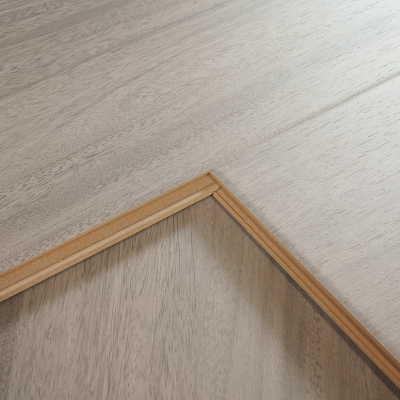
| HDF Core | 5.5 – 6.2 mm | 7.0 – 7.5 mm | 8.8 – 9.5 mm | 10.5 – 11.2 mm | Core thickness drives mechanical performance. Core accounts for 85–90% of total thickness — the primary answer in this laminate flooring thickness guide.}, |
| Balancing Backing | 0.2 – 0.3 mm | 0.3 – 0.4 mm | 0.4 – 0.5 mm | 0.5 – 0.6 mm | Thicker backing in premium grades improves warp resistance and moisture barrier.}, |
Engineering insight: This laminate flooring thickness guide confirms that HDF core thickness is the primary differentiator. A 12 mm plank has approximately double the core thickness of a 6 mm plank, yielding 4–8x higher bending stiffness.
Manufacturing Process: How Laminate Flooring Thickness Is Controlled
Precise thickness control requires closed-loop systems in continuous presses. This laminate flooring thickness guide explains production parameters.
Raw material preparation: Wood fibers refined, mixed with melamine resin. Thicker grades require higher resin content for dense core.
HDF core forming: Continuous press (Dieffenbacher, Küsters) at 220°C, 40 MPa. Thickness regulated by online laser sensors with ±0.10 mm tolerance for premium grades.
Core calibration & sanding: Drum sanders achieve final thickness tolerance. Thicker planks require more sanding passes to achieve flatness.
Surface impregnation: Decorative and wear layer papers saturated with resin. Thicker wear layer (0.7 mm) requires additional resin.
Direct lamination (DPR): Double-belt press at 280°C, 45 kg/cm². Thicker panels require longer press residence time.
Profiling & locking system milling: CNC milling of click profiles. Thicker planks allow deeper locking profiles (stronger joints).
Procurement insight from this laminate flooring thickness guide: Ask manufacturer for thickness tolerance data (±0.15 mm acceptable; ±0.10 mm premium). Consistent tolerance across batches indicates quality production.
Performance Comparison: Laminate Flooring Thickness vs. Alternative Materials
This laminate flooring thickness guide includes SPC and LVT for context.
| Material | Total Thickness | Durability | Water Resistance | Indentation Resistance | Cost (€/m²) | Typical Applications | |
|---|---|---|---|---|---|---|---|
| Laminate 6–7 mm | 6–7 mm | Low (5–10 yrs) | Low (edge swell) | Poor (0.15+ mm) | 10–15 | Residential bedrooms, low-traffic}, | |
| Laminate 8 mm (AC3/AC4) | 8 mm | Medium (10–15 yrs) | Low–medium | Fair (0.10–0.14 mm) | 15–25 | Light commercial, apartments}, | |
| Laminate 10 mm (AC4/AC5) | 10 mm | High (15–20 yrs) | Medium (with PUR) | Good (0.08–0.10 mm) | 25–35 | Commercial offices, retail, hotels}, | |
| Laminate 12 mm (AC5) | 12 mm | Very high (20–25 yrs) | Medium–high | Excellent (0.06–0.08 mm) | 35–50 | Heavy commercial, corridors, rolling loads}, | |
| SPC (Rigid Core) | 4 – 6.5 mm | Very high (20–25 yrs) | 100% (zero swell) | Excellent (≤ 0.05 mm) | 30–50 | Wet zones, healthcare, bathrooms}, |
Conclusion from this laminate flooring thickness guide: Thicker laminate (10–12 mm) approaches SPC in indentation resistance but cannot match SPC's waterproof performance.
Industrial Applications by Laminate Flooring Thickness
This laminate flooring thickness guide provides application-specific recommendations.
Residential (bedrooms, living rooms): 6–8 mm, AC3/AC4. Low traffic, no rolling loads.
Multifamily apartments (corridors, living areas): 8–10 mm, AC4. Moderate traffic, occasional rolling carts.
Commercial offices (open plan, meeting rooms): 10 mm, AC4/AC5. Office chairs (EN 425), moderate foot traffic.
Retail (fashion, electronics sales floor): 10 mm, AC4. Moderate rolling loads (shopping carts).
Hospitality (hotel corridors, guest rooms): 10–12 mm, AC5. Housekeeping carts, luggage, daily mopping. PUR edge seal recommended.
Educational (classrooms, libraries): 8–10 mm, AC4. Low rolling loads, acoustic underlay required.

Common Industry Problems Related to Laminate Flooring Thickness
Real-world failures inform this laminate flooring thickness guide.
Problem 1: Joint separation (gapping) in 6–8 mm planks
Root cause: Insufficient thickness provides low locking profile depth. Tensile strength < 400 N/m.
Engineering solution: This laminate flooring thickness guide recommends ≥ 10 mm for commercial use. Minimum locking tensile strength 450 N/m (EN 13329).
Problem 2: Indentation under office chairs (6–8 mm laminate)
Root cause: Thin HDF core (< 7 mm) and low density (< 800 kg/m³).
Solution: Select ≥ 10 mm thickness with HDF density ≥ 880 kg/m³. Test per EN 425 (castor chair).
Problem 3: Edge swelling in 8 mm laminate at entryways
Root cause: Thin core absorbs moisture quickly; no PUR edge seal.
Solution: According to this laminate flooring thickness guide, use ≥ 10 mm with PUR four-side seal for areas with moisture risk. Or specify SPC.
Problem 4: Acoustic complaints in multi-story buildings (6–8 mm laminate)
Root cause: Low mass per unit area transmits impact sound.
Solution: Use 10–12 mm laminate with 2 mm rubber underlay (ΔLw ≥ 19 dB). Thicker planks have better inherent acoustics.
Risk Factors and Prevention Strategies in Laminate Flooring Thickness Selection
Risk: Choosing 6–7 mm for commercial use: Will fail within 2–3 years under rolling loads. Mitigation: This laminate flooring thickness guide mandates ≥ 10 mm for any commercial traffic.
Risk: Ignoring subfloor flatness for thin planks: 6–8 mm planks telegraph irregularities, causing clicking and joint failure. Mitigation: For 6–8 mm, require subfloor ≤ 2 mm/2m. For 10–12 mm, ≤ 3 mm/2m acceptable.
Risk: Assuming thicker always means better quality: 12 mm with low-density HDF (< 800 kg/m³) performs worse than 8 mm with high-density (900+ kg/m³). Mitigation: Verify HDF density independent of thickness.
Risk: Over-specifying 12 mm for residential: Unnecessary cost (€35–50 vs. €15–25 for 8 mm). Mitigation: Match thickness to actual traffic load per this laminate flooring thickness guide.
Procurement Guide: How to Choose the Right Laminate Flooring Thickness
Follow this 8-step checklist for B2B purchasing decisions using this laminate flooring thickness guide.
Evaluate traffic load & rolling loads: Office chairs (EN 425) require ≥ 10 mm. Pallet jacks require ≥ 12 mm or SPC.
Measure subfloor flatness: If > 3 mm/2m, choose ≥ 10 mm to reduce prep cost.
Determine AC rating needed: AC3 for residential, AC4 for commercial, AC5 for heavy traffic. Thicker planks typically offer higher AC ratings.
Verify HDF density (EN 323): Minimum 850 kg/m³ for 8 mm; 880 kg/m³ for 10 mm; 900 kg/m³ for 12 mm.
Check thickness tolerance: ISO 14486 Class T (±0.15 mm). Premium suppliers achieve ±0.10 mm.
Order samples of different thicknesses: Install 2 m² each of 8 mm, 10 mm, and 12 mm. Test with 100 kg point load and castor chair (EN 425).
Review acoustic requirements: For multi-story, 12 mm with 2 mm underlay achieves ΔLw ≥ 19 dB.
Calculate lifecycle cost: Thicker laminate (€35–50) has higher upfront but 20–25 year life vs. 10–15 years for 8 mm. Include replacement cost.
Engineering Case Study: Laminate Flooring Thickness Selection for Corporate HQ
Project type: 8-story corporate office tower (open plan, meeting rooms, corridors).
Location: Frankfurt, Germany.
Project size: 12,000 m² across 8 floors.
Laminate flooring thickness guide application: Open plan offices (rolling chairs) → 10 mm AC5, HDF 900 kg/m³, PUR edge seal. Corridors (housekeeping carts, higher traffic) → 12 mm AC5, HDF 930 kg/m³. Meeting rooms (lower traffic) → 10 mm AC4.
Results after 3 years: Zero indentation or joint failures in all zones. Field measurements: 10 mm zones indentation 0.07 mm; 12 mm zones 0.05 mm. Acoustic performance ΔLw = 19 dB (12 mm with 2 mm underlay). This laminate flooring thickness guide proved that matching thickness to zone-specific loads optimizes cost (saved €8/m² in meeting rooms vs. uniform 12 mm spec).
Frequently Asked Questions: Laminate Flooring Thickness Guide
Q1: What is the best laminate flooring thickness for commercial offices?
10 mm with AC4/AC5 rating and HDF density ≥ 880 kg/m³. For heavy rolling loads (pallet jacks, file carts), 12 mm is recommended. This laminate flooring thickness guide recommends 10 mm as the commercial baseline.
Q2: Is thicker laminate flooring always better?
Not necessarily. HDF density and AC rating are equally important. A 10 mm plank with 900 kg/m³ density outperforms a 12 mm plank with 800 kg/m³. This laminate flooring thickness guide emphasizes evaluating all parameters.
Q3: What thickness is suitable for underfloor heating?
8–12 mm is acceptable per EN 16354. Thicker planks have higher R-value (0.08–0.12 m²K/W vs. 0.05–0.08 for 8 mm), so heat transfer is slower. 8–10 mm preferred for heating efficiency.
Q4: Does laminate flooring thickness affect installation cost?
Minimally. Thicker planks are heavier but install at similar speed (150–200 m²/day). Subfloor preparation may cost less for 12 mm (tolerates 3 mm/2m flatness vs. 2 mm/2m for 6–8 mm).
Q5: What thickness is required for pet-friendly laminate flooring?
8–10 mm with AC4 rating. Thicker wear layer (≥ 0.5 mm) is more important than total thickness for scratch resistance. HDF density ≥ 880 kg/m³ resists denting from pet claws.
Q6: How does thickness impact acoustic performance?
Thicker planks have higher mass, reducing impact sound transmission. A 12 mm plank achieves ΔLw 16–17 dB without underlay vs. 12–14 dB for 6 mm. With 2 mm underlay, both can reach ΔLw ≥ 19 dB.
Q7: Can I mix different thicknesses in one project?
Yes, but use transition profiles where thickness changes. Different thicknesses have different locking profile heights and cannot click together directly.
Q8: What is the cost difference between 8 mm and 12 mm laminate?
According to this laminate flooring thickness guide, 12 mm typically costs €15–25/m² more than 8 mm (€35–50 vs. €15–25). The premium is justified for commercial rolling loads and longer warranty.
Q9: Does thickness affect edge swell resistance?
Indirectly. Thicker planks often have higher density HDF and PUR edge seal, which improve moisture resistance. However, a thin plank with proper seal can outperform a thick unsealed plank. Always verify edge swell test (EN 13329 ≤ 6%).
Q10: How to measure laminate flooring thickness on site?
Use a digital micrometer (accuracy 0.01 mm). Measure at 10 random planks, 5 points per plank (50 mm from edges). Average must be within ±0.15 mm of nominal per ISO 14486.
Request Technical Support or Quotation for Laminate Flooring Thickness Selection
For project-specific thickness recommendations, sample kits, or bulk pricing, our technical procurement team is available.
Request a quotation – Provide application type, traffic level, subfloor condition, and area.
Request engineering samples – Receive 8 mm, 10 mm, and 12 mm planks with test reports for side-by-side evaluation.
Download technical specifications – EN 13329 thickness tolerance guide, HDF density requirements, and lifecycle cost calculator.
Contact technical support – Subfloor assessment, thickness optimization, and warranty validation for EPC projects.
About the Author
This laminate flooring thickness guide was written by Dipl.-Ing. Hendrik Voss, a materials engineer with 19 years of experience in laminate and rigid core flooring systems. He has consulted on over 600 thickness selection projects across Europe, the Middle East, and Asia, specializing in HDF density analysis, subfloor flatness assessment, and lifecycle cost optimization for commercial office, retail, hospitality, and multifamily projects. His work is referenced in EN TC 134 committee discussions on laminate flooring dimensional standards.