Does SPC Flooring Crack? A Technical Guide for Global Buyers
For distributors, importers, and project contractors, durability is a non-negotiable factor when sourcing flooring materials. One of the most frequently asked questions in procurement discussions is: does SPC flooring crack under pressure, temperature changes, or long-term use?
SPC flooring (Stone Plastic Composite) has gained global traction due to its rigid core structure, dimensional stability, and cost-performance ratio. However, concerns about cracking often arise in large-scale projects, especially in regions with extreme climates or heavy foot traffic.
This article provides a technical, data-driven analysis of SPC flooring performance, helping B2B buyers evaluate whether cracking is a realistic risk—and how to mitigate it through proper selection, installation, and sourcing.
What is SPC Flooring?
SPC flooring is a type of rigid core vinyl flooring engineered with a limestone-based composite core. It is designed to deliver superior stability compared to traditional LVT (Luxury Vinyl Tile).
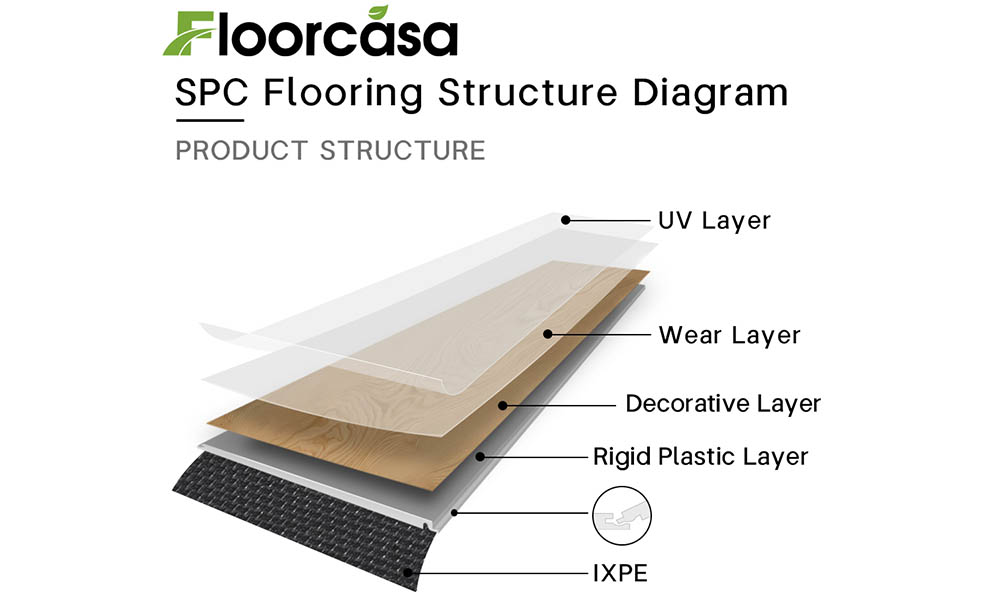
Typical SPC Flooring Structure:
l UV Coating (wear resistance)
l Wear Layer (0.2mm–0.7mm)
l Decorative Film
l SPC Core (limestone + PVC composite)
l IXPE/EVA Backing (optional)
Unlike flexible vinyl flooring, SPC flooring features a high-density rigid core, which significantly reduces expansion and contraction.
Key Technical Specifications
Understanding technical parameters is essential when evaluating cracking risks.
Parameter | Typical Range | Impact on Cracking Resistance |
Density | 1.8–2.2 g/cm³ | Higher density = better rigidity |
Core Thickness | 3.5–6.5 mm | Thicker core improves impact resistance |
Wear Layer | 0.3–0.7 mm | Protects against surface damage |
Dimensional Stability | ≤0.1% | Lower values reduce warping/cracking |
Impact Resistance | ≥1600 mm drop test | Indicates resistance to cracking |
Thermal Expansion | Low | Minimizes stress fractures |
Key Insight:
Cracking is rarely caused by material weakness alone—it is usually a result of external stress exceeding the product’s design tolerance.
Main Performance Factors Affecting Cracking
1. Temperature Fluctuations
SPC flooring performs well in temperatures ranging from -10°C to 60°C, but extreme and rapid fluctuations can induce stress.
l Poor-quality SPC may become brittle in cold environments
l High heat without expansion gaps can lead to structural stress
2. Subfloor Conditions
Uneven or unstable subfloors are a leading cause of cracking.
l Concrete moisture >3% can weaken locking systems
l Surface deviation >2mm over 2m can create pressure points
3. Load and Impact Stress
Heavy equipment, pallet traffic, or point loads can exceed design limits.
l Industrial use requires ≥5.0 mm thickness and high wear layer
l Thin boards are more prone to cracking under concentrated loads
4. Material Quality
Low-cost SPC often uses:
l Lower PVC content
l Recycled fillers with inconsistent density
This leads to brittleness and reduced flexibility, increasing crack risk.
Product Structure and Core Technology
The SPC core is the most critical factor in crack resistance.
Advanced Core Formulations Include:
l High-purity calcium carbonate (limestone ≥75%)
l Virgin PVC for flexibility
l Stabilizers to prevent thermal degradation
Click Lock System Design
A weak locking system can lead to edge cracking.
l Unilin / Valinge systems offer better stress distribution
l Precision milling reduces installation damage
Engineering Insight:
High-quality SPC flooring balances rigidity and micro-flexibility, preventing brittle failure under stress.
Manufacturing Process Overview
Cracking resistance is heavily influenced by production quality control.
Typical SPC Manufacturing Steps:
1. Raw material mixing
2. High-temperature extrusion (≈200°C)
3. Calendaring and shaping
4. UV coating application
5. Slotting (click system cutting)
6. Quality inspection
Critical Control Points:
l Temperature consistency during extrusion
l Core density uniformity
l Precision in click profile cutting
Factories with automated extrusion lines and strict QC protocols produce SPC flooring with significantly lower defect rates.
Industry Comparison
Feature | SPC Flooring | WPC Flooring | Ceramic Tile | |
Crack Resistance | High | Medium | Low | Very High (but brittle) |
Flexibility | Low | Medium | Low | None |
Water Resistance | 100% | High | Low | 100% |
Installation | Easy (click) | Easy | Moderate | Complex |
Cost | Medium | High | Low | Medium–High |
Conclusion:
SPC flooring offers the best balance between crack resistance and flexibility among modern flooring options.
Application Scenarios
SPC flooring is widely used in:
Commercial Projects
l Retail stores
l Offices
l Hotels
Residential Developments
l Apartments
l Villas
l Renovation projects
Light Industrial Use
l Warehouses (low traffic zones)
l Showrooms
Note:
For heavy industrial environments, reinforced flooring solutions may be more suitable.
Common Buyer Concerns
Does SPC flooring crack easily?
No. High-quality SPC flooring is engineered to resist cracking under normal conditions.
What causes SPC flooring to crack?
l Poor installation
l Low-quality materials
l Excessive load or impact
l Lack of expansion gaps
Is SPC flooring suitable for cold climates?
Yes, but buyers should specify cold-resistant formulations.
Procurement and Selection Guide
For B2B buyers, selecting the right SPC flooring involves technical evaluation.
Key Selection Criteria:
1. Project Type
l Residential: 4.0–5.0 mm thickness
l Commercial: ≥5.0 mm + 0.5 mm wear layer
2. Climate Conditions
l Cold regions: require higher PVC content
l Hot regions: prioritize dimensional stability
3. Load Requirements
l High traffic → thicker core + reinforced click system
4. Supplier Qualification
l ISO-certified factories
l Third-party testing reports (SGS, Intertek)
5. Installation Environment
l Ensure proper subfloor preparation
l Confirm expansion gap requirements
Case Study: Large Commercial Project
A Southeast Asian distributor supplied SPC flooring for a 12,000 m² retail complex.
Challenges:
l High foot traffic
l Temperature fluctuations (air-conditioned vs outdoor zones)
Solution:
l Selected 5.5 mm SPC flooring with 0.5 mm wear layer
l Used high-precision click system
l Implemented strict installation guidelines
Result:
l Zero cracking issues after 3 years
l Reduced maintenance costs by 25%
FAQ
1. Can SPC flooring crack under heavy furniture?
Only if the load exceeds design limits or lacks proper support.
2. Does thickness affect cracking?
Yes. Thicker boards provide better resistance.
3. Is SPC flooring brittle?
High-quality SPC is not brittle; low-grade products may be.
4. Can improper installation cause cracking?
Absolutely—this is one of the most common causes.
5. How does temperature affect SPC flooring?
Extreme changes can create stress but rarely cause cracking in quality products.
6. Is SPC better than laminate in durability?
Yes, especially in moisture and crack resistance.
7. Can SPC flooring be used outdoors?
Not recommended due to UV and temperature exposure.
8. What certifications should buyers request?
l ISO9001
l CE
l FloorScore
9. Does the click system matter?
Yes, it directly impacts structural integrity.
10. How to avoid cracking issues?
Choose reliable suppliers, correct specs, and proper installation.
Request a Quote or Technical Information
Selecting the right SPC flooring is not just about price—it’s about long-term performance and risk control.
For detailed specifications, samples, and project-based recommendations:
l Share your project requirements (area, usage, climate)
l Request technical datasheets and test reports
l Consult with experienced manufacturers for customized solutions
Contact us today to receive a tailored quotation and expert guidance for your next project.