What mil wear layer is recommended for commercial spc flooring
Product Definition
What mil wear layer is recommended for commercial SPC flooring refers to the technical determination of optimal transparent wear layer thickness (measured in mil, 1 mil = 0.001 inch) required to ensure abrasion resistance, lifecycle durability, and performance compliance in commercial environments.
Technical Parameters & Specifications
When evaluating what mil wear layer is recommended for commercial SPC flooring, decision-makers must focus on measurable wear performance, not only total plank thickness.
| Wear Layer (mil) | Equivalent (mm) | Typical Application | Commercial Suitability |
|---|---|---|---|
| 8 mil | 0.20 mm | Light Residential | Not Recommended |
| 12 mil | 0.30 mm | Light Commercial | Limited |
| 20 mil | 0.50 mm | General Commercial | Recommended |
| 22–30 mil | 0.55–0.75 mm | Heavy Commercial | Highly Recommended |
For most retail, office, and hospitality projects, 20 mil is the minimum threshold. High-traffic environments may require 22–30 mil.
Structure & Material Composition
Understanding internal structure clarifies what mil wear layer is recommended for commercial SPC flooring.
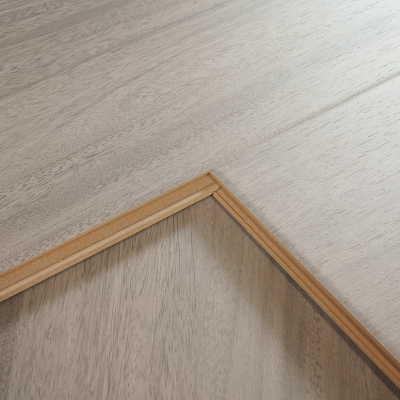
UV Coating: Scratch and stain resistance
Transparent Wear Layer (12–30 mil): Primary abrasion protection
Decorative Film: High-resolution print layer
SPC Core: Rigid limestone-PVC composite
Optional IXPE/EVA Backing: Acoustic absorption
Wear layer thickness directly influences abrasion class, while core density impacts indentation resistance.
Manufacturing Process
1. Raw Material Blending
PVC resin, stabilizers, and calcium carbonate are mixed in high-speed mixers.
2. SPC Core Extrusion
Twin-screw extrusion lines form rigid boards with calibrated thickness tolerance ±0.1mm.
3. Lamination of Wear Layer
High-pressure hot pressing bonds the transparent wear layer to the decor film.
4. UV Surface Coating
Multiple UV layers enhance scratch and chemical resistance.
5. Precision Click Profiling
CNC milling machines create locking systems suitable for commercial loads.
6. Quality Inspection
Abrasion testing, dimensional stability, and locking strength verification ensure compliance.
Industry Comparison
| Material | Wear Protection | Water Resistance | Maintenance Cost | Commercial Durability |
|---|---|---|---|---|
| SPC 12 mil | Moderate | 100% | Low | Light Use Only |
| SPC 20 mil | High | 100% | Low | General Commercial |
| SPC 30 mil | Very High | 100% | Low | Heavy Traffic |
| Laminate AC4 | High | Moisture Sensitive | Medium | Moderate |
| LVT 20 mil | High | Waterproof | Medium | Good |
The decision regarding what mil wear layer is recommended for commercial SPC flooring should align with expected foot traffic and maintenance strategy.
Application Scenarios
Retail Stores: Minimum 20 mil recommended.
Office Buildings: 20–22 mil suitable.
Hotels: 22–30 mil for corridors and lobby areas.
Educational Facilities: 22 mil minimum.
Healthcare Clinics: 20–30 mil depending on equipment load.
Core Pain Points & Solutions
1. Premature Surface Wear
Solution: Upgrade from 12 mil to 20 mil minimum.
2. Indentation from Heavy Furniture
Solution: Ensure high-density SPC core and proper load distribution.
3. High Maintenance Cost
Solution: Select thicker wear layer to reduce replacement frequency.
4. Scratching in Public Areas
Solution: Multi-layer UV coating with 22–30 mil wear protection.
Risk Warnings & Mitigation
12 mil wear layer may fail under continuous foot traffic.
Improper cleaning chemicals can degrade UV coating.
Subfloor unevenness accelerates joint stress.
Low-cost products may not meet declared mil thickness.
Procurement Selection Guide
Define traffic classification (light, medium, heavy).
Specify minimum wear layer in mil (20 mil recommended baseline).
Verify abrasion test reports from factory.
Assess core density (≥1900 kg/m³ preferred).
Review locking strength certification.
Confirm UV coating layers.
Evaluate lifecycle cost over 10-year period.
Request sample boards for onsite mock-up testing.
Engineering Case Study
A 5,000 m² retail renovation project required analysis of what mil wear layer is recommended for commercial SPC flooring. Initial specification proposed 12 mil to reduce budget.
After traffic simulation assessment (estimated 1,500 daily visitors), engineering consultants upgraded specification to 22 mil. Over 6 years of operation, wear patterns remained within acceptable limits, and replacement rate was below 2%, significantly reducing long-term maintenance expenditure.
FAQ
1. What mil wear layer is recommended for commercial SPC flooring?
Minimum 20 mil for general commercial environments.
2. Is 12 mil acceptable for offices?
Only for low-traffic, small offices.
3. What does mil mean?
1 mil equals 0.001 inch (0.0254 mm).
4. Does thicker wear layer increase cost significantly?
Yes, but improves lifecycle value.
5. Is 30 mil necessary for all projects?
No, only for heavy commercial traffic.
6. Does total plank thickness equal wear thickness?
No, they are separate parameters.
7. Can UV coating replace thicker wear layer?
No, both serve different functions.
8. How to verify wear layer thickness?
Request laboratory abrasion test reports.
9. Is 20 mil suitable for hotels?
Yes, but corridors may require 22–30 mil.
10. What is expected service life of 20 mil SPC?
Typically 10–15 years under proper maintenance.
Request Technical Documentation
For project evaluation regarding what mil wear layer is recommended for commercial SPC flooring, submit traffic data, layout drawings, and maintenance expectations. Technical datasheets, abrasion reports, and commercial-grade samples are available upon request.
Author & Technical Authority
This article is prepared by a flooring engineering consultant with over 10 years of SPC manufacturing and commercial project specification experience, supporting distributors, EPC contractors, and developers across international markets.