SPC vs Waterproof Vinyl: Installation, Subfloor & Performance Guide
SPC vs Waterproof Vinyl: Installation, Subfloor & Performance
Choosing between SPC and flexible waterproof vinyl is not only a question of durability. The rigid SPC core behaves differently during installation, while flexible vinyl can accommodate certain subfloor conditions more easily. Thickness, locking system, temperature, expansion, acoustic backing, and subfloor flatness therefore need to be evaluated before installation.
This page focuses on the installation and performance differences between SPC and flexible waterproof vinyl. For commercial project selection and specification, see the Waterproof Vinyl vs SPC Flooring for Commercial Projects page.
Quick Installation Comparison
| Factor | SPC | Waterproof Vinyl |
|---|---|---|
| Core | Rigid | Flexible |
| Subfloor | Flatter | More forgiving |
| Cutting | More rigid | Easier |
| Floating installation | Common | Depends on product |
| Thermal movement | Lower | Higher |
| Cold installation | More sensitive | More flexible |
| Repair | Plank replacement | Product-dependent |
Important note: This table provides general guidance. The appropriate choice depends on the specific product and the installation conditions—verify product requirements before installation.
What Is the Difference Between SPC and Waterproof Vinyl?
SPC and waterproof vinyl are both PVC-based flooring products. The key difference is the core.
SPC Rigid Core
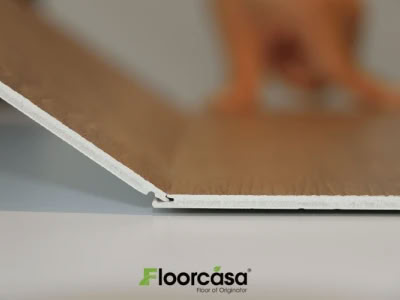
The SPC core is a composite of calcium carbonate (limestone) and PVC. It is rigid and does not contain plasticizers. The rigid core provides high indentation resistance, dimensional stability, and point-load resistance.
Flexible Vinyl Core
The flexible vinyl core is a plasticized PVC compound. The plasticizer content makes the core flexible. The flexible core provides subfloor tolerance and a softer underfoot feel, but it has lower indentation resistance and dimensional stability than SPC.
How the Core Changes Flooring Performance
The core determines the mechanical performance of the product. The rigid SPC core resists indentation and maintains its dimensions under temperature variation. The flexible vinyl core accommodates subfloor irregularities and provides a softer underfoot feel, but it may indent under heavy point loads and may expand or contract with temperature changes.
For detailed product information, see the What Is SPC Flooring page.
SPC vs Waterproof Vinyl Layer by Layer
| Layer | SPC | Waterproof Vinyl |
|---|---|---|
| Wear Layer | Polyurethane + aluminum oxide (0.3–0.7 mm) | Polyurethane or ceramic bead (0.3–0.5 mm) |
| Decorative Layer | Printed film (high resolution) | Printed film (high resolution) |
| Core | Rigid limestone-filled composite | Flexible plasticized PVC |
| Attached Underlayment | IXPE foam (1.0–1.5 mm) or cork | IXPE foam (0.5–1.0 mm) or felt |
| Locking System | Rigid click-lock profile | Flexible click-lock profile |
Wear layer thickness: typically 0.3–0.7 mm for SPC and 0.3–0.5 mm for flexible vinyl. Verify the specific product's wear layer before specification.
Key insight: The core (limestone-filled rigid vs. flexible plasticized PVC) drives all mechanical performance differences. The wear layer and decorative layer are similar in both products. The locking system differs because of the core material.
Wear layer. Both SPC and flexible vinyl use a polyurethane or similar wear layer with aluminum oxide or ceramic bead for abrasion resistance. SPC often has a thicker wear layer for commercial grades.
Decorative layer. Both products use a high-resolution printed film. EIR (Embossed in Register) is available on both.
SPC core vs flexible PVC core. The core defines the rigidity vs. flexibility of the product. SPC is rigid and dimensionally stable; flexible vinyl remains pliable.
Attached underlayment. Both products may have attached underlayment (IXPE foam or cork). SPC often has a thicker pad for acoustic parity.
Locking system. SPC's rigid core allows stronger click-lock profiles. Flexible vinyl locking can flex and separate under heavy loads.
For detailed product information, see the What Is SPC Flooring page.
Subfloor Requirements for SPC vs Waterproof Vinyl
Subfloor condition is one of the most important factors in the choice between SPC and flexible vinyl. The two products have different tolerance for subfloor irregularities.
SPC Subfloor Flatness
SPC requires a flat subfloor. The rigid core does not conform to subfloor irregularities, so any unevenness must be corrected before installation. Uneven subfloors can cause hollow spots, clicking, and eventual locking failure.
Flexible Vinyl Subfloor Tolerance
Flexible vinyl is more forgiving of subfloor irregularities. The flexible core can accommodate minor unevenness without affecting the installation. This makes flexible vinyl suitable for renovation projects where the existing subfloor is not perfectly flat.
Existing Tile Floors
For installations over existing tile, the grout lines may create unevenness. SPC usually requires preparation (filling the grout lines or levelling) to achieve the required flatness. Flexible vinyl may be more forgiving, depending on the product and the grout line depth.
Concrete Subfloors
Concrete subfloors must be dry, flat, and clean before installation. Verify moisture content before installation. Install a vapour barrier where required.
Uneven Subfloors
Uneven subfloors must be levelled before installation. Self-levelling compound can be used for minor unevenness. For larger unevenness, the subfloor may need to be repaired or replaced.
When Self-Leveling Is Necessary
Self-levelling is necessary when the subfloor flatness exceeds the product's tolerance. For SPC, flatness tolerance is typically ≤2 mm over 2 m. For flexible vinyl, flatness tolerance is typically ≤3–4 mm over 2 m. If the subfloor exceeds these tolerances, self-levelling is required.
Subfloor Decision Table
| Subfloor Condition | SPC | Flexible Vinyl |
|---|---|---|
| Smooth concrete | Suitable | Suitable |
| Minor irregularities | Preparation needed | More forgiving |
| Tile with grout lines | Usually requires preparation (fill grout lines) | More forgiving; some products may be installed over grout lines |
| Large depressions | Level first | Level first |
| Moisture issue | Fix moisture first | Fix moisture first |
Important note: Subfloor requirements are product-specific. Verify the specific product's subfloor requirements before installation. For detailed installation instructions, see the SPC installation and maintenance guide.
SPC vs Waterproof Vinyl Installation Steps
The installation process for SPC and flexible vinyl follows the same general sequence. The differences are in the subfloor preparation and the handling of the product.
Step 1 — Inspect the Subfloor
Verify that the subfloor is clean, dry, and sound. Check for cracks, unevenness, and contamination. Address any issues before proceeding.
Step 2 — Check Moisture
Verify subfloor moisture content before installation. Install a vapour barrier where required.
Step 3 — Confirm Flatness
Verify subfloor flatness against the product's tolerance. SPC requires a flatter subfloor than flexible vinyl. If the flatness exceeds the tolerance, level the subfloor with self-levelling compound.
Step 4 — Acclimate the Flooring
Acclimate the flooring in the installation area before installation. Follow the manufacturer's instructions. SPC may require longer acclimation in cold environments.
Installation temperature: SPC should be acclimated at the recommended temperature (typically 18–25°C). Flexible vinyl is more tolerant of lower temperatures, but verify the product's installation temperature range.
Step 5 — Plan Expansion Gaps
Plan the expansion gaps at the perimeter and at intermediate intervals, as required by the product and project conditions.
Step 6 — Install the Flooring
Connect the planks using the click-lock system. Ensure full joint engagement during installation. Use a tapping block (not a mallet) and avoid excessive force.
Step 7 — Check Joints and Edges
Verify joint engagement and edge alignment. Check for any gaps, lipping, or damaged edges.
Step 8 — Inspect the Finished Floor
Inspect the finished floor for gaps, lipping, and joint engagement. Verify that the expansion gaps are maintained. Clean the floor and remove any debris.
For detailed installation instructions, contact us for the installation manual for your specific product. For general SPC installation instructions, see the SPC installation and maintenance guide.
Thermal Expansion and Dimensional Stability
SPC and flexible vinyl respond differently to temperature changes. Understanding these differences helps specifiers plan the installation and avoid problems.
Why SPC Moves Less
SPC has a rigid core with low thermal expansion. The core does not expand or contract significantly under normal temperature variation. This makes SPC more dimensionally stable in large commercial areas and in areas with temperature variation.
Why Flexible Vinyl Can Expand or Contract
Flexible vinyl has a plasticized core that can expand or contract with temperature changes. The plasticizer content makes the core more flexible, but it also makes the product more sensitive to temperature variation.
Temperature During Installation
Installation temperature affects the installation process. SPC is more brittle in cold environments—verify the recommended installation temperature. Flexible vinyl is more flexible in cold environments, but it may also expand more at higher temperatures.
Large Commercial Areas
Large commercial areas require careful planning for thermal movement. SPC is more dimensionally stable in large areas, but expansion gaps and profiles are still required. Flexible vinyl may require larger expansion gaps or more frequent expansion profiles.
Sunlit Areas and Glass Facades
Areas with strong sunlight or glass facades can experience higher floor temperatures. Verify the product's temperature resistance before installation. SPC and flexible vinyl both have temperature limits—verify the specific product's temperature range.
Expansion Gap Calculation
Expansion gap calculation (SPC): gap (mm) = room length (m) × 0.08 mm/m/°C × ΔT × 1.2. For a 15 m room with ΔT = 20°C: gap = 15 × 0.08 × 20 × 1.2 = 28.8 mm. Verify the manufacturer's expansion gap requirements.
Important note: Thermal expansion and dimensional stability are product-specific. Verify the specific product's test data before specification.
SPC vs Waterproof Vinyl for Underfloor Heating
Both SPC and flexible vinyl are compatible with underfloor heating within specified temperature limits. The differences are in heat transfer and installation requirements.
Heat Transfer
SPC has lower thermal resistance (R-value) than flexible vinyl, so SPC transfers heat more efficiently. This means SPC may reach the target floor temperature faster and with less energy.
Thermal Resistance
Thermal resistance (R-value) determines how well the flooring transfers heat from the underfloor heating system. Lower R-value means better heat transfer.
Maximum Floor Temperature
Both SPC and flexible vinyl have maximum floor temperature limits. Typical maximum surface temperature: ≤27°C for SPC. Verify the specific product's maximum temperature before installation.
Manufacturer Requirements
Verify the product's underfloor heating compatibility and follow the underfloor heating manufacturer's instructions. The underfloor heating system must be commissioned and brought to operating temperature before installation, then cooled before installation.
Installation Precautions
Verify the product's underfloor heating compatibility.
Commission the underfloor heating system before installation.
Bring the system to operating temperature before installation, then cool it.
After installation, raise the temperature gradually.
Verify the maximum surface temperature.
Follow the underfloor heating manufacturer's instructions.
Important note: Underfloor heating compatibility is product-specific. Verify the specific product's requirements before installation.
Acoustic Performance and Underlayment
Acoustic performance is an important consideration in multi-story buildings and areas where noise is a concern. SPC and flexible vinyl have different acoustic characteristics.
Impact Sound
Impact sound is the sound generated by foot traffic, dropped objects, or furniture movement. The acoustic performance of the flooring depends on the product and the underlayment.
Attached IXPE Pad
Both SPC and flexible vinyl may have attached IXPE foam pad. The attached pad provides acoustic insulation and comfort underfoot. SPC often has a thicker pad for acoustic parity with flexible vinyl.
Separate Underlayment
Where additional acoustic performance is required, a separate underlayment may be installed beneath the flooring. The appropriate underlayment depends on the project's acoustic requirements.
Apartment Projects
Apartment projects often require acoustic performance to meet building code requirements. Verify the product's acoustic test data and the underlayment requirements for the specific project.
Commercial Projects
Commercial projects may require acoustic performance in specific areas (meeting rooms, offices). Verify the product's acoustic test data and the underlayment requirements for the specific project.
Acoustic impact reduction: typical values are 16–18 dB for SPC (without pad); 14–16 dB for thin flexible vinyl (without pad). With attached pad, both may achieve ΔLw ≥19 dB. Verify the specific product's acoustic test data.
Important note: Acoustic performance is product-specific. Verify the specific product's acoustic test data before specification. For general SPC information, see the What Is SPC Flooring page.
Common SPC and Waterproof Vinyl Installation Problems
The most common problem in SPC and flexible vinyl installations is gaps between planks, followed by hollow sound, edge lifting, buckling, plank movement, click lock damage, and telegraphing of subfloor imperfections.
SPC Click Lock Damage
Symptom: Broken or damaged locking profile during installation.
Cause: Excessive force during installation, incorrect installation angle, or cold environment (SPC is more brittle in cold conditions).
How to check: Inspect the locking profile for cracks or chips. Verify the installation angle and the installation temperature.
How to handle: Replace damaged planks. Use a tapping block (not a mallet) and the correct installation angle.
How to avoid: Acclimate SPC at the recommended temperature. Train installers on the correct angle. Avoid excessive force.
Gaps Between Planks
Symptom: Visible gaps between planks after installation.
Cause: Incomplete joint engagement, subfloor unevenness, or thermal movement.
How to check: Check the joint engagement and the subfloor flatness. Verify the expansion gap calculation.
How to handle: For small gaps, use colour-matched filler; for larger gaps, disassemble and reinstall.
How to avoid: Verify subfloor flatness, ensure full joint engagement, and calculate expansion gaps correctly.
Hollow Sound
Symptom: Hollow or clicking sound when walking on the floor.
Cause: Uneven subfloor, inadequate underlayment, or debris beneath the planks.
How to check: Check the subfloor flatness and the underlayment installation. Clean the subfloor before installation.
How to handle: Address subfloor flatness, verify underlayment installation, and clean the subfloor.
How to avoid: Verify subfloor flatness, use appropriate underlayment, and clean the subfloor before installation.
Plank Movement
Symptom: Planks move or shift after installation.
Cause: Insufficient expansion gaps, inadequate perimeter support, or subfloor movement.
How to check: Verify the expansion gaps and the perimeter support. Check the subfloor stability.
How to handle: Verify expansion gaps, install baseboards or moldings to secure the perimeter, and address subfloor movement.
How to avoid: Calculate expansion gaps correctly, secure the perimeter, and verify subfloor stability.
Edge Lifting
Symptom: Plank edges lift or curl after installation.
Cause: Moisture ingress, incomplete joint engagement, or subfloor unevenness.
How to check: Check the moisture source, joint engagement, and subfloor flatness.
How to handle: Address the moisture source, ensure full joint engagement, and address subfloor unevenness.
How to avoid: Verify subfloor flatness, ensure full joint engagement, and maintain appropriate indoor humidity.
Buckling
Symptom: The floor lifts or buckles at the edges or in the middle of the room.
Cause: Insufficient expansion gaps, excessive temperature variation, or moisture ingress.
How to check: Verify the expansion gaps and the temperature variation. Check the moisture source.
How to handle: Increase expansion gaps, install expansion profiles, and address the moisture source.
How to avoid: Calculate expansion gaps correctly, install expansion profiles, and maintain appropriate indoor temperature and humidity.
Telegraphing of Subfloor Imperfections
Symptom: Subfloor irregularities (grout lines, small dips) are visible on the floor surface.
Cause: The flooring does not conform to the subfloor irregularities. SPC is more susceptible than flexible vinyl.
How to check: Check the subfloor flatness and the underlayment installation.
How to handle: Level the subfloor and reinstall. For renovation over existing tile with grout lines, flexible vinyl may be more forgiving.
How to avoid: Verify subfloor flatness before installation. Use appropriate underlayment to bridge minor irregularities.
Important note: Installation problems are product-specific. Verify the specific product's installation requirements before installation. For general SPC installation instructions, see the SPC installation and maintenance guide.
FAQ: SPC vs Waterproof Vinyl Installation
1. What should I check before installing SPC over an existing floor?
Check the subfloor flatness (typically ≤2 mm over 2 m for SPC), moisture content, and cleanliness. Check for loose tiles or unevenness. Verify the installation temperature and the expansion gap requirements.
2. Does SPC require a perfectly flat subfloor?
SPC requires a flat subfloor within tolerance (typically ≤2 mm over 2 m). Uneven subfloors must be levelled before installation. Flexible vinyl is more forgiving of subfloor irregularities (typically ≤3–4 mm over 2 m).
3. Can SPC be installed over tile?
Yes, if the tile is flat, sound, and clean. Grout lines may need to be filled if they create unevenness beyond tolerance. Verify subfloor flatness and moisture content before installation.
4. Does SPC expand and contract?
SPC has low thermal expansion and near-zero moisture expansion. It is more dimensionally stable than flexible vinyl, but expansion gaps are still required.
5. Can SPC flooring be used with underfloor heating?
Yes, within specified temperature limits (typically ≤27°C surface temperature). Verify the product's underfloor heating compatibility and follow the underfloor heating manufacturer's instructions.
6. Does SPC need underlayment?
Underlayment is recommended for acoustic performance and can also provide minor subfloor tolerance. Some SPC products have integrated underlayment. Verify the product requirements.
7. Why do SPC click locks break?
SPC click locks can break due to excessive force during installation, incorrect installation angle, or cold environment (SPC is more brittle in cold conditions). Acclimate SPC at the recommended temperature and use the correct installation angle.
8. Which flooring is easier to cut and repair?
Flexible vinyl is easier to cut (utility knife). SPC requires more force to cut. For repair, both products allow individual plank replacement by disassembling the floor from the nearest edge, provided the locking profiles are not damaged.
CTA
For installation manuals, technical datasheets, product samples, or project-based quotations for SPC or waterproof vinyl flooring, procurement and engineering teams are encouraged to submit detailed project requirements for evaluation.