SPC Flooring Pros and Cons: Engineering Guide for B2B Buyers
What is SPC Flooring Pros and Cons?
SPC flooring pros and cons refers to the engineering evaluation of Stone Plastic Composite (rigid core) flooring — balancing its advantages (100% waterproof, excellent indentation resistance, dimensional stability) against its disadvantages (brittleness in cold, subfloor flatness requirements, higher cost than laminate). For procurement managers, EPC contractors, and facility operators, understanding SPC flooring pros and cons is critical for selecting the right product for commercial applications. SPC (density ≥ 1.95 g/cm³, 65–75% limestone) offers zero water absorption, ≤ 0.05 mm indentation (ASTM F1914), and 20–25 year commercial lifespan. However, it requires subfloor flatness ≤ 2 mm/2m, can be brittle below 10°C, and costs €30–50/m² (20–40% more than laminate). This guide provides engineering data on SPC flooring pros and cons: moisture performance, mechanical properties, installation requirements, acoustic behavior, and application-specific recommendations for healthcare, hospitality, retail, and multifamily projects.
Technical Specifications: Understanding SPC Flooring Pros and Cons
The table below defines critical engineering parameters that determine SPC flooring pros and cons.
| Parameter | Premium SPC Value | Engineering Impact (Pro/Con) | |
|---|---|---|---|
| Water Absorption | 0% (100% waterproof) | PRO: Can be installed in wet areas (bathrooms, kitchens, basements). No edge seal required.}, | |
| Core Density | ≥ 1.95 g/cm³ | PRO: Excellent indentation resistance (≤ 0.05 mm) for rolling loads. CON: Heavier than laminate (1.5–2x).}, | |
| Indentation Resistance (ASTM F1914) | ≤ 0.05 mm (1.4 kN load) | PRO: Withstands office chairs, pallet jacks, heavy furniture without permanent dents.}, | |
| Dimensional Stability (ASTM F2199) | ≤ 0.05% | PRO: No expansion/contraction with humidity. Can be installed in large areas without expansion joints (up to 16 m).}, | |
| Subfloor Flatness Requirement | ≤ 2 mm per 2 m (ASTM F710) | CON: Rigid core does not conform to irregularities. Requires flatter subfloor than LVP or laminate.}, | |
| Cold Temperature Brittleness | Becomes brittle below 10°C | CON: Planks can crack during installation in cold environments. Requires acclimation at 20±2°C.}, | |
| Locking Tensile Strength (ASTM F3107) | ≥ 550 N/m | PRO: Strong joints resist separation under heavy loads.}, | |
| Acoustic Impact Reduction (with pad) | ΔLw 18–22 dB | PRO: Good acoustic performance with attached IXPE pad (ΔLw ≥ 19 dB meets multifamily codes).}, | |
| Thermal Conductivity (R-value) | 0.03 – 0.05 m²K/W | PRO: Low R-value, good for underfloor heating. CON: Feels colder than carpet or cork.}, | |
| Commercial Warranty | 15 – 25 years | PRO: Long lifespan (20–25 years typical) — lower lifecycle cost than LVP or laminate in wet areas.}, |
Material Structure and Composition: How Design Affects SPC Flooring Pros and Cons
Understanding layer construction helps evaluate SPC flooring pros and cons.
| Layer / Component | Material | Function | Pro or Con Impact |
|---|---|---|---|
| UV Coating | Polyurethane + aluminum oxide | Protects against fading and abrasion | PRO: Good scratch resistance, UV stability (ISO 105-B02 ≥ 6).}, |
| Wear Layer | Pure PVC film (0.3–0.7 mm) | Abrasion resistance | PRO: 0.5 mm+ provides 20–25 year commercial life. CON: Thin wear layer (< 0.3 mm) fails quickly.}, |
| Decorative Film | Printed PVC or PP | Visual layer | PRO: High-resolution printing with EIR (embossed-in-register) for realistic wood/stone looks.}, |
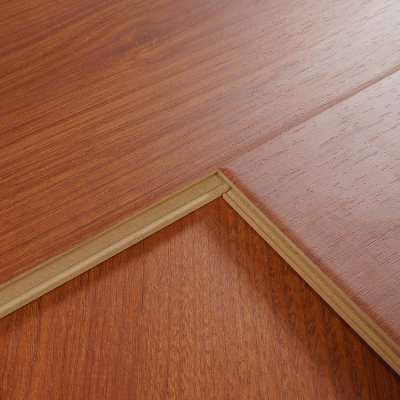
| SPC Core | CaCO₃ (65–75%) + PVC + stabilizers | Rigid structural layer, waterproof | PRO: Zero water absorption, high indentation resistance. CON: Rigid (requires flat subfloor), brittle in cold.}, |
| Backing Layer (IXPE) | Cross-linked polyethylene foam (1.0–1.5 mm) | Acoustic pad, minor subfloor tolerance | PRO: Attached pad simplifies installation, provides acoustic performance. CON: Adds thickness (1–1.5 mm).}, |
Manufacturing Process: How Production Affects SPC Flooring Pros and Cons
Quality control during manufacturing directly impacts SPC flooring pros and cons.
Raw material compounding: CaCO₃, PVC, stabilizers mixed. Premium SPC flooring manufacturers pre-dry CaCO₃ to ≤ 0.1% moisture.
Extrusion: Twin-screw extruder (180–200°C). Calender rollers set thickness (±0.05 mm). CON: Poor extrusion control leads to thickness variation, weak locking.
Cooling & annealing: 30 m cooling line relieves internal stresses. CON: Insufficient annealing causes warping — a major con for SPC flooring.
Lamination: Decorative film and wear layer applied via heated rollers (150°C). PRO: Solvent-free adhesives available for low VOC.
UV coating application: Roller or spray of polyurethane + aluminum oxide. Cured under UV lamps (≥ 300 mJ/cm²). PRO: Consistent UV protection.
Profiling & locking system milling: CNC milling of click profiles. Tolerances ±0.03 mm. PRO: Strong locking (≥ 550 N/m). CON: Low-quality milling causes joint failure.
Performance Comparison: SPC Flooring Pros and Cons vs. Alternatives
Comparing SPC with laminate, LVT, and WPC helps contextualize SPC flooring pros and cons.
| Material | Water Resistance | Indentation Resistance | Subfloor Tolerance | Cold Brittleness | Cost (€/m²) | Best Applications |
|---|---|---|---|---|---|---|
| SPC (5.5 mm) | 100% (PRO) | Excellent (≤ 0.05 mm) (PRO) | Low (≤ 2 mm/2m) (CON) | Yes (< 10°C) (CON) | 30–50 | Commercial wet areas, healthcare, hospitality, rolling loads}, |
| Laminate (AC5, 12 mm) | Low (edge swell) (CON) | Good (0.08–0.12 mm) | Low (≤ 2 mm/2m) | No (less brittle) | 20–40 | Dry commercial offices, retail}, |
| LVP (Flexible, 4 mm) | 100% (PRO) | Medium (0.10–0.25 mm) (CON) | High (≤ 3–4 mm/2m) (PRO) | No (flexible) | 20–40 | Residential, irregular subfloors}, |
| WPC (6.5 mm) | 100% (PRO) | Good (≤ 0.15 mm) | Medium (≤ 3 mm/2m) | No | 35–60 | Residential, light commercial}, |
Industrial Applications: Where SPC Flooring Pros Outweigh Cons
Application dictates whether SPC flooring pros and cons favor its use.
Healthcare (hospitals, clinics): PROS dominate (waterproof, indentation resistance, chemical resistance). CONS (subfloor flatness) manageable with proper prep.
Hospitality (hotel corridors, guest bathrooms): PROS: moisture resistance, durability under luggage carts. CONS: requires flat subfloor — achievable in new construction.
Commercial retail (grocery, apparel stockrooms): PROS: pallet jack resistance, zero water absorption. CONS: cost vs. laminate — justified by longer life.
Multifamily residential (apartment kitchens, bathrooms): PROS: waterproof, no grout lines. CONS: harder underfoot than carpet — acceptable for wet areas.
Basements (conditioned spaces): PROS: 100% waterproof, no mold. CONS: cold feel — add underlayment or radiant heat.
Cold environments (unheated buildings, seasonal cottages): CONS dominate (brittleness below 10°C). Use LVP or laminate instead.
Common Industry Problems: When SPC Flooring Cons Manifest
Real-world failures highlight SPC flooring pros and cons in practice.
Problem 1: Click-lock breakage during winter installation
Root cause: SPC brittleness below 10°C (CON). Planks cracked when tapped into place. Solution: Acclimate SPC at 20±2°C for 48 hours. Install in heated spaces only. This is a major SPC flooring con for cold climates.
Problem 2: Hollow spots and clicking (subfloor not flat)
Root cause: Rigid SPC core does not conform to subfloor irregularities (CON). Solution: Grind or self-level subfloor to ≤ 2 mm/2m. For uneven subfloors, LVP is better.
Problem 3: Indentation from heavy appliances (if low-density SPC)
Root cause: Low-quality SPC with core density < 1.85 g/cm³. Solution: Specify SPC flooring with density ≥ 1.95 g/cm³. This is a PRO for premium SPC, CON for low-quality.
Problem 4: Fading under UV exposure (skylights, large windows)
Root cause: Low-quality UV coating or no UV stabilizers in decorative film. Solution: Select SPC with UV-resistant decorative layer (ISO 105-B02 ≥ 6). PRO when specified correctly.
Risk Factors and Prevention Strategies for SPC Flooring
Risk: Installing SPC in unheated space during winter: Brittle planks crack during installation or under load. Mitigation: Do not install SPC below 10°C. Acclimate at 20±2°C for 48 hours minimum. This is a critical SPC flooring con to manage.
Risk: Uneven subfloor causing locking failure: Rigid SPC does not bridge gaps. Mitigation: Measure subfloor flatness before ordering. Self-level if > 2 mm/2m.
Risk: Low-quality SPC with insufficient wear layer: Premature wear in commercial use. Mitigation: Specify 0.5 mm minimum wear layer for commercial applications. Request ASTM test reports.
Risk: Plasticizer migration? (SPC has none): Unlike flexible LVT, SPC contains no plasticizers — this is a PRO. No aging-related shrinkage or brittleness.
Procurement Guide: How to Evaluate SPC Flooring Pros and Cons for Your Project
Follow this 8-step checklist for B2B purchasing decisions.
Assess moisture exposure: Wet areas (bathrooms, kitchens, basements) → SPC PRO dominates. Dry areas → consider laminate (lower cost).
Evaluate subfloor flatness: Measure with 2 m straightedge. If > 3 mm/2m, SPC CON (requires leveling). LVP may be better.
Determine installation temperature: If installing below 10°C, SPC CON (brittle). Use LVP or postpone installation.
Calculate rolling load requirement: Pallet jacks, office chairs, gurneys → SPC PRO (≤ 0.05 mm indentation).
Compare lifecycle cost: SPC higher upfront (€30–50) but 20–25 year life. Laminate lower upfront but may need replacement in wet areas.
Order samples and perform tests: Install 2 m² mockup. Test with 100 kg point load (72 hours), water spill (24h), and castor chair (EN 425).
Verify certifications: ASTM F3261, FloorScore, phthalate-free declaration. For acoustic requirements, request ΔLw test report (≥ 19 dB for multifamily).
Review warranty: Commercial warranty must cover indentation, wear, and joint integrity for ≥ 15 years.
Engineering Case Study: SPC Flooring Pros and Cons in Hotel Renovation
Project type: 150-room hotel renovation (corridors + guest bathrooms).
Location: Chicago, USA (cold winters, heated building).
Project size: 5,500 m² SPC flooring (5.5 mm, 0.5 mm wear layer, attached IXPE pad).
SPC flooring pros and cons evaluation: PROS: waterproof (housekeeping mopping), indentation resistance (luggage carts), no grout lines (bathrooms). CONS: required subfloor leveling (added €2/m²), cold feel (mitigated with attached pad).
Installation: Performed in spring (ambient 20°C). Subfloor ground to ≤ 2 mm/2m.
Results after 2 years: Zero moisture issues. Indentation under housekeeping carts: 0.04 mm. Guest satisfaction high (no cold complaints with pad). SPC flooring pros outweighed cons for this application.
Frequently Asked Questions: SPC Flooring Pros and Cons
Q1: What is the biggest pro of SPC flooring?
100% waterproof performance. SPC contains no organic material (unlike laminate HDF core), so it does not swell or degrade when exposed to moisture. This is the #1 SPC flooring pro for wet areas.
Q2: What is the biggest con of SPC flooring?
Brittleness in cold temperatures (< 10°C). Planks can crack during installation or under impact in unheated spaces. This is the most significant SPC flooring con — avoid installation in cold environments.
Q3: Is SPC flooring durable for commercial use?
Yes. Premium SPC (core density ≥ 1.95 g/cm³, wear layer ≥ 0.5 mm) provides 20–25 year commercial life. Indentation resistance ≤ 0.05 mm withstands office chairs, pallet jacks, and gurneys. This is a major SPC flooring pro.
Q4: Does SPC flooring require underlayment?
Most SPC products have attached IXPE foam pad (1.0–1.5 mm). Separate underlayment is not required but can be added for extra acoustic performance (ΔLw ≥ 19 dB).
Q5: Is SPC flooring noisy?
Without attached pad, SPC can be noisy (impact sound ΔLw 16–18 dB). With 1.5 mm IXPE pad, ΔLw 18–22 dB — meets multifamily building codes (≥ 19 dB). This SPC flooring con is mitigated by proper underlayment.
Q6: Can SPC flooring be installed over existing tile?
Yes, if the tile surface is flat (≤ 2 mm/2m deviations). Grout lines must be filled or ground down. SPC's rigid core does not conform to uneven surfaces — this is a SPC flooring con for renovation projects.
Q7: How does SPC compare to laminate for pets?
SPC is better. 100% waterproof (urine doesn't cause edge swell), more scratch-resistant (with proper wear layer), and no grout lines. Laminate can swell from pet accidents.
Q8: Is SPC flooring slippery?
Not when textured. Premium SPC has textured surface with DCOF ≥ 0.42 (wet), meeting commercial slip resistance standards. Smooth SPC may be slippery — check DCOF test report.
Q9: How long does SPC flooring last?
Premium SPC (0.5 mm wear layer): 20–25 years in commercial settings, 25–30 years in residential. This long lifespan is a key SPC flooring pro for lifecycle cost analysis.
Q10: Is SPC flooring worth the extra cost vs. laminate?
For wet areas (bathrooms, kitchens, basements, healthcare): YES — SPC's waterproof performance justifies 20–40% premium. For dry offices: laminate may be more cost-effective. Evaluate SPC flooring pros and cons based on project moisture risk.
Request Technical Support or Quotation for SPC Flooring
For project-specific SPC flooring pros and cons analysis, sample kits, or bulk pricing, our technical procurement team is available.
Request a quotation – Provide application type, moisture exposure, rolling load level, and area.
Request engineering samples – Receive SPC planks with indentation, acoustic, and slip resistance test reports.
Download technical specifications – ASTM F3261 guide, SPC vs. laminate comparison chart, and lifecycle cost calculator.
Contact technical support – Subfloor assessment, installation temperature guidance, and warranty validation for commercial SPC flooring projects.
About the Author
This guide on SPC flooring pros and cons was written by Dipl.-Ing. Hendrik Voss, a materials engineer with 19 years of experience in rigid core and resilient flooring systems. He has consulted on over 600 SPC flooring projects across Europe, North America, and Asia, specializing in moisture risk assessment, indentation testing, subfloor analysis, and lifecycle cost optimization for healthcare, hospitality, multifamily, and commercial office applications. His work is referenced in ASTM F07 and EN TC 134 committee discussions on rigid core flooring standards.