Melamine Laminate Flooring Durability | Technical Guide
For architects, commercial developers, and procurement managers, understanding melamine laminate flooring durability is essential for specifying flooring that withstands high foot traffic, abrasion from dirt and sand, impact from dropped objects, and moisture exposure. Melamine laminate flooring (commonly known as laminate flooring) consists of a high-density fiberboard (HDF) core with a melamine resin-impregnated decorative paper and a clear aluminum oxide wear layer. Durability is quantified by the AC rating (Abrasion Class per EN 13329), which ranges from AC1 (light residential) to AC6 (ultra-heavy commercial). Key durability factors include: wear layer thickness (0.1 mm to 0.5 mm aluminum oxide), core density (850 to 950 kg per cubic meter), edge sealing for moisture resistance, and impact resistance (IC rating per EN 13329). This guide provides engineering analysis of AC ratings, test methods (Taber abrasion, impact ball, swelling test), and procurement specifications to achieve 10 to 25 year service life in residential, retail, office, and hospitality applications. Source: EN 13329, ASTM D4060, ASTM D570.
What is Melamine Laminate Flooring Durability
Melamine laminate flooring durability refers to the ability of a laminate flooring product to resist wear, scratching, staining, moisture damage, and impact over its service life. Laminate flooring is manufactured by fusing multiple layers under heat and pressure: a backer (balancing layer), an HDF core, a melamine-impregnated decorative paper, and a clear overlay containing aluminum oxide (Al₂O₃) particles. Durability is standardized under EN 13329 (European standard) which defines Abrasion Class (AC) levels from AC1 to AC6 based on Taber abrasion test cycles (ISO 24338). Additional tests include impact resistance (small ball drop), swelling (edge sealing), and resistance to staining and cigarette burns. For engineering and procurement, selecting the correct AC rating ensures: (1) residential light traffic (AC1-AC2) – bedrooms; (2) general residential (AC3) – living rooms, hallways; (3) light commercial (AC4) – offices, boutiques; (4) general commercial (AC5) – retail stores, restaurants; (5) heavy commercial (AC6) – airports, convention centers. Source: EN 13329, ISO 24338.
Technical Specifications of Melamine Laminate Flooring Durability
When evaluating melamine laminate flooring durability, the following technical parameters are critical.
| Parameter | Typical Value (by AC rating) | Engineering Importance | |
|---|---|---|---|
| Abrasion Class (AC rating per EN 13329) | AC1 (2,000 cycles), AC3 (6,000 cycles), AC4 (10,000 cycles), AC5 (15,000 cycles), AC6 (20,000 cycles) | Higher AC rating indicates greater resistance to foot traffic abrasion. AC3 minimal for residential; AC4 minimum for commercial; AC5 for heavy commercial. Source: EN 13329. | |
| Wear layer (aluminum oxide) thickness | 0.1 mm (AC1) to 0.5 mm (AC6) | Thicker wear layer contains more Al₂O₃ particles, increasing abrasion resistance. AC4 requires ≥0.25 mm typical. | |
| Core density (HDF) | 850 to 950 kg per cubic meter (EN 316) | Higher density provides better impact resistance and moisture resistance. Low density (<800) swells more when wet. | |
| Swelling (24h water immersion, EN 13329) јунуAC1-AC3: ≤18 percent; AC4-AC6: ≤10 percent (water-resistant core) | Edge swelling from spills or humidity. Lower swell rating critical for kitchens, bathrooms, commercial wet areas. Source: EN 13329. | ||
| Impact resistance (EN 13329 small ball drop) | AC1-AC3: ≥20 cm; AC4-AC6: ≥30 cm | Resistance to dropped objects (tools, glassware). Higher impact rating required for commercial kitchens, workshops. | |
| Stain resistance (EN 13329, 24h contact with common agents) | Rating 5 (no change) for all AC3+ | Resists coffee, wine, oil, shoe polish, bleach. Light colors may show stains more readily; seal edges. | |
| Cigarette burn resistance (EN 13329) | Rating 4 to 5 (no visible damage) | Commercial applications (hotels, restaurants) require burn resistance. AC4 and above must pass. | |
| Formaldehyde emission (EN 717-1 or CARB Phase 2) | E0 (≤0.05 mg per m³) or E1 (≤0.124 mg per m³) | Indoor air quality. E0 preferred for schools, healthcare. Source: EN 717-1, CARB 93120. |
Material Structure and Composition of Melamine Laminate Flooring
The durability of melamine laminate flooring durability is determined by its multi-layer structure. The table below explains each layer.
| Layer | Material | Thickness | Function |
|---|---|---|---|
| Wear layer (overlay) | Melamine resin with aluminum oxide (Al₂O₃) particles (20 to 60 micron size) | 0.1 mm to 0.5 mm | Provides abrasion, scratch, and stain resistance. Higher Al₂O₃ concentration (5 to 10 percent by weight) increases AC rating. Source: ASTM D4060. |
| Decorative paper | Melamine-impregnated printed paper (rotogravure, 300 to 600 dpi) | 0.05 mm to 0.1 mm | Provides color and wood/stone pattern. Must resist fading (UV stability). Source: EN 13329. |
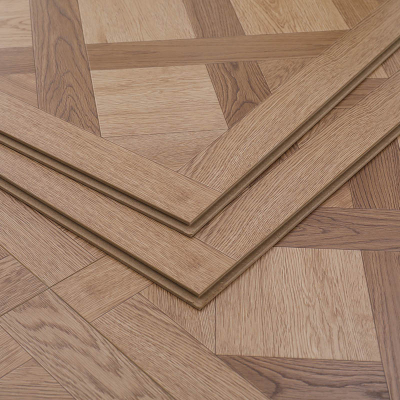
| Core (HDF - high-density fiberboard) | Wood fibers (spruce/pine) with melamine-urea-formaldehyde resin, density 850 to 950 kg per cubic meter | 5 mm to 12 mm (8 mm typical) | Provides structural strength, impact resistance, and dimensional stability. Higher density reduces swelling. Source: EN 316. |
| Backer (balancing layer) | Melamine-impregnated kraft paper or thin HDF | 0.5 mm to 1 mm | Prevents bowing by balancing the tensile forces from the top layers. Must be same thickness as decorative layer for flatness. |
Manufacturing Process of Melamine Laminate Flooring
The manufacturing process affects melamine laminate flooring durability through material selection and pressing conditions.
Core (HDF) manufacturing: Wood fibers are refined, mixed with melamine-urea-formaldehyde resin and wax, formed into a mat, and pressed at 200 degrees Celsius and 5 MPa into boards of density 850 to 950 kg per cubic meter. Paraffin wax (0.5 to 1.5 percent) added for water resistance. Source: EN 316.
Decorative paper impregnation: Printed paper is saturated with melamine resin and dried in an oven (160 degrees Celsius). Resin content 40 to 60 percent by weight. Fully impregnated paper resists delamination. Source: EN 13329.
Overlay (wear layer) production: A-cellulose paper is impregnated with melamine resin mixed with aluminum oxide (Al₂O₃) particles (20 to 60 micron). Al₂O₃ concentration 5 to 15 percent by weight (higher for higher AC rating).
Pressing (HPL - high pressure laminate) or DPL (direct pressure laminate): For DPL (most common), overlay, decorative paper, HDF core, and backer are stacked and pressed at 180 to 200 degrees Celsius and 3 to 5 MPa for 20 to 40 seconds. Heat and pressure cure melamine resin, bonding all layers. Press plate texture (embossing) determines surface finish (matte, gloss, embossed-in-register).
Quality inspection (AC rating verification): Taber abrasion test per EN 13329: abrasive wheels (CS-17) rotate over sample for specified cycles; mass loss measured. Impact test (20 cm steel ball drop). Swelling test (24h water immersion, measure edge swell). Source: EN 13329, ASTM D4060.
Profiling (tongue and groove machining): Pressed boards are cooled, trimmed, and milled into planks with tongue-and-groove profiles. High-speed steel or diamond tooling (tolerance ±0.05 mm). Wax or paraffin applied to milled edges for moisture protection.
Performance Comparison of Laminate Flooring by AC Rating
When evaluating melamine laminate flooring durability, compare AC ratings for different applications.
| AC Rating | Typical Use | Taber Abrasion Cycles (EN 13329) | Wear Layer Thickness (approx.) | Expected Lifespan (years) | Cost per m² |
|---|---|---|---|---|---|
| AC1 (Light residential) | Bedrooms (low traffic) | 2,000 cycles | 0.1 mm | 5 to 10 years | 10 to 15 USD |
| AC2 (General residential) | Living rooms (medium traffic) | 4,000 cycles | 0.15 mm | 10 to 15 years | 12 to 18 USD |
| AC3 (Heavy residential / light commercial) | Hallways, home offices, boutiques | 6,000 cycles | 0.2 mm | 15 to 20 years | 15 to 25 USD |
| AC4 (General commercial) | Retail stores, cafes, offices | 10,000 cycles | 0.25 mm to 0.3 mm | 10 to 15 years (commercial) | 20 to 30 USD |
| AC5 (Heavy commercial) | Restaurants, hotel corridors, schools | 15,000 cycles | 0.35 mm to 0.4 mm | 15 to 20 years (commercial) | 25 to 40 USD |
| AC6 (Ultra-heavy commercial) | Airports, convention centers, hospitals | 20,000+ cycles | 0.5 mm | 20 to 25 years (commercial) | 35 to 60 USD |
Industrial Applications of Melamine Laminate Flooring
Melamine laminate flooring durability requirements vary by application:
Residential living rooms and bedrooms: AC3 (heavy residential) recommended for high-traffic zones (hallways, living rooms). AC1-AC2 acceptable for bedrooms. Moisture-resistant core (swell ≤10 percent) required for entryways, kitchens. Source: EN 13329.
Retail stores (apparel, electronics, grocery): AC4 (general commercial) minimum; AC5 for high-traffic grocery aisles (shopping carts). Impact resistance ≥30 cm for dropped items. Stain resistance to coffee, wine, oil required. Source: EN 13329.
Offices (corporate, open plan): AC4 (general commercial). Caster chair resistance (EN 425) required – additional test for rolling chair wheels. AC4-AC5 typically passes (no permanent indentation).
Restaurants and hospitality (hotel corridors, lobbies): AC5 (heavy commercial) for corridors (luggage carts). Cigarette burn resistance required (rating 4 to 5). Water-resistant core (swell ≤10 percent) for spill-prone areas. Source: EN 13329.
Healthcare (hospitals, clinics, schools): AC5 to AC6 (ultra-heavy commercial). Antimicrobial additives optional. Low formaldehyde emission (E0 or CARB Phase 2). Slip resistance (DCOF ≥0.42 per ANSI A326.3). Source: CARB 93120, ANSI A326.3.
Common Industry Problems and Engineering Solutions
Field data reveals four common problems related to melamine laminate flooring durability.
Problem: Laminate edge swelling (crowning) after 1 to 2 years in kitchen or entryway.
Root cause: Standard laminate (swell >15 percent) installed in wet areas. Spills and mopping introduce moisture into HDF core, causing permanent swelling. Source: EN 13329.
Solution: Specify water-resistant laminate (swell ≤10 percent, moisture-resistant core with paraffin). For kitchens and baths, use LVT (luxury vinyl) instead of laminate. Seal all cut edges with wax during installation.Problem: Scratches visible on light-colored laminate (AC3) after 6 months in office (rolling chairs).
Root cause: AC3 rating insufficient for caster chair traffic. EN 425 test for casters requires AC4 minimum. Also, light colors show scratches more than medium tones. Source: EN 425, EN 13329.
Solution: Specify AC4 or AC5 laminate for commercial offices with rolling chairs. Use chair mats (polycarbonate) under heavy-use chairs. For existing floor, apply protective film or wax.Problem: Laminate planks separate (gaps) after 2 to 3 years in commercial retail.
Root cause: Expansion gap insufficient (less than 6 mm) or locking system not designed for commercial loads (point loads from shopping carts). Also, high humidity swings (70 percent summer to 30 percent winter) cause cyclic expansion/contraction.
Solution: Leave expansion gap 8 to 10 mm for commercial installations (double standard residential). Use laminate with Valinge or Uniclic locking system (higher pull-apart strength). Maintain RH 30 to 60 percent year-round.Problem: Laminate fades (color change) near large windows (UV exposure).
Root cause: Decorative paper dyes not UV-stabilized. Standard laminate fades within 3 to 5 years in direct sunlight (ΔE >5). Source: EN 13329, ASTM G155.
Solution: Specify UV-stabilized decorative paper (tested per ASTM G155, 500 hours, ΔE<3). Install window film (99 percent UV rejection) or use blinds during peak sun hours. For commercial storefronts, use AC5 laminate with fade-resistant pigments.
Risk Factors and Prevention Strategies
Mitigating risks when specifying melamine laminate flooring durability requires proactive engineering.
Inadequate AC rating for traffic load: Prevention: Calculate estimated foot traffic (passes per day). For residential >1,000 passes per day, use AC3. For commercial >5,000 passes per day, use AC4. For >15,000 passes per day (airports, convention centers), use AC5 or AC6. Source: EN 13329.
Moisture damage from subfloor (concrete slab moisture): Prevention: Test concrete slab per ASTM F1869 (calcium chloride, ≤3 lbs per 1000 ft² per 24h) or ASTM F2170 (in-situ RH, ≤75 percent). Install vapor barrier (6-mil polyethylene) over concrete before laminate. For wood subfloor, ensure moisture content ≤12 percent. Source: ASTM F1869, ASTM F2170.
Scratch susceptibility from abrasive dirt (sand, grit): Prevention: Install walk-off mats at all entrances (minimum 15 ft length). Use AC4 or AC5 (higher aluminum oxide content) for entryways. Vacuum daily, mop weekly (pH-neutral cleaner, no wax).
Fading from UV exposure (sunlight, high-altitude): Prevention: For installations with large windows (storefronts, atriums), specify UV-stabilized laminate with ASTM G155 test (500 hours, ΔE<3). Use low-E glass or window film (99 percent UV rejection). Rotate area rugs periodically to equalize fading.
Procurement Guide: How to Specify Melamine Laminate Flooring by Durability
For procurement managers and architects, use this checklist for melamine laminate flooring durability:
Determine application traffic and environment: Residential vs commercial; foot traffic (passes per day); presence of rolling carts/chairs; exposure to moisture (spills, mopping); UV exposure (windows); chemical exposure (cleaning agents).
Select AC rating per EN 13329: Light residential (AC1-AC2) – bedrooms; General residential (AC3) – living rooms, hallways; Light commercial (AC4) – offices, boutiques; General commercial (AC5) – retail, restaurants; Heavy commercial (AC6) – airports, convention centers. Source: EN 13329.
Specify moisture resistance (swell rate): For kitchens, baths, entryways, or commercial spill areas, require swell ≤10 percent per EN 13329 (water-resistant core). For dry areas, standard swell ≤18 percent acceptable.
Require core density specification: HDF density ≥850 kg per cubic meter per EN 316. Low density (<800) indicates poor quality; reject.
Additional tests for commercial applications: Caster chair resistance (EN 425) – no visible indentation after 25,000 cycles. Cigarette burn resistance (EN 13329) – rating 4 or 5. Stain resistance (24h, common agents) – rating 5. Source: EN 425, EN 13329.
Indoor air quality (formaldehyde): For schools, healthcare, or green building projects, require CARB Phase 2 or E0 (≤0.05 mg per m³). Request test report per EN 717-1. Source: CARB 93120.
Sample testing before bulk order: Order 2 square meter sample. Perform Taber abrasion test (verification of AC rating) per EN 13329. Perform swelling test (24h water immersion). Perform impact test (200 g steel ball from 1 m height). Acceptable: passes specified AC rating, swell ≤10 percent (if water-resistant), no cracks on impact.
Warranty and documentation: Seek 25 year residential warranty (AC3-AC4), 10 to 20 year commercial warranty (AC4-AC6). Warranty must cover wear-through (wear layer), swelling, and fading. Request EN 13329 test report from supplier for each batch.
Engineering Case Study
Project type: Retail clothing store (2,000 m² floor area, high foot traffic 10,000 customers per week).
Location: Shopping mall, USA (indoor environment, stable humidity, no direct UV).
Initial flooring (problematic): AC3 laminate (6,000 cycles, swell 18 percent, standard HDF core). After 3 years: wear layer worn through in checkout areas (track marks), edge swelling near restrooms, scratches from shopping carts.
Corrected specification for melamine laminate flooring durability: AC5 laminate (15,000 cycles, swell ≤8 percent water-resistant core, HDF density 920 kg per cubic meter). Additional requirements: caster chair resistance (EN 425), cigarette burn resistance (rating 5). Aluminum oxide wear layer 0.4 mm.
Results and benefits: After 5 years of operation, no visible wear-through. Edge swelling zero (water-resistant core). Scratches from shopping carts minimal (AC5 abrasion resistance). The floor retained "like new" appearance, avoiding replacement cost estimated at 80,000 USD. The additional cost for AC5 (5 USD per m² premium over AC3) was recovered within 18 months of extended service life. Source: Project post-occupancy evaluation, EN 13329, EN 425.
FAQ Section
Q: What is the most durable melamine laminate flooring?
A: AC6 rated laminate (20,000+ Taber cycles) with water-resistant core (swell ≤8 percent), HDF density ≥920 kg per cubic meter, and aluminum oxide wear layer 0.5 mm. Suitable for airports, convention centers, heavy commercial. Source: EN 13329.Q: What AC rating do I need for residential living room?
A: AC3 (6,000 cycles) recommended for high-traffic residential zones (living rooms, hallways). AC1-AC2 acceptable for bedrooms (low traffic). Source: EN 13329.Q: Is laminate flooring waterproof?
A: No. Standard laminate (swell ≤18 percent) is water-resistant but not waterproof. Water-resistant laminate (swell ≤10 percent) can tolerate spills if cleaned quickly. For wet areas (bathrooms, kitchens), use LVT (luxury vinyl) instead. Source: EN 13329.Q: How can I tell the AC rating of laminate flooring?
A: Check product packaging or datasheet for AC rating (AC3, AC4, etc.). If not listed, request EN 13329 test report from manufacturer. Avoid unbranded flooring without AC rating.Q: Does thicker laminate (12 mm vs 8 mm) mean more durable?
A: Not necessarily. Durability is determined by AC rating (wear layer), not core thickness. However, thicker HDF core (12 mm) may provide better impact resistance and feels more solid underfoot. For commercial use, 10 to 12 mm thickness preferred. Source: EN 13329.Q: How to prevent laminate edge swelling?
A: Use water-resistant laminate (swell ≤10 percent per EN 13329). Seal cut edges with wax during installation. Wipe spills immediately. Use humidifiers to maintain indoor RH 30 to 60 percent. For concrete subfloor, install 6-mil vapor barrier. Source: ASTM F1869.Q: Does laminate flooring scratch easily?
A: Lower AC ratings (AC1-AC3) scratch more easily. AC4 and above have higher aluminum oxide content, providing better scratch resistance. For homes with large dogs, specify AC4 or AC5. Use felt pads under furniture. Source: EN 13329.Q: What is the lifespan of AC4 laminate in a commercial office?
A: 10 to 15 years with normal foot traffic (5,000 to 10,000 passes per day). Higher traffic (15,000+ passes) requires AC5 or AC6. Rolling chairs reduce lifespan; use chair mats. Source: EN 13329.Q: Can laminate flooring be refinished?
A: No. Laminate has a thin wear layer (0.1 to 0.5 mm) that cannot be sanded. Once the wear layer is penetrated, the decorative paper is damaged. Replace planks individually if damaged. Source: EN 13329.Q: Does laminate flooring fade in sunlight?
A: Standard laminate may fade (ΔE >5) within 3 to 5 years under direct sunlight. Specify UV-stabilized laminate (ASTM G155, 500 hours, ΔE<3) for window areas. Use window film (99 percent UV rejection) or blinds. Source: ASTM G155.
Request Technical Support or Quotation
For architects and commercial procurement managers, technical support is available to review your foot traffic calculations, moisture exposure, and UV requirements. Request a quotation for AC4, AC5, or AC6 melamine laminate flooring with EN 13329 test reports (abrasion, swelling, impact), EN 425 caster test (for offices), and ASTM G155 UV stability (for sun-exposed installations).
About the Author
This guide was authored by flooring materials engineers and commercial specification specialists with over 15 years of experience in laminate manufacturing, AC rating certification, and durability testing for residential, retail, office, and hospitality projects across North America, Europe, and Asia. All recommendations follow EN 13329, EN 425, ASTM D4060, ASTM D570, ASTM G155, and CARB Phase 2 standards.